StartupNews · Markets
Zepto Pauses Its IPO Amid a Sharp Valuation Cut: Inside the Story Everyone in Indian Startup Circles Is Talking About
The 10-minute delivery unicorn is stepping back from Dalal Street for now, opting instead for a Rs 1,000 crore pre-IPO round at roughly $4.5 billion — a steep markdown from the $7 billion price tag it commanded just nine months ago. Here is the full story, explained simply.
By Startup news · Published · Updated
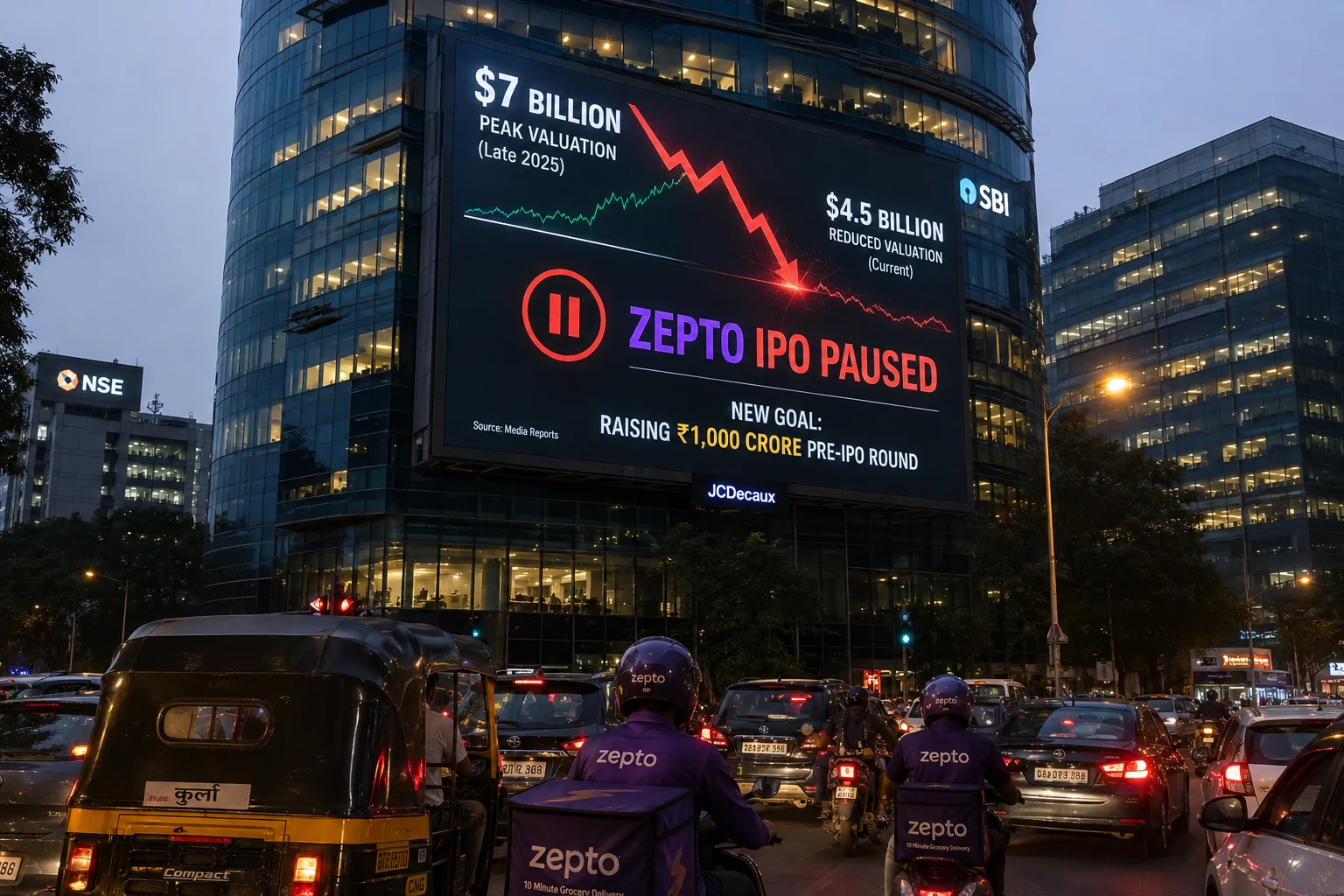
There is a particular kind of silence that falls over a startup's headquarters when a listing gets pulled. Bankers stop returning calls as quickly. Employees start refreshing news apps instead of dashboards. And founders, who had spent months rehearsing their pitch for public market investors, have to explain — to their board, their staff, and eventually the world — why the party has been postponed.
That is roughly where Zepto finds itself this week.
The Mumbai-based quick-commerce company, known for its promise of delivering groceries and daily essentials to Indian doorsteps in under ten minutes, has hit pause on its long-awaited initial public offering. In its place, the company is now working to raise close to Rs 1,000 crore through a pre-IPO funding round, at a valuation of around $4.5 billion. That number matters enormously, because it sits roughly 35 to 36 percent below the $7 billion valuation Zepto commanded in October 2025, when it last raised money from private investors.
For a company that was, until recently, being spoken of as one of the marquee new-age listings of the year, this is a significant reset. It is not a collapse. It is not a scandal. But it is a very public reminder that the number a private investor is willing to pay for a startup on a term sheet, and the number public market investors are willing to pay for the same company on a stock exchange, can be two very different things.
This article walks through exactly what happened, why it happened, what the numbers actually show about Zepto's business, and what it means for India's broader quick-commerce and startup-listing story.
WHAT EXACTLY HAPPENED
According to multiple media reports citing people familiar with the matter, Zepto has decided to hold off on its stock market debut, which had originally been targeted for around July 2026. Instead of pushing ahead with a public listing at a valuation investors were not fully willing to pay, the company is pursuing a smaller, private "pre-IPO" round of roughly Rs 1,000 crore — a modest sum by Zepto's own fundraising history, but a strategically important one.
The reported valuation attached to this round is around $4.5 billion, though some reports suggest the number investors were actually willing to pay during early conversations was even lower, somewhere between $2.5 billion and $4 billion. Zepto itself has not issued an official public statement confirming either the fundraising round or the specific valuation, and a query sent to the company by at least one financial daily reportedly went unanswered. That is not unusual for a deal that is still being finalised — companies rarely comment publicly on live negotiations — but it does mean that some of the finer details here are still being pieced together from sources rather than from an official filing.
What is fairly well established, because it comes from Zepto's own regulatory paperwork, is the direction of travel: the IPO is being pushed back, and a smaller private round is being lined up to bridge the gap until public market conditions, or investor appetite, look more favourable.
BREAKING DOWN THE VALUATION MATH
To understand why this is such a big story, it helps to see the numbers side by side.
Zepto's private valuation, October 2025: $7.0 billion Zepto's reported pre-IPO round valuation, mid-2026: $4.5 billion
In simple visual terms, the drop looks like this:
Oct 2025 ($7.0B) ████████████████████████████████████████ Jul 2026 ($4.5B) █████████████████████████████
That is a decline of roughly 35 to 36 percent in under a year. If the lower end of the reported investor demand is used instead — the $2.5 billion to $4 billion figures that some reports cite from early roadshow conversations — the haircut looks even steeper, potentially in the range of 45 to 64 percent.
A useful way to think about this: imagine selling a house you bought for Rs 1 crore, only to have serious buyers tell you, less than a year later, that they would pay somewhere between Rs 36 lakh and Rs 65 lakh for it. You would probably want to take the house off the market too, at least until you understood why buyers had changed their minds, or until you found buyers who saw it differently.
It is also worth noting that $4.5 billion is typically being described as a pre-money valuation — meaning the company's value before the new Rs 1,000 crore (roughly $105 to $120 million) is added in. Once that fresh capital is included, the post-money valuation would land closer to $5.1 billion, according to some reports. That is a meaningful distinction, because it shows the round is structured to give Zepto a bit of a cushion above the lowest valuation figures being discussed, even if it is still well below the October 2025 peak.
None of this means Zepto's business has suddenly gotten worse. As the sections below will show, the company's revenue has actually grown explosively. What has changed is how public and institutional investors are pricing that growth relative to genuine, listed comparables — a distinction that turns out to be the entire crux of this story.
A TIMELINE: HOW WE GOT HERE
To understand how a company goes from "preparing to list in July" to "pausing the IPO entirely," it helps to walk through the sequence of events.
October 2025: Zepto raises $450 million in a private funding round led by the California Public Employees' Retirement System (CalPERS), pushing its valuation to $7 billion. At the time, this was treated as a strong vote of confidence from a marquee global institutional investor, and it set the stage for an IPO push.
December 2025: Zepto confidentially files preliminary papers with India's markets regulator, the Securities and Exchange Board of India (SEBI), reportedly targeting an IPO size of around $1.3 billion, or roughly Rs 11,000 to 12,000 crore. Confidential filings are a route increasingly used by large companies to test the IPO process without immediately disclosing every detail publicly.
May 2026: Zepto reportedly receives observations from SEBI, effectively clearing a key procedural hurdle on the way toward a public listing.
June 2026: The company files an updated draft offer document with SEBI. This version reportedly proposes a fresh issue of shares worth Rs 8,010 crore, alongside an offer for sale of 11.35 crore equity shares by existing shareholders — pushing the total planned IPO size toward roughly Rs 10,000 crore. Some reports later suggest this size may have already been trimmed toward Rs 5,000 to 6,000 crore as the company reassessed how much capital it actually needed.
Through June and July 2026: Zepto reportedly begins pre-listing investor conversations — sometimes referred to informally as "roadshow" discussions — with domestic mutual funds, insurance companies, and other large institutional buyers who would typically anchor a big Indian IPO. This is where the trouble starts. Instead of validating anything close to the $7 billion figure, investor feedback reportedly clusters much lower, with some estimates as low as $2.5 billion to $4 billion, and more centrist estimates around $4.5 billion.
Late July 2026: Rather than proceed with a public listing at a price the company and its existing shareholders view as underwhelming, Zepto decides to postpone. Reports place this decision around July 30, 2026. In its place, the company begins structuring a pre-IPO round of about Rs 1,000 crore at approximately $4.5 billion, aimed primarily at domestic investors.
Early August 2026: The story becomes one of the most discussed items in Indian business media, with commentary running the gamut from sober analysis of valuation resets to more dramatic framing about the "brutal" nature of the discount.
Some reports also suggest Zepto's leadership has communicated an expected delay of roughly two to three quarters before revisiting the public listing, though this detail — like several others in this story — comes from unofficial sources rather than a company statement.
WHY DID THE VALUATION GAP OPEN UP?
This is really the heart of the story, and it comes down to a simple but uncomfortable truth for many fast-growing private companies: growth alone does not automatically justify a premium valuation once public market investors are the ones setting the price.
When Zepto was valued at $7 billion in October 2025, that number was set in a private negotiation between the company and a small number of sophisticated investors, led by CalPERS. Private valuations like this are often influenced by momentum, competitive dynamics among investors wanting exposure to a hot sector, and the simple fact that a private round doesn't have to be justified to thousands of retail shareholders or benchmarked minute-by-minute against public trading multiples.
An IPO changes that dynamic completely. Once Zepto started talking to the domestic mutual funds and insurance companies who typically anchor large Indian public offerings, those investors did what public market investors always do: they compared Zepto to the closest available yardsticks.
And in India's quick-commerce space, there are two very visible, very public yardsticks:
Swiggy Limited, which owns the food delivery business as well as the Instamart quick-commerce arm, carried a market capitalisation of roughly Rs 78,655 crore.
Eternal Limited (formerly known as Zomato), which owns Blinkit, the market-leading quick-commerce player, carried a market capitalisation of roughly Rs 2,91,778 crore — but crucially, that valuation reflects a business built around multiple established, often profitable or near-profitable divisions, not a quick-commerce-only operation.
Here is the uncomfortable math for Zepto: at a $7 billion valuation (roughly Rs 58,000 to 60,000 crore depending on the exchange rate used), Zepto — a business that, unlike Swiggy or Eternal, operates only in quick commerce and has no diversified profit engine to lean on — would have been valued at a substantial fraction of Swiggy's entire market capitalisation, despite Swiggy owning food delivery, Instamart, and other businesses on top of its own quick-commerce arm. Investors weighing that comparison, and weighing Eternal's far larger and more diversified valuation as well, reportedly balked. A $4.5 billion figure (approximately Rs 42,750 crore) was seen as sitting more comfortably in line with how the market was actually pricing comparable, already-listed businesses.
In other words: this wasn't really a story about Zepto's growth being disappointing. It was a story about the gap between what private investors, in a competitive fundraising round nine months earlier, were willing to pay — and what public market investors, staring directly at real trading multiples of Zepto's closest peers, were willing to pay today.
There is a broader backdrop here too, and it matters. India's IPO market overall cooled noticeably through the first half of 2026. Global geopolitical tensions, volatility in crude oil prices, a weakening rupee (which slid toward around Rs 96 to the US dollar during the year), and sustained selling by foreign institutional investors all combined to make 2026 a far more cautious year for new listings than the record-breaking 2025 that preceded it. Where 2025 saw over a hundred companies raise a combined Rs 1.75 lakh crore through IPOs, activity through the early part of 2026 slowed considerably, with several companies — not just Zepto — choosing to delay or rework their listing plans rather than test a jittery market. Analysts covering this trend have generally framed it not as the end of India's new-age tech IPO boom, but as a "temporary stall" while promoters wait for calmer markets, stronger profitability signals, and more favourable valuation windows.
Zepto's decision to pause fits neatly into that wider pattern. It isn't an isolated event; it's one visible data point in a broader recalibration happening across India's startup-to-public-markets pipeline in 2026.
THE NUMBERS BEHIND THE BUSINESS
It's worth pausing here to separate two different questions that are easy to blur together: "Is Zepto's business doing well?" and "Was Zepto's IPO valuation justified?" The answers, based on available data, are not the same.
On the growth side, Zepto's numbers are genuinely striking. According to figures included in its regulatory filings:
Revenue from operations, FY2024 (year ended March 2024): approximately Rs 4,544 crore Revenue from operations, FY2025 (year ended March 2025): approximately Rs 11,110 crore Revenue from operations, FY2026 (year ended March 2026): approximately Rs 22,624 crore
Shown as a simple text chart, the growth curve looks like this:
FY24 ████████ FY25 ███████████████████ FY26 ███████████████████████████████████████
That represents revenue roughly doubling year after year for two consecutive years — a growth rate that would be the envy of almost any consumer business anywhere in the world, in any market.
But growth of this kind rarely comes free, and Zepto's losses have grown too. The company's net loss for FY2025 was reported at around Rs 3,367 crore. For FY2026, reported figures put the net loss at roughly Rs 5,900 crore (some reports round this to approximately $590 to $700 million depending on the exchange rate used). In percentage terms, that means losses have grown at a pace not far off the growth in revenue itself — a pattern that is common in the early years of high-growth consumer internet businesses, but one that public market investors, unlike venture capital investors, tend to scrutinise far more closely, because they need a credible, near-term path to profitability rather than a promise of scale.
Beyond the headline revenue and loss figures, a few other data points from Zepto's filings help paint a fuller picture of where the business actually stands:
Number of dark stores (micro-warehouses used for ultra-fast delivery) as of March 31, 2026: approximately 1,139 Average daily orders processed during FY2026: approximately 17.5 lakh (1.75 million) orders per day Total orders processed over the course of FY2026: approximately 640 million Cash and investments on the balance sheet as of March 31, 2026: approximately Rs 5,681 crore Borrowings on the balance sheet: reportedly nil
That last point is worth dwelling on. A company carrying no debt, with over Rs 5,600 crore in cash and investments, is not a company in any kind of financial distress. It has real breathing room. What it does not have — at least not yet, in the eyes of the investors it was courting for its IPO — is a valuation story that public markets are ready to underwrite at the price the company and its earliest backers might have hoped for.
THE BATTLEFIELD: QUICK COMMERCE COMPETITION IN INDIA
No conversation about Zepto's valuation is complete without talking about the market it operates in, because quick commerce in India has become one of the most fiercely contested corners of the country's digital economy.
What began, in the pandemic years, as a slightly experimental idea — delivering groceries within thirty minutes, then fifteen, then ten — has become a full-blown battleground involving some of India's best-funded consumer technology companies. The category itself has scaled dramatically. Various industry estimates put India's quick-commerce gross merchandise value in the range of $5 billion or more annually as of recent data, with growth rates commonly cited in the 40 to 45 percent range year over year, and projections suggesting the category could be worth well over $10 billion within a few years.
Market share, as of the most recent data available in 2026, breaks down roughly as follows (figures vary somewhat depending on the research source, since some track gross order value while others track order volume):
Blinkit (owned by Eternal/Zomato) ~46% ███████████████████████ Swiggy Instamart ~24% ████████████ Zepto ~22% ███████████ BigBasket "BB Now" (Tata Group) ~6% ███ Amazon Now, Flipkart Minutes & others ~2% █
Blinkit's leadership position is not a close call. Backed by the much larger, more diversified Eternal Limited, Blinkit has scaled its dark-store network aggressively and has, at times, become its parent company's single largest business line by order value — even overtaking Zomato's original food-delivery business in some quarters. Blinkit has also been the first of the major quick-commerce players to talk publicly about profitability at the cluster or store level, which matters enormously to how investors think about the category's long-term economics.
Swiggy Instamart occupies a strong number-two position, though the battle between Instamart and Zepto for that second spot has, at various points over the past two years, been close enough that market share rankings have shifted depending on which quarter or which data source you look at. Instamart has grown its order value rapidly, but it has also continued to post sizeable losses as it expands its dark-store footprint aggressively — a pattern very similar to Zepto's own.
Further back in the field, BigBasket's "BB Now" quick-commerce push — backed by the deep pockets and sourcing relationships of the Tata Group — has been steadily scaling, while newer entrants Amazon Now and Flipkart Minutes, backed by two of the world's largest e-commerce companies, have begun building out meaningful dark-store networks of their own, each reportedly crossing 500 or more locations.
Two things about this landscape are worth understanding, because they help explain why Zepto's IPO valuation became such a contentious question.
First, quick commerce, as a category, is capital-intensive and margin-thin. A typical order might generate revenue of around Rs 100, against delivery costs of Rs 40 to 50 and operational costs of another Rs 20 to 25 — leaving very little room for error, and making scale, order frequency, and average order value the critical levers for eventually reaching profitability.
Second, and more specific to Zepto's situation: unlike Blinkit and Instamart, which sit inside larger, already-listed, multi-business parent companies, Zepto is a pure-play quick-commerce business preparing to list on its own. That means its IPO valuation cannot lean on the cushion of a profitable food-delivery arm or a diversified logistics business the way its two biggest rivals effectively can. Every rupee of Zepto's public market valuation has to be justified purely on quick commerce, at a moment when investors are being unusually disciplined about what they are willing to pay for that category.
FROM A WHATSAPP GROUP TO A MULTI-BILLION-DOLLAR COMPANY
Whatever happens with the IPO, it's worth remembering just how remarkable Zepto's rise has already been — because it makes the current valuation debate feel less like a story about failure and more like a story about a young company colliding, for the first time, with the very different expectations of public markets.
Zepto was founded by Aadit Palicha and Kaivalya Vohra, two childhood friends from Mumbai who had both been admitted to Stanford University to study computer science. During the COVID-19 pandemic, while grocery deliveries in India were routinely taking two to three days to arrive, the two — then teenagers — began experimenting with faster ways to get essentials to people's doorsteps. Their first attempt, a venture called KiranaKart that partnered with local neighbourhood stores to promise 45-minute delivery, didn't find the traction they had hoped for.
Rather than give up, they pivoted. One of their early investors, Contrary Capital, reportedly made its funding conditional on the founders dropping out of Stanford entirely, treating the dropout not as a risk but as a precondition for full commitment. Palicha and Vohra took the deal, left Stanford, returned to India, and rebuilt their idea from the ground up — this time centred on a "dark store" model, where small, strategically located micro-warehouses stocked with a curated range of fast-moving products could support genuinely ten-minute delivery windows in dense Indian cities.
The rebranded company, Zepto — a name drawn from "zeptosecond," an almost incomprehensibly small unit of time — launched in 2021 and grew astonishingly quickly. Backed at various points by investors including Y Combinator, Nexus Venture Partners, Glade Brook Capital, General Catalyst, Goodwater Capital, and eventually institutional heavyweights like CalPERS, Zepto's valuation climbed from under a billion dollars in its early days to $3.6 billion, then $5 billion, and eventually $7 billion by October 2025. Across its funding history, the company is estimated to have raised somewhere in the region of $2.5 to $3 billion in total private capital from well over a hundred investors.
Ahead of its planned IPO, Zepto also completed a corporate restructuring to shift its parent entity fully into India — a move increasingly common among Indian startups that had originally incorporated holding companies overseas, and one generally seen as a necessary step before a domestic public listing.
Today, Palicha, still only in his mid-twenties, is regularly described as one of India's youngest self-made billionaires — a striking marker of just how quickly Zepto's private valuation climbed, even as the company now works through the more sobering process of proving that valuation to public markets.
ZEPTO ISN'T ALONE: THE WIDER SLOWDOWN IN INDIA'S STARTUP IPO MARKET
It would be a mistake to read Zepto's story purely as a company-specific stumble. It is, in many ways, a symptom of a broader shift happening across India's new-age technology IPO pipeline in 2026.
Coming off a blockbuster 2025 — a year that saw new-age tech companies including Meesho, Ather Energy, Urban Company, Lenskart, Groww, Pine Labs and PhysicsWallah successfully list on Indian exchanges — 2026 has been noticeably more cautious. A combination of factors has weighed on sentiment: escalating geopolitical tensions in West Asia, volatile crude oil prices, a depreciating rupee, and persistent selling by foreign institutional investors, who pulled tens of billions of dollars out of Indian equities over the course of the year. India's benchmark stock indices themselves slipped by roughly 8 to 10 percent at points during 2026, a backdrop that makes any company weighing a fresh public listing think twice about timing.
Industry trackers have noted that while dozens of startups remain in various stages of preparing draft filings for eventual IPOs, actual fundraising through new-age tech listings in 2026 has lagged well behind the prior year's pace. Retail investor subscription levels for new IPOs have also moderated, another signal of more cautious appetite across the board.
Crucially, analysts covering this trend have generally not framed it as the end of India's startup IPO story — quite the opposite. The consensus view is that India's pipeline of high-growth private companies eyeing public markets remains deep and largely intact; what has changed is that promoters and their bankers are being noticeably more selective about when to pull the trigger, waiting for friendlier valuation windows, clearer paths to profitability, and calmer broader market conditions before committing to a listing date.
Seen through that lens, Zepto's decision to step back from its July 2026 target and instead raise a smaller bridge round looks less like an emergency retreat and more like a rational, if publicly uncomfortable, adjustment to the environment every large Indian startup preparing to list is currently navigating.
WHAT A "PRE-IPO ROUND" ACTUALLY MEANS
For readers less familiar with the mechanics, it's worth briefly explaining what a pre-IPO round is and why Zepto is using this particular tool rather than simply delaying and doing nothing.
A pre-IPO round is a private fundraising round that a company runs shortly before — or, as in Zepto's case, instead of proceeding immediately with — its public listing. Under India's regulatory framework, companies preparing for an IPO are permitted to raise pre-IPO placements of up to roughly 20 percent of their planned fresh issue size, though funds raised this way generally cannot be counted toward, or substituted for, the fresh issue portion of the eventual public offering itself.
For Zepto, this route serves a few purposes simultaneously. It brings in fresh capital — around Rs 1,000 crore — without forcing the company to accept a valuation from public market investors that it and its board consider too low. It gives existing backers such as Glade Brook, General Catalyst, Goodwater Capital and Nexus Venture Partners, all reportedly expected to participate, a chance to continue supporting the company at a valuation that, while lower than October 2025's peak, is arguably more defensible against public comparables. And notably, the round is reportedly being structured to draw primarily from domestic investors — a deliberate push to increase Zepto's Indian shareholding, which currently stands at around 40 percent, ahead of any eventual public listing on Indian exchanges.
That last point matters more than it might first appear. Indian regulators and exchanges have, in recent years, placed growing emphasis on Indian ownership and governance structures for companies seeking to list domestically, and a startup with a heavily international capitalisation table can face additional friction in the run-up to an IPO. By tilting this round toward domestic capital, Zepto appears to be addressing two problems at once: raising money at a workable valuation, and cleaning up its shareholding profile for whenever it does eventually return to the public markets.
WHAT HAPPENS NEXT
So where does this leave Zepto?
In the near term, the company is expected to close its roughly Rs 1,000 crore pre-IPO round at the reported $4.5 billion valuation, bringing in primarily domestic capital from a mix of new and existing investors. That should give Zepto additional runway and, just as importantly, a fresh, more market-tested valuation benchmark to work from.
Beyond that, most reports suggest the IPO itself has not been cancelled, only delayed — with some accounts citing an expected gap of roughly two to three quarters before Zepto revisits the public listing process in earnest. That would put a realistic new listing window somewhere in the first half of 2027, though this, like several figures in this story, is an estimate based on unofficial reporting rather than a confirmed company plan.
What would need to change for that next attempt to go more smoothly? A few things stand out. Zepto would likely need to show continued progress narrowing its losses relative to revenue, giving public investors more confidence in a credible profitability timeline rather than just a growth story. Broader market conditions — the rupee, foreign investor flows, and general risk appetite for new-age tech listings — would need to stabilise or improve. And perhaps most importantly, Zepto would need the market's perception of quick commerce as a category to keep maturing, so that investors feel more comfortable valuing a pure-play quick-commerce business closer to, rather than meaningfully below, its private valuation history.
None of that is guaranteed, but none of it is far-fetched either. Blinkit's move toward store-level profitability has already shown that the category can, at least in pockets, work economically. If Zepto and Instamart can tell increasingly convincing versions of that same story over the next several quarters, the valuation gap that forced this pause could well narrow on its own.
QUICK QUESTIONS, STRAIGHT ANSWERS
Since this story has generated a lot of chatter, it might help to address a few of the most common questions readers are likely to have, in plain language.
Has Zepto's IPO been cancelled? No. Based on available reporting, it has been postponed, not cancelled. The company appears to be waiting for a better valuation window rather than abandoning its public-listing plans altogether. Some reports suggest a delay of roughly two to three quarters, though Zepto has not confirmed an exact new timeline.
Is Zepto in financial trouble? Not based on the numbers available. The company reportedly holds over Rs 5,600 crore in cash and investments, carries no debt, and has more than doubled its revenue in each of the past two financial years. Its losses have also grown, which is the real point of tension, but "growing losses alongside rapid growth" is a very different situation from "running out of money."
Why would investors pay less for the same company in less than a year? Because the two rounds involved very different kinds of investors asking very different questions. Private investors in October 2025 were largely betting on Zepto's growth trajectory and competitive position. Public market investors evaluating an IPO nine months later were doing something more mechanical: comparing Zepto's proposed price to the actual, real-time trading value of its closest listed peers, Swiggy and Eternal. When those comparisons didn't support a $7 billion price tag, the number moved.
Who is actually buying into the new pre-IPO round? Reports suggest the round is being led primarily by domestic investors, including mutual funds and insurance companies, with several of Zepto's existing backers — Glade Brook, General Catalyst, Goodwater Capital and Nexus Venture Partners — also expected to participate.
Does this mean quick commerce as an industry is struggling? Not really. The category itself continues to grow at a rapid pace, with industry estimates putting annual growth in the range of 40 to 45 percent. Blinkit, the market leader, has already demonstrated that parts of the business can be run profitably at the store level. What this episode really shows is that investors are being more disciplined about price, not that the underlying demand for quick commerce is fading.
What should other startups eyeing an IPO take away from this? Probably the clearest lesson is that a private funding round's valuation is not a guarantee, or even necessarily a strong predictor, of what public markets will pay. Companies preparing to list are increasingly being advised to stress-test their expected valuations against real, listed comparables well before locking in an IPO timeline — precisely the exercise Zepto appears to have gone through in real time, in full public view, over the past several weeks.
THE BOTTOM LINE
Strip away the headlines, and the Zepto story is really a fairly familiar one in the life cycle of fast-growing startups: a company that scaled at extraordinary speed in the friendly, forgiving environment of private fundraising rounds, arriving at the far more exacting, comparison-driven environment of public markets — and discovering that the two worlds do not always agree on what a business is worth.
Zepto's underlying business, on the evidence available, is not in trouble. Revenue has more than doubled for two years running. Order volumes are enormous — well over half a billion orders processed in a single financial year. The company has real cash reserves and no debt. It has built a top-three position in one of the most competitive consumer categories in India, against rivals backed by two of the country's largest internet conglomerates.
What Zepto has run into is something narrower but no less consequential: a valuation set in a private round, nine months earlier, that public market investors were simply not yet ready to validate. Rather than force the issue, the company has chosen to step back, raise a smaller round at a more defensible price, and wait for a better moment.
Whether that moment arrives in two quarters or six, one thing seems fairly clear: when Zepto does eventually ring the opening bell on an Indian stock exchange, the number attached to that listing will be one earned through public market scrutiny — not simply carried over from the momentum of a private funding round. For a company built on the promise of speed, that may turn out to be one race worth taking a little more slowly.