StartupNews · Markets
Swiggy Narrows Losses to Rs 791 Crore as Revenue Jumps 37% in Q1 FY27: Inside India's Quick-Commerce Turnaround Story
Instamart hits contribution breakeven, food delivery margins strengthen, but a Bengaluru restaurant boycott threat and cautious brokerages cloud the road ahead
By StartupNews · Published · Updated
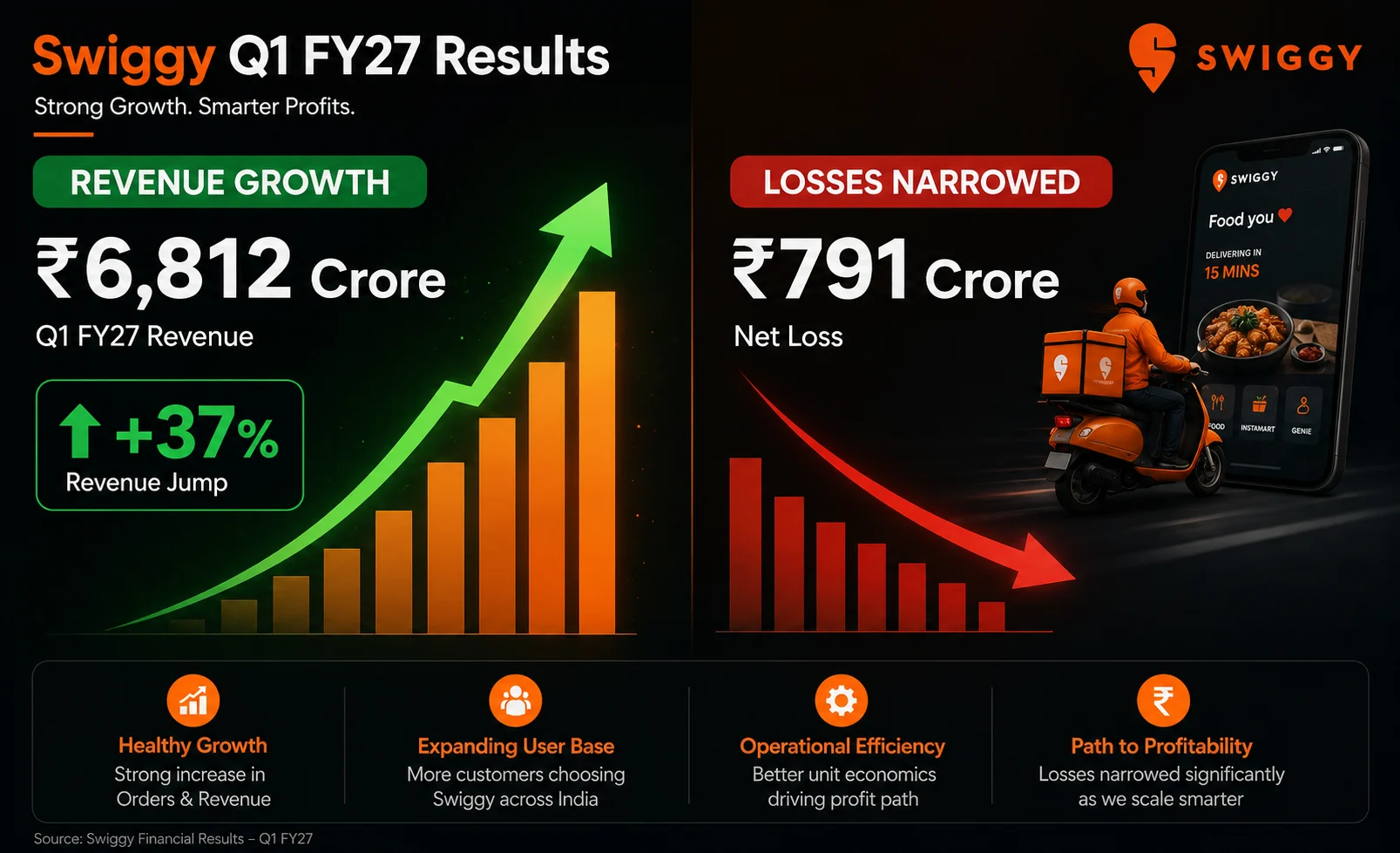
Swiggy has delivered one of its strongest quarters since going public, and the numbers tell a story that Indian investors, restaurant partners, and millions of app users will all be watching closely. For the quarter ended June 30, 2026, the Bengaluru-based food delivery and quick-commerce major reported a 37.31% year-on-year jump in revenue from operations to Rs 6,812 crore, while its consolidated net loss narrowed by nearly 34% to Rs 791 crore. It is a report card that, on paper, looks like exactly what long-suffering shareholders have been waiting for. Yet the market's reaction was anything but straightforward — and that contradiction is really the heart of this quarter's story.
This is not just another quarterly results update. It is a snapshot of where India's food-tech and quick-commerce battle stands in the middle of 2026: a market where growth is still explosive, losses are shrinking but not gone, competition is fiercer than ever, and even restaurant partners are now pushing back against the platforms that made online ordering a way of life for urban India. Let's break down every part of this story — the numbers, the segments, the market reaction, the brokerage views, and the storm clouds gathering over Swiggy's home turf in Bengaluru.
QUICK SNAPSHOT: SWIGGY Q1 FY27 AT A GLANCE
Revenue from Operations: Rs 6,812 crore (up 37.31% YoY, up 6.72% QoQ) Total Income: Rs 7,023 crore (up 39.12% YoY) Net Loss: Rs 791 crore (narrowed 33.92% YoY from Rs 1,197 crore) EBITDA Loss (excluding other income): Rs 650 crore (narrowed from Rs 954 crore YoY) EBITDA Margin: -9.54% (improved from -19.23% a year ago) Total Expenses: Rs 7,813 crore (up 25.1% YoY) Instamart Contribution Margin: -0.2% of GOV (breakeven milestone achieved) Food Delivery GOV: Rs 9,490 crore (up 17.4% YoY) Quick Commerce GOV: Rs 7,907 crore (up 39.8% YoY) Monthly Transacting Users: 27.5 million (up 27.4% YoY) Results Announced: July 30, 2026
THE HEADLINE NUMBERS, EXPLAINED
Let's start with the topline. Swiggy's revenue from operations for the April-June 2026 quarter came in at Rs 6,812 crore, up from Rs 4,961 crore in the same quarter last year — a jump of 37.31%. That is a big number for a company operating at the scale Swiggy now does, and it comes on top of an already large base built over the past two years of aggressive expansion in both food delivery and quick commerce.
Here's a simple way to visualize how revenue has moved over the last three reported quarters:
REVENUE FROM OPERATIONS (Rs Crore)
Q1 FY26 (Apr-Jun 2025) Rs 4,961 Cr ████████████████ Q4 FY26 (Jan-Mar 2026) Rs 6,383 Cr ████████████████████ Q1 FY27 (Apr-Jun 2026) Rs 6,812 Cr █████████████████████
Even sequentially — comparing this quarter to the previous one — revenue grew 6.72%, climbing from Rs 6,383 crore in Q4 FY26. That is a meaningful detail because it shows growth isn't just a year-on-year story driven by a weak base; Swiggy is still adding real incremental revenue quarter after quarter, even as it has scaled well past the Rs 25,000-crore annualized revenue mark.
Total income, which includes other income such as interest earned on cash reserves, rose even faster — up 39.12% YoY to Rs 7,023 crore, compared to Rs 5,048 crore a year earlier. Other income itself more than doubled, rising to Rs 211 crore from Rs 87 crore, reflecting the interest Swiggy is earning by parking its still-substantial cash pile, thought to be in the range of Rs 14,000-15,000 crore, in short-term instruments.
NET LOSS NARROWS: WHAT'S ACTUALLY DRIVING THE TURNAROUND
The number that will dominate headlines is the net loss: Rs 791 crore for Q1 FY27, down sharply from Rs 1,197 crore in the same quarter a year ago. That's a reduction of Rs 406 crore, or almost 34%, in the space of twelve months.
NET LOSS TREND (Rs Crore) — Lower is Better
Q1 FY26 Rs 1,197 Cr ████████████████████████ Q2 FY26 Rs 1,092 Cr ██████████████████████ Q4 FY26 Rs 800 Cr █████████████████ Q1 FY27 Rs 791 Cr █████████████████
What jumps out here is that Swiggy has now strung together multiple quarters of improvement in its bottom line. From a loss of over Rs 1,197 crore in Q1 FY26, the company has trimmed losses in three consecutive reporting periods, and the Rs 791 crore figure for this quarter is only marginally better than the Rs 800 crore loss reported in Q4 FY26 — suggesting the pace of improvement, while still positive, has flattened out a little on a sequential basis. That nuance matters, and we'll come back to why some brokerages flagged it as a concern rather than pure celebration.
The improvement in losses has largely come from operating leverage — in plain English, Swiggy is spending relatively less to generate each additional rupee of revenue than it used to. The company's EBITDA loss (a measure of operating performance that strips out other income, interest, taxes and depreciation) came in at Rs 650 crore for the quarter, compared with a loss of Rs 954 crore in the same period last year — an improvement of nearly 32%. As a percentage of revenue, the EBITDA margin improved to -9.54%, compared with -19.23% a year ago and -10.92% in the previous quarter. In other words, Swiggy is now losing less than 10 paise on every rupee of business at the operating level, compared to almost 19 paise a year ago.
SEGMENT-BY-SEGMENT: WHERE THE MONEY IS COMING FROM
Swiggy today is really four businesses stitched together under one app and one balance sheet: food delivery, quick commerce (Instamart), a B2B supply chain and distribution arm, and a bucket of newer bets the company calls "Platform Innovations." Breaking down performance segment by segment tells a much richer story than the consolidated numbers alone.
REVENUE BY SEGMENT, Q1 FY27 vs Q1 FY26 (Rs Crore)
B2B Supply Chain & Distribution Q1 FY26: Rs 2,259 Cr ██████████████ Q1 FY27: Rs 3,195 Cr ████████████████████ (+41.4% YoY)
Food Delivery Q1 FY26: Rs 1,800 Cr (approx.) ███████████ Q1 FY27: Rs 2,208 Cr █████████████ (+22.66% YoY)
Instamart (Quick Commerce) Q1 FY26: Rs 805 Cr (approx.) █████ Q1 FY27: Rs 1,232 Cr ████████ (+53% YoY)
Platform Innovations Q1 FY26: Rs 20 Cr ▌ Q1 FY27: Rs 51 Cr █▌ (+155% YoY)
B2B Supply Chain and Distribution: This segment — which supplies restaurant partners and retailers through Swiggy's backend logistics network — was actually the single largest contributor to revenue this quarter, posting Rs 3,195 crore, up 41.4% year-on-year from Rs 2,259 crore. Encouragingly, the segment's own losses shrank dramatically too, narrowing to just Rs 8 crore from Rs 47 crore a year earlier — putting this business tantalizingly close to profitability in its own right.
Food Delivery: Swiggy's original and most mature business generated Rs 2,208 crore in revenue, up 22.66% year-on-year. Food delivery Gross Order Value (GOV) — the total value of orders placed, before Swiggy's cut — rose 17.4% YoY to Rs 9,490 crore. This business is now firmly Swiggy's profit engine, contributing an EBITDA of around Rs 292 crore for the quarter, according to the company's own disclosures. It is worth noting that food delivery GOV growth of 17.4% came in slightly below what some analysts had been expecting (closer to 18-19%), a detail brokerages flagged as a mild disappointment even amid the overall positive results.
Instamart (Quick Commerce): This is where the most dramatic story of the quarter lies. Instamart's revenue jumped 53% year-on-year to Rs 1,232 crore, the fastest growth rate of any segment. Quick commerce GOV rose 39.8% YoY to Rs 7,907 crore. More importantly, Instamart's Net Order Value grew 38.9% from a year ago — a touch below the 40-50% growth some analysts had penciled in, but still an extremely strong pace for a business operating in one of the most capital-intensive and competitive corners of Indian e-commerce.
Platform Innovations: This is Swiggy's basket of newer, smaller bets — including Swiggy Minis, Swiggy Sports, the snacking brand Snacc, the toy and gifting platform Toing, and Crew (Swiggy's part-time gig-work platform for delivery partners). Revenue here nearly tripled to Rs 51 crore from Rs 20 crore a year ago. But this remains the company's least mature segment, and losses here actually widened to Rs 131 crore from Rs 52 crore, reflecting continued heavy investment in unproven ideas. Taken together, the combined loss across all of Swiggy's operating segments narrowed by 30.8% to Rs 477 crore, down from Rs 689 crore a year earlier.
THE BIG MILESTONE: INSTAMART REACHES CONTRIBUTION BREAKEVEN
If there is one number Swiggy's management wanted the market to notice this quarter, it's this one: Instamart's contribution margin improved by 440 basis points year-on-year to reach -0.2% of Gross Order Value, effectively touching breakeven at the contribution level in May 2026. A year earlier, that same metric stood at a much deeper -4.6% of GOV.
INSTAMART CONTRIBUTION MARGIN (% of GOV) — Journey to Breakeven
Q1 FY26 -4.6% ████████████████████████ Q4 FY26 -1.8% █████████ Q1 FY27 -0.2% █ (near breakeven)
For context, "contribution margin" measures whether a business is covering its direct, order-level costs — delivery, packing, and fulfilment expenses — before accounting for fixed overheads like technology, marketing, and corporate costs. Reaching near-breakeven at this level is considered a crucial milestone in the life of any quick-commerce business, because it signals that the fundamental unit economics of the model — get an order, deliver it in minutes, and don't lose money doing it — finally work. It does not yet mean the segment is profitable overall; Instamart's adjusted EBITDA loss for the quarter still stood at around Rs 778 crore, since the business continues to invest heavily in expanding its dark-store network, warehousing, and technology.
Still, this is the milestone Swiggy's leadership had explicitly guided the market toward roughly a year earlier, and delivering on it — even as rivals continue to burn cash aggressively to chase market share — will likely be seen as one of the more credible proof points in this result. It suggests that as Instamart matures and order volumes per dark store rise, losses on each order shrink, a dynamic that mirrors what Swiggy's food delivery business went through several years ago before it became consistently profitable.
WHERE THE MONEY WENT: A LOOK AT EXPENSES
Growth of this scale does not come free. Swiggy's total expenses for the quarter rose 25.1% year-on-year to Rs 7,813 crore, up from Rs 6,244 crore. The key point analysts flagged approvingly is that expenses grew slower than revenue (25.1% versus 37.31%), which is precisely the kind of operating leverage that narrows losses over time.
Within that expense base, the biggest swing items were advertising and sales promotion costs and delivery-related charges — both of which rose meaningfully as Swiggy continued to fight for market share in quick commerce while also running promotions to defend its food delivery user base. On the cost-control side, share-based payment expenses — a non-cash cost tied to employee stock compensation — actually declined to Rs 173 crore from Rs 265 crore a year earlier, helping offset some of the pressure elsewhere. Depreciation and amortization ticked up modestly to Rs 298 crore from Rs 288 crore, reflecting the company's continued investment in dark stores, warehouses, and technology infrastructure.
One structural change worth noting: Swiggy's Instamart business was transferred, effective April 1, 2026, into a new step-down wholly owned subsidiary called Swiggy Instamart Private Limited, through a slump sale on a going-concern basis. This is largely a corporate restructuring move — the kind companies sometimes undertake ahead of potential fundraising, strategic partnerships, or even future listing plans for a subsidiary — though Swiggy has not detailed specific next steps tied to the move.
THE MARKET'S VERDICT: WHY DID THE STOCK FALL ON GOOD NEWS?
Here is where the story gets interesting. Despite reporting numbers that beat expectations on several fronts, Swiggy's stock did not rally in a straight line. On the day results were announced, July 30, 2026, shares actually closed 2.98% higher. But the real reaction came the next trading session: shares fell as much as 5.3% in early trade on July 31 before paring losses to close around 2.9% to 3.7% lower, depending on the exact time of trading referenced across various market reports.
That decline extended an already rough patch for the stock. Swiggy shares have underperformed the broader market significantly through 2026, down roughly a quarter to more than a quarter over the past twelve months, compared to a much smaller single-digit decline in the Nifty 50 over the same period. At a market capitalization of roughly Rs 78,000-79,000 crore at the time of the results, Swiggy remains a closely watched but heavily debated stock among Indian institutional and retail investors alike.
Why the disconnect between "good" headline numbers and a falling share price? A few reasons stand out:
First, expectations had already priced in strong growth, so the market was looking for confirmation on more granular metrics — and some of those, like food delivery GOV growth of 17.4% (versus an expected 18-19%) and Instamart Net Order Value growth of 38.9% (versus an expected 40-50%), came in a shade below what bulls were hoping for.
Second, the sequential improvement in net loss — from Rs 800 crore in Q4 FY26 to Rs 791 crore in Q1 FY27 — was fairly marginal, raising questions about whether the pace of loss reduction is beginning to plateau even as the company continues to invest heavily in quick commerce.
Third, and perhaps most significantly, the market is looking past this one quarter toward a genuinely uncertain competitive and regulatory backdrop — including rising competition in quick commerce, a brewing dispute with restaurant partners in Bengaluru, foreign ownership considerations, and continued regulatory scrutiny of the food delivery business model in India. We'll unpack each of these below.
WHAT THE BROKERAGES ARE SAYING: A DIVIDED STREET
Perhaps nowhere was the split verdict clearer than in how brokerage houses reacted to the results. Rarely does a results season produce such a wide spread of views on a single stock — and Swiggy's Q1 FY27 print triggered exactly that kind of divergence.
On the bearish side, global brokerage Macquarie retained its "Underperform" rating on Swiggy with a target price of Rs 230, implying meaningful downside from levels near Rs 285, citing concerns over slower growth and elevated cash burn in the Instamart business. Hong Kong-based CLSA downgraded the stock to "Hold" from "Accumulate" and trimmed its target price to Rs 318 from Rs 357, projecting that Instamart's losses will persist through the rest of FY27, with the brokerage modeling an adjusted EBITDA loss of around Rs 3,100 crore for the full year, improving to roughly Rs 2,300 crore in FY28. Domestic brokerage JM Financial turned even more cautious, downgrading the stock to "Sell" from "Reduce" with a target price of Rs 250 — among the more pessimistic calls on the Street.
On the bullish side, Nomura struck a notably more constructive tone, arguing that Swiggy is well placed to absorb near-term losses given its substantial cash balance — estimated at around Rs 14,300 crore — along with steady cash generation from its now-profitable food delivery business. Motilal Oswal Financial Services (MOFSL) went further, retaining its "Buy" rating and actually raising its target price to Rs 350, implying meaningful upside from the stock's post-results levels. MOFSL's note pointed specifically to Instamart's contribution margin improvement to -0.2% in Q1, up from -1.8% in the previous quarter, as validation that the quick-commerce business had crossed an important threshold.
BROKERAGE VIEWS AT A GLANCE (Post Q1 FY27 Results)
Macquarie Underperform Target: Rs 230 CLSA Hold (downgraded) Target: Rs 318 JM Financial Sell (downgraded) Target: Rs 250 Nomura Constructive (cash cushion cited) Motilal Oswal Buy (raised) Target: Rs 350
This kind of split is itself telling. It suggests Swiggy today sits at a genuine inflection point where reasonable analysts, looking at the same set of numbers, can draw very different conclusions about whether the company's investment phase in quick commerce is nearing its end or has meaningfully longer to run. Broader consensus data from financial platforms tracking around two dozen analysts still leans toward an overall "Buy" rating on the stock, with price targets ranging widely — a further sign of just how unsettled the debate remains.
THE STORM ON THE HORIZON: BENGALURU'S RESTAURANT BOYCOTT THREAT
Just as Swiggy was digesting its results, a very different kind of pressure was building in its own backyard. Restaurant associations in Bengaluru — the city where Swiggy itself is headquartered — have threatened to boycott both Swiggy and rival Zomato starting August 15, 2026, unless the platforms address long-standing grievances over commissions, discounts, and payout deductions.
The Bruhat Bengaluru Hotels Association (BBHA), along with other restaurant bodies, has accused the platforms of levying commissions ranging from 8% to 28%, layering on additional charges for advertising and payment gateway fees, and running discounts without restaurant owners' explicit consent — all of which, they argue, eat deeply into already thin margins. According to the honorary president of the Bengaluru Hotel Association, restaurants earning roughly Rs 1 lakh in revenue through these platforms are often left with only around Rs 40,000 after all commissions, discounts, and deductions are accounted for — a claim that, if broadly representative, highlights just how much value the platforms are capturing from the restaurant side of the marketplace.
To put the scale of this dispute in perspective: Bengaluru is estimated to have around 34,000 hotels and restaurants, of which nearly 20,000 are listed on food delivery apps. A coordinated boycott by even a fraction of these establishments could visibly disrupt order volumes in one of Swiggy's most important metro markets. Restaurant bodies have demanded a detailed, transparent breakdown of commissions and payouts, fairer policies for handling customer complaints and order cancellations, and dedicated relationship managers to improve two-way communication with the platforms. As of the boycott deadline approaching, neither Swiggy nor Zomato had announced changes to their commission structures.
The National Restaurant Association of India (NRAI), the industry's apex body, has backed the Bengaluru restaurants' underlying concerns even while urging continued dialogue rather than an outright boycott. This dispute doesn't exist in isolation — it sits alongside an ongoing antitrust investigation by the Competition Commission of India (CCI) into both Swiggy and Zomato, triggered originally by an NRAI complaint alleging anti-competitive practices, including preferential treatment for certain restaurant partners in which the platforms hold financial interests.
Adding to the competitive pressure on this front, restaurants frustrated with existing platforms are increasingly exploring alternatives — including the government-backed Open Network for Digital Commerce (ONDC), which positions itself as a dramatically lower-cost channel, and ride-hailing player Rapido, which has signaled plans to enter food delivery with what it describes as a "commission-light" model. If restaurants begin meaningfully diversifying away from the two dominant platforms, it could reshape the competitive economics of Indian food delivery over the next few years — a risk that investors are clearly beginning to price in, even if its ultimate impact remains uncertain for now.
THE BIGGER PICTURE: SWIGGY'S PLACE IN THE QUICK-COMMERCE WAR
It's impossible to read Swiggy's Q1 FY27 results in isolation from the broader battle raging across Indian quick commerce. Instamart competes directly against Zomato's Blinkit, Zepto, and a growing list of well-funded challengers, all racing to build dense networks of dark stores that can deliver groceries and daily essentials in ten to twenty minutes. This is one of the most capital-intensive consumer businesses in India today, with companies collectively burning thousands of crores of rupees annually to acquire customers, subsidize delivery, and build out warehousing infrastructure ahead of demand.
Swiggy's own disclosures suggest the Indian quick-commerce market could grow roughly six-fold between FY24 and FY27, based on earlier brokerage projections — a scale of opportunity that explains why every major player, from listed giants to well-capitalized startups, continues to prioritize growth over near-term profitability in this segment. Within that race, Swiggy has generally been viewed by analysts as running second to Zomato's Blinkit in terms of scale, even as it has narrowed the gap on several operating metrics.
What makes this quarter notable is that Swiggy chose, in its own words through management commentary, to deliberately prioritize profitability and stronger unit economics in quick commerce over the most aggressive possible growth — a strategic stance that appears to be paying off in margin terms, even if it means ceding some growth-rate comparisons to rivals willing to burn more cash for market share. Whether that trade-off proves to be the right one over a two-to-three-year horizon is likely to be one of the central debates among Swiggy watchers through the rest of FY27.
WHAT MANAGEMENT IS SAYING
In the shareholder letter accompanying the results, Swiggy's co-founder, Managing Director and Group CEO, Sriharsha Majety, framed the quarter as validation of a strategy the company had committed to roughly a year earlier — describing food delivery's continued innovation around affordability and consumer offerings as key to widening the category's user base, and calling the Instamart contribution breakeven a genuine inflection point for that business, achieved in line with earlier guidance.
That framing matters because it sets a marker analysts and investors will hold the company to going forward: having promised contribution breakeven and delivered it, the next tests will be whether Instamart can sustain that discipline while continuing to grow at a pace competitive with rivals, and whether food delivery can keep expanding margins even as the category matures and user growth naturally slows from its earlier hyper-growth years.
TWO YEARS OF SWIGGY'S LOSS TRAJECTORY
Zooming out helps put this single quarter into context. Here is how Swiggy's net losses have trended over the past several quarters, based on the company's own reported results:
Q1 FY25 (Apr-Jun 2024) Rs 611 Cr █████████████ Q1 FY26 (Apr-Jun 2025) Rs 1,197 Cr ██████████████████████████ Q2 FY26 (Jul-Sep 2025) Rs 1,092 Cr ████████████████████████ Q4 FY26 (Jan-Mar 2026) Rs 800 Cr ██████████████████ Q1 FY27 (Apr-Jun 2026) Rs 791 Cr █████████████████
This trend line is a useful reminder that Swiggy's losses actually widened considerably through FY26 — from Rs 611 crore in the year-ago quarter of FY25 to nearly double that a year later — as the company ramped up investment heavily in quick commerce expansion. It is only in the more recent quarters, roughly since late FY26, that losses have begun to consistently shrink again, coinciding with Instamart's march toward contribution breakeven and continued strength in food delivery profitability. Understanding this full arc — expand aggressively, absorb rising losses, then gradually rein them back in as unit economics mature — is central to understanding why analysts remain divided on whether the story ahead is one of continued improvement or renewed investment-driven losses as competition intensifies.
WHAT THIS MEANS FOR INVESTORS
For shareholders, the message from this quarter is genuinely two-sided. On one hand, the fundamentals are moving in the right direction: revenue growth remains robust across every segment, food delivery is a real and growing profit generator, the B2B supply chain business is nearly breakeven, and Instamart has hit a milestone many doubted it would reach on schedule. Total expenses are growing slower than revenue, which is the single most important signal that operating leverage is finally working in Swiggy's favor.
On the other hand, the market's muted-to-negative reaction reflects legitimate open questions: whether growth in food delivery GOV and quick-commerce order value can reaccelerate closer to earlier expectations; whether the sequential improvement in net losses, which slowed to a near-flatline this quarter, will resume its earlier pace; and whether external pressures — from the Bengaluru restaurant standoff to regulatory scrutiny to intensifying quick-commerce competition — could disrupt the smooth trajectory management has charted. The wide spread in analyst price targets, from Rs 230 on the bearish end to Rs 350 and beyond on the bullish end, is itself a signal that this stock currently carries an unusually high degree of genuine uncertainty rather than settled consensus.
WHAT THIS MEANS FOR CONSUMERS AND RESTAURANT PARTNERS
For the millions of Indians who order food and groceries through Swiggy every month, this quarter's results are mostly invisible in daily life — except where they aren't. As platforms push harder toward profitability, consumers can expect continued experimentation with delivery fees, minimum order values, subscription pricing, and platform fees, all levers Swiggy and its rivals use to inch closer to sustainable unit economics. Meanwhile, for restaurant partners — especially the tens of thousands operating on thin margins in cities like Bengaluru — this quarter's results, which show Swiggy narrowing its own losses partly through improved take rates and cost discipline, will likely reinforce exactly the grievances driving the current boycott threat: the sense that platform profitability is being built, at least in part, on the back of restaurant margins.
THE ROAD AHEAD: WHAT TO WATCH IN FY27
Looking forward, a handful of developments will likely determine whether this quarter marks a durable turning point or just a temporary lull in Swiggy's loss-making journey:
Instamart's next act: Having reached contribution breakeven, can Instamart now begin generating positive contribution margin, and eventually work its way toward full segment-level profitability, all while continuing to expand into new cities and categories against well-funded rivals?
The Bengaluru standoff: How Swiggy and Zomato respond to restaurant associations' demands ahead of the August 15, 2026 deadline could set a precedent for restaurant relations nationally, and any prolonged disruption to restaurant supply in a key market could weigh on food delivery volumes in the near term.
Regulatory overhang: The ongoing CCI investigation into alleged anti-competitive practices remains unresolved, and any adverse findings or penalties could carry both financial and reputational consequences.
Competitive intensity in quick commerce: With Zepto, Blinkit, and other players continuing to expand aggressively, Swiggy's decision to prioritize margin discipline over maximum growth in Instamart will be tested repeatedly through the year — particularly if rivals use continued cash burn to pull ahead on market share.
Cash runway and capital allocation: With a cash balance estimated around Rs 14,000-15,000 crore, Swiggy has room to keep investing, but how it balances that investment against the market's growing appetite for a clearer, nearer-term path to consolidated profitability will shape sentiment through the rest of the fiscal year.
UNDERSTANDING THE JARGON: A QUICK GLOSSARY FOR READERS
Quarterly results season comes loaded with financial jargon, and Swiggy's numbers are no exception. Here's a plain-English guide to the terms that matter most in this story:
Revenue from Operations: The money Swiggy earns directly from its core businesses — food delivery commissions, quick-commerce sales, B2B supply fees, and platform charges. This is the cleanest measure of how much the actual business is growing, separate from one-off or investment income.
Gross Order Value (GOV): The total value of everything ordered on Swiggy's platforms — food, groceries, essentials — before Swiggy takes its cut. GOV is a useful proxy for how much economic activity is flowing through the platform, even if not all of it ends up as Swiggy's own revenue.
Net Order Value (NOV): Similar to GOV, but adjusted for cancellations, refunds, and returns — giving a slightly more realistic picture of orders that were actually completed and paid for.
EBITDA (Earnings Before Interest, Tax, Depreciation and Amortization): A measure of how a business is performing purely from its operations, stripping out financing costs, taxes, and non-cash accounting charges like depreciation. It's often used to judge whether the "core engine" of a business is improving, separate from one-time or non-operational items.
Contribution Margin: This measures whether a single order is profitable once you subtract the direct costs of fulfilling it — like delivery rider payouts, packaging, and last-mile logistics — but before allocating fixed costs like technology, salaries of corporate staff, or marketing. Reaching contribution breakeven means each order, on average, no longer loses money at this most basic level, even though the wider business may still be investing heavily elsewhere.
Take Rate: The percentage of an order's value that the platform effectively earns as revenue, combining commissions, delivery charges, and platform fees. A rising take rate generally helps profitability but can also draw pushback from restaurant partners and price-sensitive customers if pushed too aggressively.
Monthly Transacting Users (MTU): The number of unique users who placed at least one order on the platform in a given month, averaged across the quarter. It's one of the simplest ways to track whether a platform's active customer base is genuinely growing, shrinking, or stagnating.
Slump Sale: A corporate restructuring method where an entire business unit — in this case, Instamart — is transferred to another company (often a subsidiary) as a complete, going concern, rather than by selling individual assets one by one. Companies often use this structure ahead of potential future fundraising or strategic transactions involving that specific business.
THE BOTTOM LINE
Swiggy's Q1 FY27 results capture a company genuinely in transition — no longer the purely growth-at-all-costs story of its earlier years as a listed entity, but not yet the consistently profitable business its most bullish supporters believe it can become. Revenue growth of 37% and a near-34% reduction in net losses are, by any objective measure, strong results. Instamart's arrival at contribution breakeven is a milestone worth taking seriously, delivered exactly on the timeline management had promised a year in advance — a rare thing in an industry known for shifting goalposts.
Yet the market's cautious, at times outright negative, reaction is a reminder that in a business as competitive and capital-intensive as Indian quick commerce and food delivery, good numbers alone don't guarantee investor confidence. Slightly-below-expectation growth in food delivery GOV and Instamart order values, a flattening pace of loss reduction on a sequential basis, and a very real, very public standoff brewing with restaurant partners in Swiggy's own home city all add up to a picture that is encouraging in direction but still uncertain in its ultimate destination.
For now, Swiggy has proven it can grow fast and lose less at the same time — a combination that eluded it for much of its post-IPO life. Whether it can sustain that combination through a year likely to bring intensifying competition, restaurant-partner friction, and continued regulatory scrutiny will be the real test of whether Q1 FY27 goes down as the quarter Swiggy turned a corner, or simply one good quarter in an ongoing, unfinished story.
(This article is based on Swiggy Limited's Q1 FY27 consolidated financial results announced on July 30, 2026, along with subsequent market commentary, brokerage notes, and reporting on the Bengaluru restaurant-association dispute. Figures are as disclosed by the company and reported in the public domain as of early August 2026 and are subject to revision in the company's final audited filings.)