StartupNews · Breaking News
SHIPROCKET'S ₹1,618-CRORE IPO HITS THE MARKET: WHAT INVESTORS NEED TO KNOW
India's Biggest E-Commerce Enabler Opens Its Books to the Public, Betting That Wall Street-Style Logic Around Growth and Discipline Will Win Over Dalal Street
By StartupNews · Published · Updated
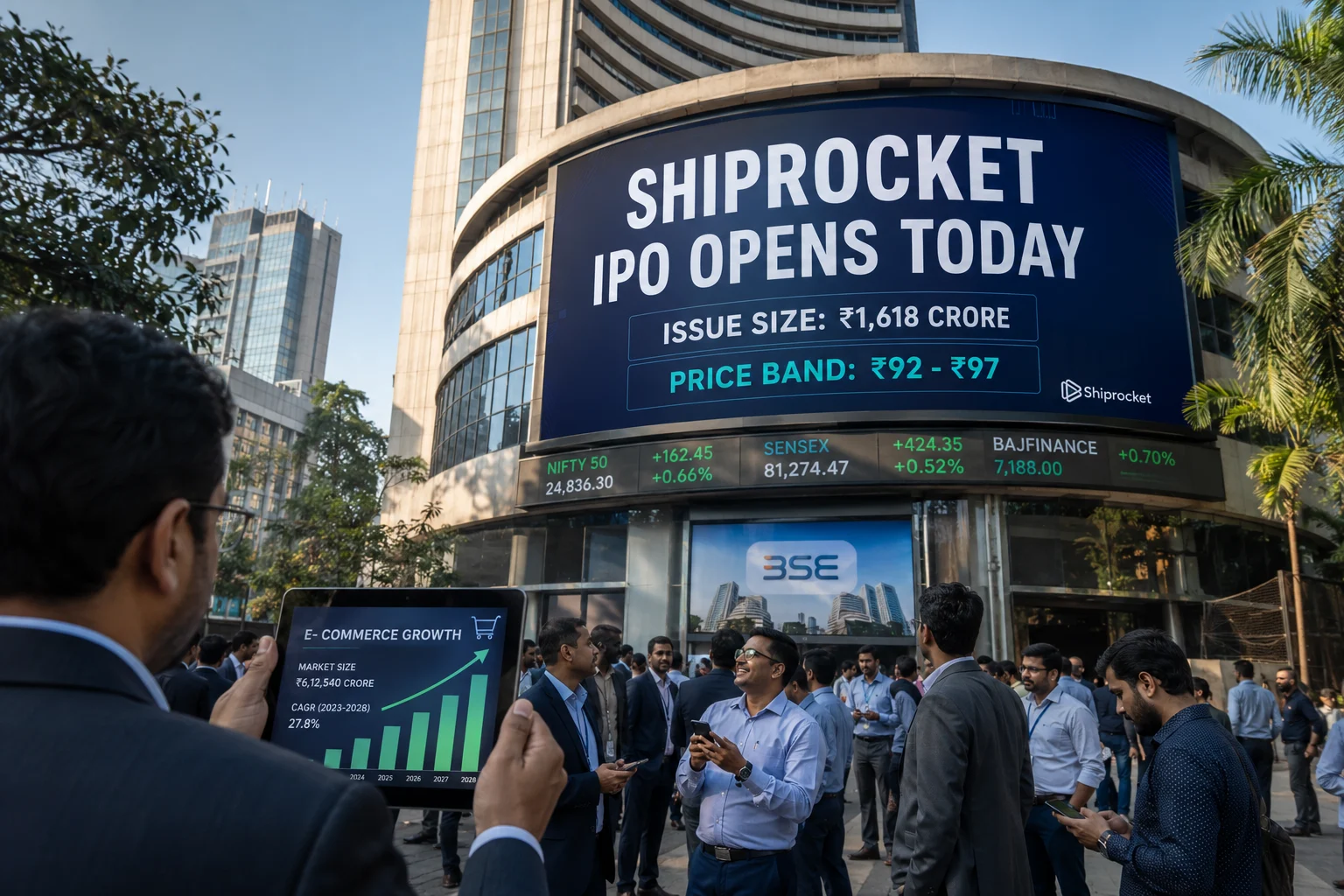
Shiprocket, the Gurugram-headquartered technology platform that has quietly become the backbone of India's small-business e-commerce boom, opened its initial public offering for public subscription today, August 12, 2026. The company is looking to raise approximately ₹1,617.5 crore by selling shares in a price band of ₹92 to ₹97 apiece, a listing that arrives at a moment when India's primary market is arguably more crowded — and more discerning — than at any point in its recent history.
The subscription window runs for three days, closing on August 14, 2026. Allotment is expected to be finalised on August 17, and if the timetable holds, Shiprocket's shares will begin trading on the National Stock Exchange and the Bombay Stock Exchange on August 19, 2026.
On paper, this looks like a familiar story: another well-funded, venture-backed Indian startup cashing in years of private capital for a shot at public market liquidity. But scratch beneath the headline number and a more interesting narrative emerges — one about a company that spent years bleeding cash, clawed its way to something resembling financial discipline, and is now asking retail investors to underwrite the next chapter at a price that, notably, is lower than what its own private investors paid for it four years ago.
Here is everything worth knowing before the closing bell on August 14.
QUICK-LOOK SNAPSHOT
Company Name : Shiprocket Limited Sector : E-commerce enablement / logistics technology Issue Opens : August 12, 2026 Issue Closes : August 14, 2026 Anchor Bidding : August 11, 2026 Price Band : ₹92 to ₹97 per share Face Value : ₹10 per share Total Issue Size : ~₹1,617.5 crore Fresh Issue : ₹885.50 crore (9.13 crore shares) Offer for Sale (OFS) : ₹731.98 crore (7.55 crore shares) Lot Size : 154 shares Minimum Retail Investment : ₹14,168 (lower band) to ₹14,938 (upper band) Allotment Date : August 17, 2026 Listing Date : August 19, 2026 (NSE and BSE) Lead Managers : Axis Capital, BofA Securities India, JM Financial, Kotak Mahindra Capital Registrar : KFin Technologies Estimated Post-Issue Market Cap : ₹6,739 crore to ₹7,058 crore
WHO IS SHIPROCKET, AND WHY DOES IT MATTER
To understand why this IPO is being watched closely, it helps to understand what Shiprocket actually does — because it is easy to lump it in with the wave of consumer apps that have gone public in India recently, when in fact it sits one layer beneath the consumer, inside the plumbing of Indian e-commerce itself.
Shiprocket was founded in 2012 by Saahil Goel, Gautam Kapoor, Vishesh Khurana and Akshay Ghulati, originally under the name KartRocket, with an ambition to become something like India's answer to Shopify — a do-it-yourself storefront builder for small merchants. That version of the business did not take off. In 2017, the founders pivoted hard, repositioning the company as a shipping aggregator: a single dashboard that let small online sellers compare rates and book deliveries across multiple courier partners, rather than negotiating with each logistics company separately. That pivot worked, and worked well. Today, Shiprocket is not itself a logistics company in the traditional sense — it does not own trucks, warehouses or a delivery fleet at scale. Instead, it sits on top of a network of courier partners, including listed rival Delhivery, along with Ekart, XpressBees, Shadowfax and others, routing each shipment to whichever partner makes sense on cost, speed and reliability.
This "asset-light" positioning is central to the investment case. It means Shiprocket does not have to sink the kind of capital into trucks and sorting centres that a Delhivery or an Ecom Express does. It also means Shiprocket's fortunes are, to some degree, hostage to the quality and pricing of the partners it routes through — a trade-off that shows up repeatedly in the company's own risk disclosures.
Over the years, Shiprocket has layered several additional businesses on top of its original shipping-aggregation engine. According to the company's Red Herring Prospectus filed ahead of the IPO, its operations are now organised into two broad buckets:
CORE BUSINESS — comprising the domestic shipping platform and associated "Shipping Apps." This is still, by a wide margin, the heart of the company. Domestic shipping alone accounted for roughly 73.4% of Shiprocket's total revenue from operations in the financial year ended March 2026.
EMERGING BUSINESS — a cluster of newer, faster-growing units that includes: • Fulfilment and warehousing services • Checkout and payments infrastructure for online sellers • Shiprocket X, its cross-border shipping arm • Shiprocket Quick, a same-day and hyperlocal delivery service • Shiprocket Omuni, an omnichannel commerce tool that helps brick-and-mortar retailers sell online • Shiprocket Capital, a lending arm that helps small merchants access working capital and credit
By the company's own account — based on a Redseer report commissioned for the offer documents — Shiprocket is India's largest new-age, "horizontal" e-commerce enablement platform by revenue as of fiscal 2025, meaning it serves merchants across categories (beauty, apparel, home décor, electronics, and more) rather than specialising in one vertical.
The scale is genuinely large. Per the RHP, Shiprocket served 214,769 active merchants in FY26, reaching more than 155 million end consumers across upwards of 19,000 pin codes in India — a geographic spread that would be extremely expensive to replicate through owned infrastructure, which is precisely the pitch the company is making to public investors.
Unusually for an Indian IPO of this size, Shiprocket has no identifiable promoter. It is professionally managed, with Chetan Kumar Mathur serving as Chairman and co-founder Saahil Goel continuing as Managing Director and CEO. That structure — common among venture-backed technology companies, less common among Indian listed firms historically — means there is no single controlling family or individual whose incentives anchor the stock; instead, governance sits with a board answerable to a diffuse set of institutional shareholders.
THE NUMBERS THAT MATTER: A COMPANY LEARNING TO SPEND LESS
If there is one chart every prospective investor in this IPO should look at before anything else, it is the trajectory of Shiprocket's revenue against its losses over the last three financial years. It tells a story of a company that grew consistently while working hard — with mixed recent success — to stop burning cash at the rate it once did.
REVENUE FROM OPERATIONS (₹ crore)
FY24 █████████████░░░░░░░░░░░░░░░░ 1,316 FY25 ████████████████░░░░░░░░░░░░░ 1,632 (+24% YoY) FY26 ████████████████████░░░░░░░░░ 2,024 (+24% YoY)
Shiprocket has now posted 24% year-on-year revenue growth in two consecutive financial years — a rare stretch of consistency for a company operating in India's notoriously price-competitive logistics-technology space. Revenue in the first half of FY26 alone (the six months to September 30, 2025) came in at ₹942.7 crore, up 15.4% from ₹817 crore in the same period a year earlier.
NET LOSS (₹ crore)
FY24 ████████████████████████████ 595.1 FY25 ███░░░░░░░░░░░░░░░░░░░░░░░░░░ 74.4 (down 88% YoY) FY26 ███░░░░░░░░░░░░░░░░░░░░░░░░░░ 79.2 (up ~6.8% YoY)
This is the chart that tells the real story. Between FY24 and FY25, Shiprocket cut its net loss by close to 90% — from nearly ₹600 crore down to roughly ₹74 crore — a dramatic turnaround that the company has understandably leaned on heavily in its pre-IPO messaging. Some of that improvement was driven by genuine operating leverage as the core shipping business scaled; part of it also reflects accounting treatment, since employee stock option (ESOP) charges of roughly ₹91 crore do not represent actual cash leaving the business. Strip those out, and the group's cash EBITDA is understood to have turned positive for the first time in FY25, with the core domestic shipping platform alone said to be solidly cash-generative on a standalone basis.
What is worth flagging, however, is that the loss did not continue to shrink in FY26 — it widened slightly, by roughly 6.8%, to ₹79.2 crore. That is a modest number in absolute terms, and nowhere near the scale of the FY24 losses, but it is a reversal of the trend line the company had been selling to prospective investors, and it is the kind of detail that shows up in brokerage notes urging caution. A single year of a slightly higher loss is not, by itself, alarming — but it is a reminder that the path to sustained profitability is not yet a straight line.
As of July 10, 2026, Shiprocket carried total borrowings of about ₹244.5 crore. A meaningful chunk of the fresh IPO proceeds — roughly ₹210 crore — is earmarked specifically to pay this down, which brokerages tracking the issue estimate would cut the company's outstanding debt to somewhere in the region of ₹30–34 crore. That deleveraging is one of the more concrete, non-speculative reasons cited by bullish analysts for expecting improved profitability going forward, since interest costs would fall sharply.
ANATOMY OF THE OFFER: WHERE THE MONEY GOES
Every IPO is really two transactions bundled into one: a fundraising event for the company, and an exit event for some of its existing shareholders. Shiprocket's issue is a fairly even split between the two.
Fresh Issue (new capital raised by the company) ₹885.50 crore Offer for Sale (existing shareholders selling) ₹731.98 crore ───────────────────────────────────────────────────────────── Total Issue Size ₹1,617.48 crore
The fresh-issue proceeds — the money that actually lands on Shiprocket's own balance sheet — are earmarked across four broad buckets, according to the company's offer documents:
Marketing and brand-building ~₹294 crore Technology infrastructure investment ~₹211 crore Repayment / prepayment of borrowings ~₹210 crore General corporate purposes & potential acquisitions ~₹170 crore
In plain terms: roughly a third of the new money goes toward growing the platform (marketing spend to acquire and retain merchants, plus tech investment across both the Core and Emerging Business lines), a quarter goes to cleaning up the balance sheet, and the rest is kept flexible for corporate purposes, which the company has also flagged could include acquisitions.
WHO IS CASHING OUT — AND WHO ISN'T
The Offer for Sale portion of an IPO is often where the most revealing story lives, because it shows which early backers are choosing this moment to take money off the table, and which ones are choosing to stay invested even after the company goes public.
Shiprocket's shareholder register ahead of listing includes several well-known names in Indian and global venture capital: Bertelsmann India Investments (via Bertelsmann Nederland B.V.), which is understood to be the company's single largest shareholder at roughly 21.3%; Tribe Capital; Eternal Limited (the company formerly known as Zomato), which holds around 6.85%; Temasek, through its investment vehicle Macritchie Investments; and KDT Venture Holdings.
Notably, several of the largest names are sitting this round out. Eternal and Temasek are not selling any shares in this offer. Bertelsmann, which had originally been included as a seller in the company's draft prospectus, subsequently withdrew from the OFS altogether — meaning the single biggest shareholder on the register chose not to cash out at the IPO price, a detail some analysts have read as a mild vote of confidence in future value, even as others note it may simply reflect lock-in terms or portfolio strategy rather than a view on valuation. Total funding raised by Shiprocket prior to this listing is estimated at roughly $322 million (about ₹2,700 crore) across twelve rounds, with the company's last private fundraise in 2022 valuing it at around $1.3 billion.
WHY GO PUBLIC NOW? THE TIMING QUESTION
Every IPO has a "why now" behind it, and Shiprocket's answer appears to be a mix of opportunity and necessity. On the opportunity side, India's primary market has, over the past year, shown real appetite for new-age technology businesses that can demonstrate a credible path to profitability rather than pure growth-at-any-cost — Meesho's blockbuster December 2025 debut being the clearest proof point. Shiprocket's own turnaround story, with losses cut by nearly 90% between FY24 and FY25, gave the company a genuine improvement narrative to bring to investors, rather than asking the market to underwrite years of unchecked cash burn.
On the necessity side, venture-backed companies eventually face pressure from their own investor base to deliver liquidity. Shiprocket has now raised capital across roughly a dozen private funding rounds since 2013, accumulating backers who, at some point, need an exit route beyond secondary private transactions. A public listing — even one priced at a discount to the company's 2022 peak — offers that liquidity while also, in theory, giving the company a more diversified, permanent capital base than relying on periodic venture rounds.
There is also a sector-specific dimension. With Delhivery already listed, Ecom Express working through its own listing ambitions, and Unicommerce already trading as a smaller enablement-focused peer, the Indian logistics-technology space is consolidating into a defined set of public comparables. Being early to establish itself in that peer set — rather than being the last major player to list — arguably gives Shiprocket more control over how the market frames its story, rather than being perpetually compared against whichever competitor happened to list first.
THE TECHNOLOGY AND AI PITCH
Shiprocket has, in its pre-IPO positioning, leaned heavily on describing itself as an "AI-driven" or "merchant-first, API-led" technology platform, rather than simply a shipping aggregator. In practice, this framing centres on a handful of concrete product capabilities: machine-learning-based courier routing that dynamically selects which logistics partner should handle a given shipment based on cost, historical delivery performance and transit-time data; automated returns and reverse-logistics management, a persistent pain point for Indian e-commerce given the country's high cash-on-delivery volumes; and data analytics tools that give small merchants visibility into delivery performance and customer behaviour that they would otherwise have no easy way to access on their own.
The company's lending arm, Shiprocket Capital, extends this technology layer into financial services, using the transaction and shipment data generated by merchants on the platform to underwrite working-capital loans — a model that mirrors what several fintech-adjacent platforms globally have used to extend credit to thin-file small businesses that traditional banks find difficult to underwrite. Whether this financing arm becomes a meaningful profit centre in its own right, or remains a smaller value-added feature that helps retain merchants on the core shipping platform, is one of the more interesting threads to watch in the company's post-listing disclosures.
WHAT IS SHIPROCKET ACTUALLY WORTH?
This is the question every IPO ultimately comes down to, and it is where the Shiprocket story gets genuinely interesting, because the company appears to be pricing itself at a discount rather than a premium to its own recent history.
At the top end of the price band, Shiprocket's post-issue market capitalisation works out to approximately ₹7,058 crore; at the lower end, about ₹6,739 crore. Media estimates generally converge around a ₹7,000-crore figure. That is roughly 30% below the valuation the company commanded in its last private funding round back in 2022, when it was valued at somewhere between $1.2 billion and $1.3 billion (translating to roughly ₹10,000–10,650 crore at the exchange rates of that period).
A deliberate discount to a company's own peak private valuation is not unheard of in Indian startup IPOs of the past two years — it has, in fact, become something of a pattern, as companies try to avoid the "down-round-on-listing-day" optics that soured sentiment around a few earlier tech debuts. But it is still a meaningful data point: existing private investors, and the company itself, appear to have concluded that a more conservative price is the safer path to a stable public listing, rather than reaching for the highest number the market might bear.
Because Shiprocket remains loss-making on a full-year basis, traditional valuation yardsticks like price-to-earnings (P/E) and earnings per share (EPS) are not meaningful here — the company's EPS is negative, so P/E cannot be calculated in the conventional sense. Analysts covering the issue have instead leaned on revenue-based multiples. By that measure, Shiprocket is being priced at roughly 3.2 times its FY26 revenue on an enterprise-value basis, which puts it at a noticeable discount to listed logistics-technology peer Delhivery, which trades at somewhere between 4.0 and 4.5 times sales.
HOW SHIPROCKET STACKS UP AGAINST ITS PEERS
Company Model Profitability (latest FY) ───────────────────────────────────────────────────────────────────────────── Shiprocket Asset-light courier aggregator Loss-making (~₹79 cr loss) + e-commerce enablement suite Delhivery Owned logistics network, express Historically loss-making, parcel, freight, warehousing narrowing Ecom Express Last-mile, reverse logistics for Loss-making large e-commerce clients Unicommerce Listed SaaS peer in e-commerce Profitable (smaller scale) enablement / order management Blue Dart Traditional express logistics Profitable, P/E ~64x (part of DHL group)
The comparison underlines Shiprocket's specific niche: it is not trying to be Delhivery, which owns and operates a nationwide logistics backbone catering heavily to large enterprises. Nor is it trying to be Blue Dart, a decades-old, profitable express-delivery operator with an entirely different risk profile and valuation multiple. Shiprocket's closest positioning is against fellow horizontal e-commerce enabler Unicommerce, though Unicommerce is a considerably smaller, software-first business, and against Ecom Express and XpressBees in the broader last-mile logistics fight for small and mid-sized merchant volumes.
WHAT THE GREY MARKET IS SAYING (AND WHY YOU SHOULDN'T READ TOO MUCH INTO IT)
In the run-up to any Indian IPO, an unofficial and unregulated secondary market emerges where prospective allottees informally trade their expected allotments before shares actually list — the so-called "grey market." The premium at which these unofficial trades happen, known as the Grey Market Premium or GMP, is widely tracked by retail investors as an early sentiment gauge, even though brokerages routinely warn that it is not a reliable predictor of actual listing-day performance.
Shiprocket's GMP has been volatile in the days leading up to the issue opening, swinging from a low of around ₹14 on August 7 to a high of around ₹27 by August 11 — the day before the issue formally opened. At a GMP of ₹27 over the ₹97 upper price band, the unofficial market was implying a listing price of roughly ₹124, or a listing-day gain of close to 28%. Earlier in the week, and on some tracking platforms, the GMP had also been reported at ₹0, illustrating just how quickly — and unreliably — this figure can move.
For context, it is worth remembering what happened with Meesho, a broadly comparable horizontal e-commerce platform that listed on India's exchanges in December 2025. Meesho's issue was oversubscribed more than 79 times, its GMP in the ₹33–₹43 range roughly tracked its eventual listing-day gain of 46%, and the stock has largely held those gains since. That listing has become something of a reference point for how strong appetite can be for well-marketed, new-age Indian internet businesses — though it is also a reminder that Meesho listed with far larger investor demand (nearly 80 times oversubscribed) than early indicators suggest Shiprocket may see.
WHAT ANALYSTS ARE SAYING: A DIVIDED STREET
Perhaps the most useful signal for a prospective investor is not the grey market but the range of views coming from research desks that have actually studied the Red Herring Prospectus in detail — and on Shiprocket, that range is genuinely split, rather than converging on a single "buy" or "avoid" call.
On the more constructive side, SBI Securities has recommended investors subscribe to the issue at the cut-off price, pointing specifically to the planned debt paydown — which would cut total borrowings from roughly ₹242 crore down to about ₹32 crore — as a concrete driver of lower interest costs and, by extension, improved profitability in the coming years.
Swastika Investmart has taken a more nuanced middle position. Its analysts note that Shiprocket's ~3.2x EV/Sales multiple looks reasonable relative to Delhivery's 4.0–4.5x range and represents a real discount to the company's own 2022 private valuation peak — but the brokerage frames the issue as suited to high-risk, growth-oriented portfolios with a two-to-three-year holding horizon, explicitly cautioning it against more conservative, value-oriented investors.
On the more cautious end, Sushil Finance has adopted what it describes as a cautious stance, citing the company's net losses across all three of the last fiscal years (FY24 through FY26) and the scale of existing venture-capital and insider selling through the Offer for Sale as reasons for concern. Independent market analyst Ambareesh Baliga has separately suggested the IPO looks fairly valued at current levels and may not deliver a significant listing-day premium, a more measured read than the double-digit gains implied by the grey market.
Veteran IPO analyst Dilip Davda, writing for Chittorgarh, one of India's longest-running IPO tracking platforms, declined to issue a formal ratings call on the issue at all — itself a somewhat telling signal. His written assessment notes that while Shiprocket has posted steady top-line growth, it continues to report losses, operates in what he characterises as a highly competitive and fragmented segment, and — because of its negative earnings — carries what is effectively a negative P/E. His conclusion: the issue may suit "well-informed, cash-surplus, risk-seeking" investors willing to commit moderate sums with a long-term view, rather than investors looking for a straightforward value bet.
One data point worth flagging for anyone weighing listing-day risk more broadly: the four book-running lead managers on this issue — Axis Capital, BofA Securities India, JM Financial and Kotak Mahindra Capital — have collectively managed 87 IPOs over the past three fiscal years, of which 23, or roughly a quarter, closed below their issue price on the very first day of trading. That is not a statement about Shiprocket specifically, but it is useful context on the base-rate risk of any Indian IPO in the current environment.
THE RISK COLUMN: WHAT COULD GO WRONG
No IPO analysis is complete without a clear-eyed look at what could derail the story, and Shiprocket's own offer documents — along with the analysts who have picked through them — flag several recurring concerns:
CONTINUED LOSSES, NO GUARANTEE OF PROFITABILITY. Shiprocket has posted a net loss in each of the past three financial years. While the FY24-to-FY25 improvement was dramatic, the FY26 loss actually widened slightly year-on-year, and there is no assurance the company reaches sustained profitability on any particular timeline.
DEPENDENCE ON THIRD-PARTY COURIER PARTNERS. Because Shiprocket does not own its own last-mile delivery fleet at scale, service quality, pricing and reliability are all, to a meaningful degree, outside its direct control — a structural vulnerability of the asset-light aggregator model that differentiates it from vertically integrated peers like Delhivery.
INTENSE, FRAGMENTED COMPETITION. Data platform Tracxn lists over a thousand active competitors across Shiprocket's various business lines, from pure-play logistics companies to newer horizontal enablement platforms. Pricing power in a fragmented market is inherently harder to defend.
A LARGE OFFER FOR SALE. Nearly ₹732 crore of this issue represents existing shareholders selling down, rather than fresh capital entering the business — a structure some cautious analysts read as existing investors partially monetising rather than doubling down.
ESOP-DRIVEN ACCOUNTING NOISE. A meaningful share of the company's recent loss reduction reflects non-cash employee stock option accounting rather than pure operating improvement, which investors should factor in when reading headline profitability trends.
MACRO DEPENDENCE ON INDIAN E-COMMERCE GROWTH. Shiprocket's fortunes are closely tied to the continued expansion of India's small-merchant e-commerce ecosystem; any slowdown in that broader growth story would flow directly through to Shiprocket's shipment volumes and revenue.
VALUATION-DISCOUNT SIGNAL. The fact that the IPO is priced roughly 30% below the company's own last private valuation could be read two ways — either as pricing discipline that leaves room for upside, or as a signal that even existing, informed private investors were unwilling to underwrite a higher number.
A QUICK GLOSSARY FOR FIRST-TIME IPO INVESTORS
For readers new to how Indian IPOs work, a few terms that come up repeatedly in coverage like this are worth defining plainly:
FRESH ISSUE — new shares created and sold by the company itself, with the proceeds going onto the company's own balance sheet to fund growth, debt repayment or other stated purposes.
OFFER FOR SALE (OFS) — existing shares sold by current shareholders (founders, employees or investors), where the proceeds go to those selling shareholders rather than to the company.
PRICE BAND — the range within which the company and its bankers invite bids; the final "cut-off" price at which shares are actually allotted is determined based on demand across the band.
LOT SIZE — the minimum number of shares an investor must bid for, and the increment in which further shares must be bid; Shiprocket's lot size is 154 shares.
GREY MARKET PREMIUM (GMP) — an unofficial, unregulated indicator of how much above (or below) the issue price a stock is trading in informal pre-listing trades; it is watched widely but is not a reliable forecast.
ANCHOR INVESTOR — a large institutional investor allowed to bid a day ahead of the public issue, at a price the company sets; strong anchor demand is often read as an early signal of institutional confidence.
QIB / NII / RETAIL — the three main investor categories an IPO is divided into: Qualified Institutional Buyers (large institutions such as mutual funds and insurers), Non-Institutional Investors (typically high-net-worth individuals bidding above ₹2 lakh), and Retail Individual Investors (ordinary investors bidding up to ₹2 lakh).
LISTING GAIN — the percentage difference between a stock's opening trade price on listing day and its IPO issue price; this is the number most closely tracked by short-term IPO investors, though it says little about a company's longer-term prospects.
FREQUENTLY ASKED QUESTIONS
WHAT IS THE MINIMUM AMOUNT I NEED TO INVEST? At the upper price band of ₹97, one lot of 154 shares costs ₹14,938. Retail investors can bid for one lot or in multiples of it, subject to the ₹2 lakh regulatory ceiling that defines the retail category.
HOW DO I APPLY? Applications can be made through a bank's ASBA (Applications Supported by Blocked Amount) facility or through a broker's trading platform using the UPI payment method — the funds are blocked in the applicant's account and debited only if shares are actually allotted.
IS SHIPROCKET PROFITABLE? No. The company has reported a net loss in each of the last three financial years, though the scale of that loss has fallen dramatically since FY24, even with a modest uptick in FY26.
WHO ARE THE BIGGEST SHAREHOLDERS SELLING IN THIS IPO? The Offer for Sale draws from a mix of existing venture and private-equity investors; Temasek and Eternal (formerly Zomato) are notably not selling any shares in this round, while Bertelsmann, the largest shareholder, withdrew from the OFS after originally being listed as a seller in the draft prospectus.
WHEN WILL I KNOW IF I GOT AN ALLOTMENT? The basis of allotment is expected to be finalised on August 17, 2026, and allotment status can be checked on the websites of the stock exchanges or the registrar, KFin Technologies, once published.
KEY DATES TO TRACK
August 11, 2026 Anchor investor bidding August 12, 2026 IPO opens for public subscription August 14, 2026 IPO closes for subscription August 17, 2026 Basis of allotment finalised August 18, 2026 Refunds initiated / shares credited to demat accounts August 19, 2026 Listing on NSE and BSE
THE BIGGER PICTURE: A CROWDED, MATURING PRIMARY MARKET
Shiprocket is not going public in a vacuum. It arrives in the middle of what has become one of the busiest stretches for India's IPO market in years, with new-age technology and consumer businesses lining up alongside traditional manufacturers and financiers for a slice of investor liquidity. In the same week that Shiprocket's issue opened, other companies including Molbio Diagnostics, Milky Mist Dairy Foods, LEAP India, Dhoot Transmission and Technocraft Ventures were also either open for subscription or preparing to launch — a reminder that retail and institutional investors alike are being asked to make multiple allocation decisions simultaneously, which can dilute demand for any single issue.
The more direct comparison, however, is to Meesho, the Bengaluru-based social commerce platform that listed on Indian exchanges in December 2025 in a ₹5,421-crore IPO — several times the size of Shiprocket's raise. Meesho's listing was a genuine blockbuster: the issue was subscribed nearly 80 times over, institutional demand for its qualified institutional buyer quota ran above 120 times, and the stock opened trading with a 46% premium to its issue price, a gain that has broadly held up in the months since. That listing did a great deal to validate investor appetite for India's new-age internet economy on the public markets, and it set a high bar for the next horizontal e-commerce-adjacent business to follow it onto the exchanges.
Shiprocket is, in some respects, a different animal from Meesho — it is a business infrastructure provider serving merchants rather than a consumer-facing marketplace, its losses are far smaller in absolute terms, and its growth rate, while healthy, is not in the same explosive category. Whether the market rewards Shiprocket's more measured, "show-me-the-discipline" positioning the way it rewarded Meesho's growth story remains one of the more interesting open questions of this listing season. Early grey-market signals suggest more modest expectations — a listing pop in the high-20s percentage range, if current indications hold, rather than anything close to Meesho's 46%.
There is also a broader logistics-sector storyline at play. Ecom Express, another major player in the space, has separately been working through its own path to the public markets, and has publicly sparred with Delhivery over how certain operating metrics were represented in its offer documents — a reminder that even data as seemingly straightforward as "how many shipments were delivered" can become a point of genuine contention between rival logistics businesses vying for the same investor dollars. That dispute is a useful backdrop for reading any single company's self-reported operating metrics with a healthy degree of scrutiny, Shiprocket included.
THE BOTTOM LINE
Shiprocket's IPO is, in many ways, a test case for how India's public markets value a certain kind of business: one that is large, genuinely useful to hundreds of thousands of small merchants, growing at a healthy clip, and has made real — if not yet complete — progress toward financial discipline, but that has not yet crossed the line into full-year profitability.
The bull case rests on a fairly simple thesis: revenue has compounded at 24% for two straight years, the balance sheet is about to get meaningfully cleaner thanks to planned debt repayment, the company is being offered to public investors at a discount to what sophisticated private investors paid for it in 2022, and several of its largest existing shareholders — including Temasek and Eternal — are choosing to hold rather than sell into this offering.
The bear case is equally straightforward: the company has never posted a profitable year, its most recent full-year loss actually widened rather than narrowed, it operates in a brutally competitive and fragmented market against both asset-light aggregators and vertically integrated logistics giants, and nearly half of this IPO's total value is existing investors cashing out rather than new capital entering the business.
Both cases are being made, in almost these exact terms, by different desks on Dalal Street this week — which is precisely why the analyst community is split rather than unanimous. As with any IPO, prospective investors would do well to look past the grey market noise and the headline growth numbers, and read the risk factors in the Red Herring Prospectus directly before deciding how — or whether — to participate.
DISCLAIMER: This article is intended for general informational and news purposes only and does not constitute investment advice, a recommendation to buy or sell securities, or a solicitation of any kind. IPO investments carry market risk, including the risk of listing below issue price. Readers are strongly encouraged to consult the company's Red Herring Prospectus and a licensed financial advisor before making any investment decision. Grey market premium figures are unofficial, unregulated and subject to rapid change; they should not be treated as a reliable indicator of listing-day performance.