StartupNews · Markets
SEBI Rolls Out the Closing Auction Session: India's Stock Market Closing Bell Just Got a Major Rewrite
Starting August 3, 2026, F&O-eligible stocks will stop continuous trading at 3:15 PM for a new 20-minute auction window, while derivatives trading gets a 10-minute extension, as SEBI moves to shut the door on end-of-day price manipulation.
By Startup news · Published · Updated
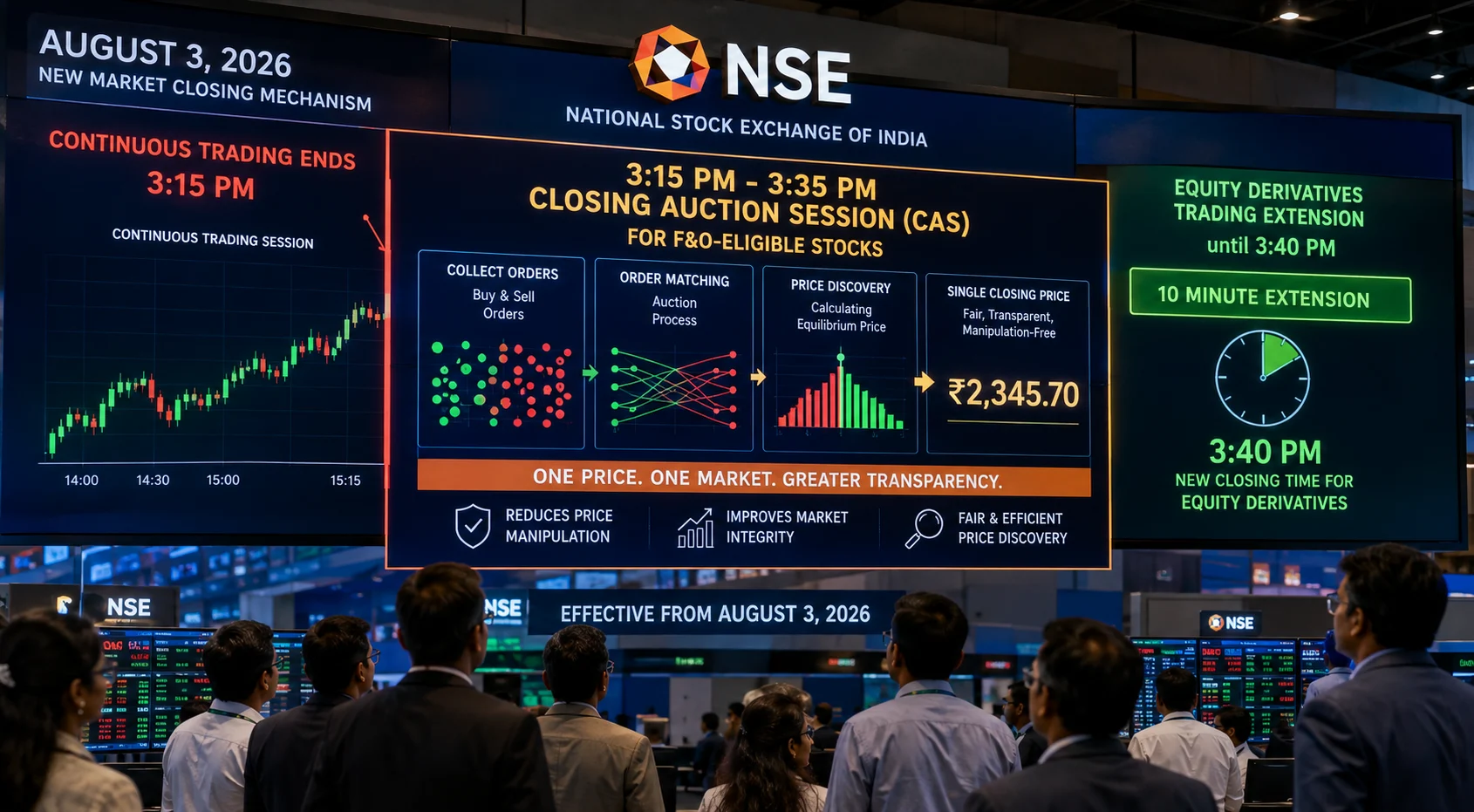
For as long as most Indian investors have been trading, the closing price of a stock has been a simple average, the Volume Weighted Average Price of every trade executed in the final thirty minutes of the day, from 3:00 PM to 3:30 PM. That single number has always mattered far more than its quiet, technical-sounding name suggests. It sets the net asset value of mutual funds, determines the settlement price for futures and options contracts, decides how index funds and exchange-traded funds rebalance, and often becomes the reference point an entire day's market commentary gets built around. Starting August 3, 2026, that number will be calculated in a completely different way for hundreds of India's most actively traded stocks, and the country's stock exchanges will, for the first time, no longer share a single, uniform closing time across the entire market.
The Securities and Exchange Board of India has introduced what it is calling the Closing Auction Session, a structured, auction-based mechanism that will replace the old VWAP method for every stock that has active futures and options contracts trading on it. Continuous trading in those stocks will now stop at 3:15 PM, fifteen minutes earlier than before, and be replaced by a twenty-minute auction window running until 3:35 PM, during which buy and sell orders are pooled together and matched to arrive at a single, official closing price. Stocks without derivatives contracts will continue trading exactly as before, all the way to 3:30 PM, untouched by the new rules for now. And in a further twist, equity derivatives trading itself, the futures and options contracts that were the reason certain stocks were selected for this new regime in the first place, will now run ten minutes longer than before, until 3:40 PM.
Why the Old System Was a Problem
To understand why SEBI felt compelled to overhaul something as seemingly mundane as how a closing price gets calculated, it helps to understand exactly how exploitable the old method was. Under the Volume Weighted Average Price system, a stock's official close was simply the average price of every trade executed between 3:00 PM and 3:30 PM, weighted by how many shares changed hands at each price. On paper, that sounds like a reasonably fair way to capture where a stock genuinely traded at the end of the day. In practice, it created a well-known vulnerability that market participants and regulators around the world refer to as marking the close.
Because the VWAP was calculated as a simple average across a thirty-minute window, a single large, well-timed order placed late in that window, particularly in a thinly traded stock, could disproportionately skew the final average. A trader with enough capital and the right intent could push a stock's official closing price higher or lower than where it had genuinely traded for most of the day, simply by executing a large order in the final few minutes. Since that closing price feeds directly into derivatives settlement values, index calculations, and mutual fund valuations, even a modest, artificial distortion at the close could ripple outward into positions and portfolios that had nothing to do with the original trade.
This was not a uniquely Indian problem. It is precisely why most of the world's largest and most closely watched stock exchanges, including the New York Stock Exchange, Nasdaq, the London Stock Exchange, Euronext, the Singapore Exchange, the Hong Kong Exchange, and the Australian Securities Exchange, have long since moved away from simple time-weighted averages and toward auction-based closing mechanisms of their own. India's equity cash market, despite being one of the largest and fastest-growing in the world by trading volume, had remained something of an outlier on this specific point, still relying on the older averaging method that most comparable global markets had already left behind.
A Simple Illustration of the Old Problem
It helps to walk through a simplified example of exactly how marking the close could work under the old system. Imagine a mid-sized stock trading steadily around Rs 500 for most of the trading day, with modest volumes throughout the final half-hour window. A trader holding a large derivatives position that would benefit from a higher settlement price could place one large buy order in the final few minutes of the VWAP window, pushing that stock's price briefly up to, say, Rs 520 on relatively thin volume. Because the VWAP averages every trade across the full thirty-minute window, that single late spike, even if it represented only a small fraction of the day's total volume, could pull the final calculated closing price noticeably higher than where the stock had genuinely traded for the rest of the session. Anyone holding a derivatives contract settling against that closing price, or any index fund rebalancing based on it, would then be affected by a price move that reflected one trader's late maneuvering rather than genuine, broad-based market consensus.
Under the new auction system, that same late order does not get quietly averaged into a broader window. Instead, it becomes one visible order among many inside a single, transparent order book, competing against every other buy and sell order submitted during the auction period to find the price at which the maximum number of shares can actually change hands. A single large order can still influence that equilibrium price to some extent, that is simply how any market works, but it can no longer do so by exploiting a narrow, thinly traded averaging window the way it could before, and the randomised closure timing removes the predictability that made such manoeuvres easier to execute precisely.
How the New System Actually Works
The Closing Auction Session replaces that averaging approach with what market microstructure specialists call a call auction, a mechanism where buy and sell orders are collected over a defined window rather than matched instantly as they arrive, and then all matched together at a single moment to discover one equilibrium price, the price at which the largest possible number of shares can change hands. That equilibrium price, not an average of scattered trades, becomes the stock's official closing price for the day.
Here is how the new sequence actually unfolds, minute by minute, for a stock that falls under the new rules.
3:00 PM to 3:15 PM, the Reference Price Window. Continuous trading proceeds completely normally during this period, exactly as it always has. Behind the scenes, the exchange calculates the Volume Weighted Average Price of all trades executed during just this fifteen-minute window, and that figure becomes the Reference Price, the anchor point around which the entire auction that follows will be built.
3:15 PM, the Cutoff. Continuous trading stops entirely for stocks under the new regime. Any pending stop-loss orders and iceberg orders on these stocks are automatically cancelled at this point, since those order types are not permitted to carry over into the auction mechanism. Orders sitting outside a band of plus or minus 3 percent around the Reference Price are also cancelled.
3:15 PM to 3:20 PM, Transition. The market shifts formally from the continuous trading session into the auction session, with the Reference Price calculation finalised during this window.
3:20 PM to 3:25 PM, Open Order Entry. Traders can freely place, modify, or cancel both market orders and limit orders. Throughout this period, the exchange publishes an indicative price, essentially a live preview of where the auction is likely to settle, along with the total buy and sell quantities on the books and any imbalance between the two sides, giving market participants real-time visibility into how the auction is shaping up.
3:25 PM to roughly 3:28 PM, Limit Orders Only. Market orders can no longer be placed, modified, or cancelled during this window. Only limit orders remain adjustable, tightening the order book ahead of the final close.
3:28 PM to 3:30 PM, Random Closure. This is one of the more technically interesting design choices in the entire framework. Rather than closing the order-entry window at a fixed, predictable second, the exchange closes it at a randomly determined moment somewhere within this final two-minute stretch. That randomness is deliberate, and it exists for a specific reason: if the exact closing instant were fixed and known in advance, it would create exactly the kind of predictable, exploitable moment that bad actors could time an order around, reintroducing the very manipulation risk the entire auction mechanism was designed to eliminate.
3:30 PM to 3:35 PM, Matching and Price Discovery. With order entry now closed, the exchange's matching engine calculates the equilibrium price, the single price point that allows the maximum number of shares to be matched between buyers and sellers, and that price becomes the stock's official closing price for the day.
Here is that entire sequence laid out as a simple visual timeline:
3:00 PM ━━━━━━━━━━━ Continuous trading (Reference Price window begins)
3:15 PM ━━━━━━━━━━━ Continuous trading STOPS • stop-loss orders cancelled
3:15-3:20 ━━━━━━━━━ Transition • Reference Price finalised
3:20-3:25 ━━━━━━━━━ Market + limit orders freely placed
3:25-3:28 ━━━━━━━━━ Limit orders only, no market order changes
3:28-3:30 ━━━━━━━━━ Random closure window (unpredictable cutoff)
3:30-3:35 ━━━━━━━━━ Equilibrium price calculated • official close set
3:35-3:50 ━━━━━━━━━ Buffer / transition phase
3:50-4:00 ━━━━━━━━━ Post-close session at the new CAS closing price
A Market With Two Different Closing Times
One of the more disorienting aspects of this change for ordinary investors is that, for the first time, India's equity market will not have a single, uniform closing time. Which rules apply to a given stock depends entirely on whether that stock has active futures and options contracts trading against it.
SEBI has split the equity cash segment into two categories for this purpose. Category I covers every stock that currently has live F&O contracts, a group that includes the Nifty 50 constituents, Bank Nifty constituents, and roughly 180-plus other large, liquid stocks across NSE, BSE, and the smaller MSEI exchange. These are the stocks that move into the new Closing Auction Session framework starting August 3, 2026. Category II covers every other listed stock, the far larger universe of smaller, less liquid companies that do not currently have derivatives contracts trading against them. For now, these stocks continue operating exactly as before, trading continuously until 3:30 PM and having their closing price calculated using the familiar VWAP method, with SEBI leaving the door open to eventually bringing this group into the auction framework in a later phase, without yet committing to a timeline for doing so.
Layered on top of that split is a third, separate timing change that applies specifically to the derivatives market itself. Futures and options contracts on Category I stocks, along with index derivatives like Nifty and Bank Nifty futures and options, will now continue trading for an additional ten minutes beyond where the auction concludes, until 3:40 PM, rather than stopping at the old 3:30 PM cutoff. That extension exists to give derivatives traders a short window to react to the newly discovered cash-market closing price before their own market closes for the day, since derivatives pricing is directly linked to the underlying stock's official close.
Here is a simple way to visualise how differently timed the market's various pieces now are:
Category II stocks (no F&O) | ████████████████████████ Trade until 3:30 PM, unchanged
Category I stocks (F&O eligible) | ███████████████████████ Continuous trade ends 3:15 PM, auction until 3:35 PM
F&O derivatives contracts | ██████████████████████████ Trade until 3:40 PM, extended
A post-close session then runs from 3:50 PM to 4:00 PM, during which trading resumes exclusively at the newly established Closing Auction Session price, giving market participants a final short window to transact at the official close before the trading day fully ends.
Why SEBI Is Making This Change Now
SEBI's own January 2026 circular introducing the framework describes its objective in fairly direct regulatory language, aiming to establish what the regulator called a more robust and manipulation-resistant closing price discovery mechanism, one that better reflects genuine market demand and supply rather than the outcome of trades concentrated in a narrow window. Market commentary and broker analysis around the change have generally converged on four specific justifications behind the move.
The first, and most emphasised, is closing-price manipulation itself. By pooling all end-of-day buying and selling interest into a single, transparent order book rather than allowing trades to occur continuously and be averaged afterward, the auction mechanism removes the specific point of leverage that made marking the close possible in the first place, a single well-timed large order can no longer disproportionately swing the final price the way it could under the old averaging system.
The second is alignment with global practice. As already noted, most of the world's major exchanges settled on auction-based closing mechanisms years ago, and SEBI's move brings India's cash equity market into step with how the New York Stock Exchange, Nasdaq, the London Stock Exchange, Euronext, the Singapore Exchange, the Hong Kong Exchange, and the Australian Securities Exchange all already operate.
The third is execution efficiency for large institutional orders. Under the old system, a large fund needing to buy or sell a substantial block of shares near the close often had to split that order into many smaller pieces, spreading them across the thirty-minute VWAP window to avoid single-handedly distorting the average price. Under CAS, that same large order can instead be placed directly into the auction's single consolidated pool, where it has a meaningfully higher chance of finding a matching counterparty at a fair, market-clearing price without needing to be artificially broken up.
The fourth, and arguably the most consequential for ordinary retail investors even if they never trade near the close themselves, is tracking accuracy for passive investment products. India's index fund and ETF industry has grown rapidly over the past several years, and both categories rely directly on official closing prices to calculate net asset values and rebalance holdings. A closing price that more accurately reflects genuine end-of-day market consensus, rather than one vulnerable to late-window distortion, directly reduces what is known as tracking error, the gap between an index fund's actual returns and the benchmark index it is supposed to mirror. As India's weight within global benchmark indices has continued to grow, drawing larger and larger passive capital flows tied directly to closing-price-based rebalancing events, the cost of an easily distorted closing mechanism has grown right alongside it.
This last point deserves a bit more context, since it explains much of the timing behind why SEBI chose to act now rather than several years ago. A decade ago, passive investing, meaning index funds and ETFs that simply track a benchmark rather than actively picking stocks, represented a fairly small slice of the overall Indian equity market. That has changed substantially. Domestic index funds, government-linked pension schemes that allocate heavily to passive equity products, and a growing pool of foreign institutional money tracking global emerging-market indices with meaningful India weightings, have together made the accuracy of the daily closing price a much higher-stakes question than it used to be. Every rebalancing event for a major global index that includes Indian stocks now moves genuinely large sums of money precisely at the closing price, which means any distortion in how that price gets calculated has a correspondingly larger real-world financial impact than it would have carried in, say, 2015 or 2018.
Here is a quick look at how India's move lines up against exchanges that had already adopted auction-based closing mechanisms:
New York Stock Exchange | Closing auction in use
Nasdaq | Closing auction in use
London Stock Exchange | Closing auction in use
Euronext | Closing auction in use
Singapore Exchange | Closing auction in use
Hong Kong Exchange | Closing auction in use
Australian Securities Exchange | Closing auction in use
India (NSE, BSE, MSEI) | Joining from August 3, 2026
What Changes for Different Kinds of Investors
The practical impact of this shift varies considerably depending on what kind of market participant someone is, and it is worth walking through each group separately.
For long-term delivery investors, people who buy shares and hold them in their demat account rather than trading actively, essentially nothing changes. Mutual fund investments, systematic investment plans, and ETF holdings continue functioning exactly as before, with brokers and fund houses handling any session-specific adjustments automatically behind the scenes.
For intraday traders, the picture is more immediately relevant. Equity intraday positions, commonly known as MIS positions, are typically auto-squared off by brokers at 3:05 PM under the new regime, ten minutes before the Closing Auction Session even begins, giving traders a firm, earlier deadline to exit same-day positions than they may have been used to under the old system, where intraday square-off times sometimes ran closer to the old 3:30 PM close.
For anyone using stop-loss orders on Category I stocks, a detail worth flagging explicitly: since stop-loss and iceberg orders are automatically cancelled at 3:15 PM and cannot carry over into the auction window, any open stop-loss protection on these stocks effectively disappears for the final twenty minutes of the trading day. Traders who rely on stop-loss orders to manage risk near the close will need to actively monitor and manually manage those positions during this window rather than assuming their existing protective orders remain active. This is arguably the single most important behavioural change active traders need to internalise before August 3, since it is the one most likely to catch someone off guard if they are not paying attention, a protective order that quietly worked exactly as expected every single trading day for years simply will not exist during this specific twenty-minute stretch going forward, and traders accustomed to setting a stop-loss and stepping away from their screens near the close will need to adjust that habit specifically for Category I stocks.
For futures and options traders specifically, the ten-minute extension to 3:40 PM gives a short additional window to react to the newly discovered closing price in the underlying cash stock before the derivatives market itself shuts for the day, along with a related technical change: static price bands of plus or minus 3 percent are applied to stock futures starting at 3:15 PM, based on the 3:00 PM to 3:15 PM VWAP, and the normal dynamic price-band flexing that futures contracts typically use is paused between 3:15 PM and 3:40 PM, keeping cash and derivatives price movements more tightly aligned during this sensitive closing window.
For institutional and passive fund managers, the change is arguably the most structurally significant of all. Fund managers can now participate directly in the auction itself and potentially execute trades at the exact price that ultimately becomes the official market close, a meaningfully different capability than trying to approximate the VWAP through a series of smaller trades under the old system.
A Quirk Worth Knowing: NSE and BSE May Not Agree
One detail buried in the mechanics of the new system is worth flagging clearly for anyone who trades across multiple exchanges. Because NSE and BSE each run their own separate Closing Auction Session independently, rather than sharing a single combined order book, it is entirely possible for the same stock to end up with a slightly different official closing price on NSE than it does on BSE on any given day. Under the old VWAP system, this kind of divergence could occur too, but the auction structure, being built around each exchange's own distinct pool of orders, makes such small discrepancies a more structurally built-in feature of the new mechanism rather than an occasional anomaly.
Industry Reaction
Reaction from India's brokerage and trading community has generally been supportive, framed around the idea that a more accurate, harder-to-manipulate closing price benefits nearly every category of market participant over time, even if it introduces some short-term adjustment friction. Zerodha co-founder Nithin Kamath, one of the more widely followed voices in India's retail trading community, has publicly described the Closing Auction Session as a mechanism that should help make closing prices more accurate and fairer, while also making it easier to execute large trades without distorting the market, a characterisation that lines up closely with SEBI's own stated rationale for the change.
Brokerages including Zerodha, Groww, Upstox, ICICI Direct, and Paytm Money have all published detailed explainer material ahead of the August 3 rollout, a fairly unusual level of coordinated educational effort across competing platforms, reflecting how significant a change to core market microstructure this represents relative to more routine regulatory updates. Several brokerages have indicated they will clearly flag which stocks fall under the new Category I rules directly within their trading apps from launch day, reducing the risk of investors accidentally placing an order type, like a stop-loss, that will simply be rejected or cancelled once the 3:15 PM cutoff arrives. That kind of proactive, app-level signalling is likely to matter more than any single explainer article in determining how smoothly the transition actually goes for the millions of retail traders who interact with these platforms daily without necessarily reading every regulatory circular that shapes how their orders are processed behind the scenes.
What Comes Next: The Pre-Open Session
The Closing Auction Session is only the first half of a broader overhaul SEBI has planned for how India's markets open and close each day. A parallel change to the morning Pre-Open Session, currently the 9:00 AM to 9:15 AM window used to establish a stock's opening price, is scheduled to take effect separately on September 7, 2026. That revised framework will align the pre-open auction with similar principles to the new closing mechanism, including a random order-entry closure in the final two minutes of the window, mirroring the anti-gaming logic already built into the Closing Auction Session. The regular market open itself will remain unchanged at 9:15 AM.
Taken together, the closing auction reform launching in August and the pre-open reform following in September represent SEBI's broader intention to apply consistent, auction-based, manipulation-resistant price discovery at both bookends of the Indian trading day, rather than treating the opening and closing mechanisms as separate problems solved by separate rules.
How the Equilibrium Price Is Actually Calculated
It is worth demystifying the term equilibrium price a little further, since it sits at the heart of the entire new mechanism. During the auction window, every participant submits either a market order, meaning a willingness to transact at whatever price the auction ultimately settles on, or a limit order, meaning a willingness to transact only at a specified price or better. As these orders accumulate in the shared order book, the exchange's matching engine effectively tests a range of possible prices and calculates, for each one, how many total shares could be matched between willing buyers and willing sellers at that price point.
The price that maximises this matched quantity, the point at which the largest possible number of shares can actually change hands given everyone's stated buy and sell interest, becomes the equilibrium price. Any orders that cannot be matched at that price simply do not execute during the auction, though unmatched limit orders may carry forward into the following day's trading depending on the order's validity settings. Throughout the order-entry phases of the auction, the exchange continuously publishes an indicative price, essentially a running preview of where the equilibrium price would land if the auction closed at that exact moment, along with the total buy quantity, total sell quantity, and any imbalance between the two sides. This transparency is itself a meaningful departure from the old system, where market participants had no comparable real-time visibility into how the closing price was shaping up as the final minutes ticked down.
Getting the Systems Ready
A change of this scale does not happen purely through a regulatory circular. SEBI's directive explicitly required exchanges and clearing corporations to upgrade their technical systems, strengthen market surveillance capabilities specifically tuned to the new auction mechanism, and issue detailed operational guidelines well ahead of the August 3 launch date, work that has been underway across NSE, BSE, and MSEI since the original circular was issued in January 2026. Brokers, in turn, have spent recent weeks updating their own trading platforms and back-end systems to correctly handle the new order types, session timings, and auto-cancellation rules that apply specifically to Category I stocks, while ensuring that unaffected Category II stocks continue functioning exactly as they always have within the same underlying trading infrastructure.
That dual-track technical requirement, correctly applying entirely different rules to two different categories of stocks within the same trading session, on the same exchange, at the same time, is itself one of the more complex engineering challenges buried inside this rollout, even though it is largely invisible to the end investor placing a routine order through a mobile app.
Common Questions, Answered
Which stocks are affected by the Closing Auction Session?
Only Category I stocks, those with active futures and options contracts, are affected starting August 3, 2026. This includes Nifty 50 and Bank Nifty constituents along with other F&O-eligible large-cap stocks, roughly 180-plus names across NSE, BSE, and MSEI.
Do stocks without F&O contracts change at all?
No. Category II stocks, everything without active derivatives contracts, continue trading normally until 3:30 PM with the existing VWAP-based closing price calculation, unchanged for now.
What happens to my stop-loss order at 3:15 PM on an affected stock?
It gets automatically cancelled. Stop-loss and iceberg orders do not carry into the Closing Auction Session and are not permitted during the auction window.
Does this affect my mutual funds, SIPs, or ETF holdings?
No direct action is needed on your part. Fund houses and brokers handle any underlying calculation changes automatically; your holdings and investment plans continue functioning as before.
Why is F&O trading extended by 10 minutes if the cash market auction ends at 3:35 PM?
The extension to 3:40 PM gives derivatives traders a short window to react to the newly discovered cash-market closing price before the derivatives segment itself closes for the day, since settlement values in F&O contracts are directly tied to the underlying stock's official close.
Is this similar to how other countries' stock markets work?
Yes. Auction-based closing mechanisms are already standard practice at the New York Stock Exchange, Nasdaq, the London Stock Exchange, Euronext, the Singapore Exchange, the Hong Kong Exchange, and the Australian Securities Exchange. SEBI's move brings India's cash equity market in line with this established global norm.
Can the closing price differ between NSE and BSE for the same stock?
Yes, potentially. Because each exchange runs its own separate auction with its own distinct pool of orders, small differences in the official closing price for the same stock across NSE and BSE are a structural possibility under the new system, more so than under the old shared VWAP approach.
What happens if I place a stop-loss order on a Category I stock without realising the new rules?
The order will be automatically cancelled at 3:15 PM when continuous trading ends for that stock. Most major brokers have said they will flag CAS-eligible stocks clearly within their apps to help investors avoid this, but it remains worth checking manually during the transition period.
Quick Facts Recap
The Closing Auction Session takes effect August 3, 2026, for stocks with active F&O contracts, across NSE, BSE, and MSEI
Continuous trading for these stocks now stops at 3:15 PM instead of 3:30 PM, moving into a 20-minute auction until 3:35 PM
Stocks without F&O contracts continue trading unchanged until 3:30 PM under the existing VWAP method
F&O derivatives trading is extended by 10 minutes, now closing at 3:40 PM instead of 3:30 PM
A post-close session runs from 3:50 PM to 4:00 PM at the newly established closing price
Stop-loss and iceberg orders are automatically cancelled at 3:15 PM and cannot be used during the auction
The auction's Reference Price is based on the VWAP of trades from 3:00 PM to 3:15 PM, with order entry restricted to within a 3 percent band around it
A related Pre-Open Session overhaul, using similar random-closure principles, takes effect separately on September 7, 2026
For most long-term investors, August 3, 2026 will likely pass as an unremarkable Monday. For the country's active traders, brokers, and institutional fund managers, though, it marks one of the more significant rewrites of India's market microstructure in recent memory, a quiet, technical change to how a single number gets calculated each day, but one that touches nearly every corner of how Indian equity markets actually function underneath the surface.
The Bigger Picture
It is worth stepping back to appreciate just how much financial machinery ultimately depends on that one daily closing number. Every futures and options contract expiring or being marked to market that day references it. Every index fund and ETF calculating its net asset value references it. Every mutual fund with equity holdings references it when publishing its own daily NAV. Every analyst report citing a stock's daily performance references it. A change to how that single figure gets calculated, even one that most retail investors will never notice in their day-to-day trading, ultimately touches an enormous, largely invisible web of financial calculations that run on top of it every single trading day.
That is ultimately the real story behind SEBI's Closing Auction Session rollout. It is not, on its surface, a dramatic or headline-grabbing kind of market reform, no new asset class, no new trading product, no flashy technology announcement. It is instead the kind of quiet, structural plumbing work that regulators around the world have increasingly recognised as essential precisely because so much else in modern markets, from passive investing to derivatives settlement to daily portfolio valuations, now depends on getting that plumbing right. Whether Indian investors notice the change at all in the weeks ahead may end up being the clearest measure of whether SEBI got it right.