StartupNews · Breaking News
RAZORPAY LAUNCHES VULCAN — INDIA'S FIRST AI FOUNDATION MODEL BUILT ONLY FOR PAYMENTS
Bengaluru-based fintech giant unveils a transformer-based intelligence engine trained on nearly 3 trillion data points, built with NVIDIA and AWS, to fix failed transactions, catch fraud, and rewire how digital payments work across India
By StartupNews · Published · Updated
There is a specific kind of frustration every Indian shopper knows. You are at the checkout page, the countdown timer for the UPI PIN is ticking, and the payment fails. Not because you did anything wrong. Not because you don't have the money. It fails because somewhere in the invisible chain between your bank, the payment gateway, the card network, and the merchant's server, something didn't click into place fast enough. You try again. Maybe it works the second time. Maybe you give up and close the tab.
Razorpay, one of India's largest payments and fintech infrastructure companies, says it has spent years staring at exactly this moment — the failed transaction, the abandoned cart, the fraud attempt disguised as a normal purchase — and has now built a new kind of AI system to make that moment disappear more often than it currently does.
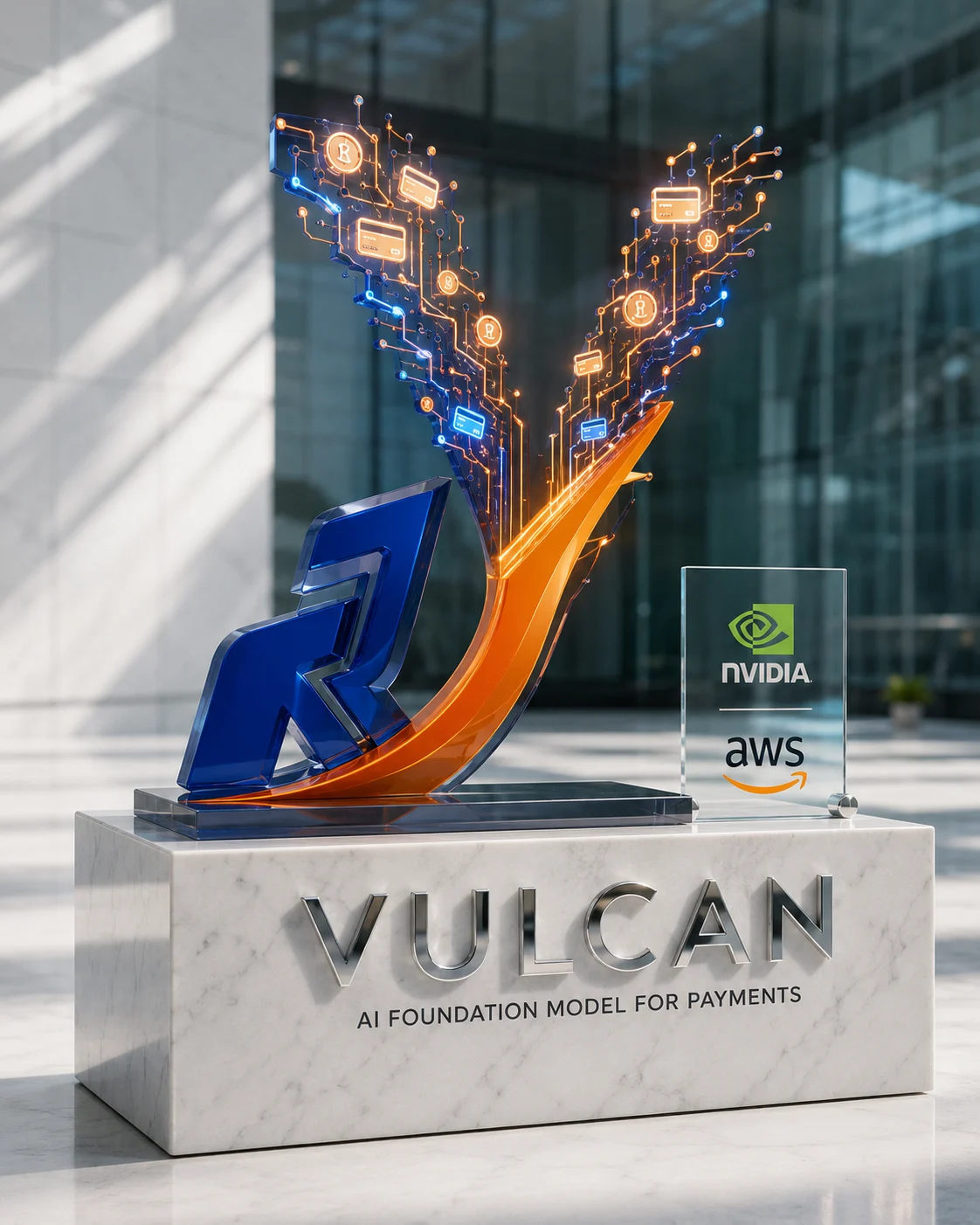
On Tuesday, the Bengaluru-headquartered company officially announced the launch of Vulcan, which it is calling India's first transformer-based AI foundation model built specifically for the payments industry. The company said the model was developed with deep technical involvement from two of the biggest names in global computing infrastructure — NVIDIA, which provided the accelerated computing power needed to train a model at this scale, and Amazon Web Services (AWS), whose cloud infrastructure and Amazon SageMaker platform were used to build and deploy it.
The headline number that has caught most people's attention is the scale of the training data. Razorpay says Vulcan was trained on nearly 3 trillion data points, drawn from more than 4 billion payment transactions processed on its platform, with the model learning from roughly 3,000 distinct signals attached to every single one of those transactions. To put that in perspective, that is not 3 trillion transactions — it is 3 trillion individual pieces of information extracted from 4 billion transactions, which gives a sense of just how granular the model's view of the Indian payments ecosystem actually is.
This article breaks down what Vulcan is, why Razorpay built it, how it is supposed to work, what problem it is trying to solve, what the company and its partners are saying about it, how it compares to similar efforts elsewhere in the world, and what it might mean for the shape of India's digital payments over the next few years.
WHAT EXACTLY IS VULCAN
Let's start with the basics, because "AI foundation model for payments" is a phrase that sounds impressive but doesn't immediately tell you much.
A foundation model, in the language of modern AI, is a large machine learning system trained on a massive and broad dataset so that it develops a general understanding of a domain, which can then be adapted or fine-tuned for many specific tasks. The most familiar examples are large language models like GPT or Claude, which are trained on huge amounts of text so they can understand and generate language across a huge range of topics.
Vulcan applies that same underlying idea — a transformer-based architecture, which is the same category of neural network design that powers modern language models — but instead of training it on text scraped from the internet, Razorpay has trained it on the movement of money. Every transaction that flows through Razorpay's systems carries with it a huge amount of contextual information: which payment method was used, which bank or card network was involved, what time of day it happened, whether it succeeded or failed, how long it took, what device the customer was using, whether there were retries, whether fraud signals were present, and hundreds of other data points. Multiply that by four billion transactions and you get the 3 trillion data points Razorpay is talking about.
Razorpay has been explicit that Vulcan should not be thought of as a chatbot or a large language model in the ChatGPT sense. It doesn't read or write sentences. Instead, according to the company, it is a system built to understand patterns in how money moves through the payments ecosystem — essentially learning the underlying "grammar" of transactions the way a language model learns the grammar of words.
Importantly, Razorpay has described Vulcan as a proprietary, ground-up model. That means the architecture of the model and the training data used to build it both belong to Razorpay itself, rather than being licensed or adapted from an existing third-party AI system. The company built this from scratch, specifically for its own payments data and its own use case, rather than fine-tuning an off-the-shelf model.
WHY RAZORPAY DECIDED IT NEEDED THIS
To understand why a payments company would go through the trouble of building its own foundation model instead of simply using smaller, specialised machine learning tools, it helps to look at how big and messy the Indian digital payments landscape actually is.
India does not have one dominant way of paying online. It has many, all operating simultaneously, all with their own quirks, failure patterns and risk profiles:
— UPI (Unified Payments Interface), the real-time bank-to-bank transfer system that has become the backbone of retail digital payments in the country
— Credit and debit cards, run through multiple card networks and issuing banks
— Net banking, where a customer is redirected to their bank's own website to authorise a payment
— Digital wallets
— Cash on delivery, still relevant for a large share of e-commerce, especially outside major cities
Each of these payment rails is, in turn, connected to hundreds of different banks and payment gateways. A transaction might have to pass through several of these systems before it succeeds, and at any point in that journey, something can go wrong — a bank server responding slowly, a gateway timing out, a card network flagging a transaction as suspicious, or simply too many people trying to pay at once during a flash sale.
Razorpay says it commissioned an internal study covering 1.5 million shoppers and more than 51,000 businesses to understand how this friction actually plays out for ordinary users. The findings, according to the company, showed that payment friction — failed transactions, delays, and customers abandoning purchases midway — was a consistent problem, and notably, it showed up just as often in India's biggest cities as it did in smaller towns. This matters because it undercuts the assumption that payment failures are mostly a "tier 2 and tier 3 India" infrastructure problem; Razorpay's data suggests the issue is baked into the complexity of the system itself, regardless of geography.
Historically, the way payment companies have tried to fix these problems is by building separate, specialised machine learning models for each individual piece of the puzzle — one model to detect fraud, another model to decide which payment route to try first, another to personalise the checkout page, another to assess merchant risk. Each of these models is trained narrowly, solves one job, and doesn't necessarily talk to the others.
Razorpay's pitch with Vulcan is that this fragmented approach has hit its limits. Instead of many disconnected models each looking at a narrow slice of the data, Vulcan is designed to be a single, unified intelligence layer that ingests signals from across the entire payments stack at once — fraud, routing, checkout behaviour, risk — and continuously learns from every new transaction that passes through it. The company frames this as replacing a patchwork of fragmented tools with one continuously learning system that gets smarter with every transaction it processes, rather than staying frozen after being trained once.
HOW VULCAN IS SUPPOSED TO WORK, IN PLAIN TERMS
Here is a simplified walk-through of what Razorpay says happens, in principle, when a customer tries to pay for something on a website or app that uses Razorpay's payment infrastructure.
STEP 1 — The payment attempt begins
A customer clicks "pay" on a checkout page. At this exact moment, before anything is actually charged, there is already a decision to be made: which route should this payment take? Should it go through Bank A's UPI handle, or would Bank B's net banking gateway be faster and more reliable right now, at this time of day, for this particular card or bank combination?
STEP 2 — Vulcan scores the available routes
According to Razorpay, the model looks at real-time and historical signals — how different routes have been performing for similar transactions recently, whether a particular bank's servers have been slow today, whether this type of card tends to succeed more often through one gateway versus another — and assigns a kind of success probability to each possible route.
STEP 3 — The best route is selected automatically
Rather than sending the transaction down a fixed, pre-decided path, the system picks the route it calculates is most likely to succeed, before the transaction is even attempted. Razorpay says this is meant to reduce the number of "false failures" — payments that fail not because the customer did anything wrong, but because of an avoidable routing choice.
STEP 4 — Fraud and risk checks happen in parallel
At the same time, the model is scanning for fraud signals. Because it has visibility across many merchants at once, rather than just one merchant's own transaction history, Razorpay says Vulcan can potentially spot a pattern of fraudulent behaviour that has started showing up across multiple businesses, even before it becomes obvious to any single merchant looking only at their own data.
STEP 5 — The checkout experience adjusts
Vulcan is also designed to influence what the customer actually sees on the checkout screen — for example, by prioritising the UPI app that a specific customer is most likely to already have and use, rather than showing a generic, one-size-fits-all list of payment options.
STEP 6 — The system learns and updates
Every completed transaction — successful or failed — becomes new training signal for the model. Instead of retraining a static model every few months, the idea is that Vulcan is meant to continuously absorb new patterns as they emerge across the ecosystem.
A SIMPLE VISUAL: THE OLD WAY VERSUS THE NEW WAY
Since this is hard to picture in words alone, here is a simple side-by-side comparison written out as plain text, showing how Razorpay is positioning the shift from the old fragmented model approach to Vulcan's unified approach.
OLD APPROACH (Fragmented Models)
[Fraud Model] -> looks only at fraud signals
[Routing Model] -> looks only at which bank/gateway to use
[Risk Model] -> looks only at merchant risk
[Checkout Model] -> looks only at UI personalisation
Each model trained separately. Each one blind to what
the others are seeing. Improvements in one area do not
automatically improve the others.
NEW APPROACH (Vulcan, Unified Foundation Model)
[ VULCAN ]
|
| | | |
Fraud Routing Risk Checkout
One model, trained on the entire flow of data at once.
Every transaction across every merchant feeds the same
learning system. Improvements in fraud detection can, in
theory, sharpen routing decisions too, and vice versa,
because it's all one connected brain instead of four
separate ones.
THE EARLY NUMBERS RAZORPAY IS SHARING
Razorpay says components of Vulcan have already been running quietly on live transactions before the official announcement, and the company has shared some early performance figures from that rollout. Based on Razorpay's own disclosures, some of the headline results include:
— A meaningful increase in the number of shoppers seeing their preferred UPI app displayed first at checkout — the company says roughly 40 percent more shoppers now see the app they actually use most, which it estimates is helping complete an additional 1 to 2 lakh (100,000 to 200,000) purchases every month that might otherwise have been abandoned
— Improvements in overall payment success rates, which the company attributes to smarter real-time routing decisions
— Faster detection of fraud patterns that emerge across multiple merchants simultaneously, rather than fraud only being caught after it has already affected a single business
Here is a simple plain-text bar chart illustrating the scale Razorpay is describing, purely as an illustrative visual based on the figures the company has shared, not an exact statistical chart:
TRAINING SCALE OF VULCAN (illustrative, not to exact scale)
Transactions used in training | ############################ 4 Billion+
Data points extracted | ############################################################ ~3 Trillion
Signals learned per transaction | ### ~3,000
Shoppers in friction study | # 1.5 Million
Businesses in friction study | # 51,000+
These are large, company-reported figures rather than independently audited numbers, and it's worth reading them the way you'd read any company's own performance claims about its new product — as an indication of ambition and direction, not as a fully independently verified academic result.
WHY NVIDIA AND AWS ARE PART OF THE STORY
Building and training a model at the scale Razorpay is describing is not something that can be done on ordinary office computers or even a modest cloud setup. Training a transformer-based model on trillions of data points requires enormous amounts of specialised computing power, and this is where NVIDIA and AWS come in.
NVIDIA is the world's leading maker of the specialised chips — graphics processing units, or GPUs — that are used to train large AI models. These chips are designed to perform the huge number of parallel mathematical calculations needed to train neural networks far faster than traditional computer processors can. Razorpay has said Vulcan was built using NVIDIA's accelerated computing infrastructure, which would have provided the raw horsepower needed to process a dataset of this size in a workable timeframe.
AWS, meanwhile, provided the cloud infrastructure on which the model was actually built and deployed, specifically through Amazon SageMaker, which is AWS's platform for building, training and deploying machine learning models at scale. According to a statement from an AWS India executive, the company sees this partnership as part of a broader idea of consolidating billions of scattered transaction insights into one continuously learning intelligence layer, replacing fragmented machine learning tools with a unified AI system built for the demands of mission-critical payment infrastructure.
For NVIDIA and AWS, a partnership like this is also a showcase. Payments infrastructure is one of the most demanding, high-stakes environments in which to deploy AI — a fraud detection system that is too slow, or a routing decision that takes too long to compute, can cost real money in seconds. A successful, large-scale deployment in India's payments market, one of the largest and fastest-growing digital payment ecosystems in the world, is a meaningful proof point for both companies as they compete for enterprise AI infrastructure business globally.
THE MAN BEHIND THE LAUNCH
Razorpay's co-founder and CEO, Harshil Mathur, framed the launch not simply as a new feature release but as the start of a different way of thinking about how the company's payments infrastructure improves over time. His broader point, in essence, was that every single payment processed through the new system contributes something back into it, so that the next payment has a slightly better chance of going through smoothly — meaning the system's improvement is not something that requires teams to manually intervene every time, but is instead a natural byproduct of the sheer volume of transactions Razorpay already processes daily.
This "self-improving" framing is a common one in the AI industry more broadly — the idea that a well-designed learning system becomes more valuable simply by being used more, since usage itself generates the raw material for further learning. Whether that plays out cleanly in a domain as sensitive and highly regulated as payments — where mistakes can mean real financial loss, and where regulators like the Reserve Bank of India keep a close eye on how digital payment systems behave — is something that will likely be judged over the coming months and years, rather than at launch.
HOW THIS FITS INTO RAZORPAY'S BIGGER PICTURE
Razorpay is not a small startup experimenting with a side project. It is one of India's most prominent fintech unicorns, providing payment processing infrastructure to a huge number of businesses ranging from small D2C brands to some of the largest enterprises in the country. The company has also been widely reported to be preparing for a public listing, having taken steps to shift its domicile back to India as part of pre-IPO preparations, a move common among Indian startups that were previously incorporated abroad.
Against that backdrop, launching a proprietary AI foundation model serves multiple purposes at once. It is a genuine attempt to solve a real operational problem — payment failures cost merchants revenue and cost customers time and trust. But it is also a strong signal to investors, partners and competitors that Razorpay has both the data scale and the technical sophistication to build serious AI infrastructure in-house, at a moment when "AI capability" has become one of the key differentiators that public market investors scrutinise closely when evaluating technology companies.
Razorpay has also pointed to the scale of the opportunity in front of it. The company estimates that India's digital ecommerce market could grow to around 350 billion dollars by 2030, driven by increasing internet penetration, rising smartphone usage, and the continued expansion of UPI as a payment rail that has fundamentally changed how ordinary Indians transact. A bigger digital economy means more transactions, more payment failures in absolute terms if nothing improves, and a bigger market for a company that can convincingly claim to reduce that friction at scale.
HOW VULCAN COMPARES TO WHAT'S HAPPENING ELSEWHERE IN THE WORLD
Razorpay is positioning Vulcan as a first for the Indian market specifically — the first transformer-based, purpose-built foundation model designed for payments in the country. But it is not the first time a payments company anywhere in the world has attempted something like this.
Stripe, the US-based global payments giant, has previously built its own payments foundation model, trained on tens of billions of historical transactions, designed to help detect fraud patterns and improve payment performance for the businesses that use its platform. The scale of Stripe's training data — tens of billions of transactions — is smaller in raw transaction count than the four billion transactions Razorpay says it used, though it is worth noting that "transactions" and "data points" are being measured differently across these companies' public statements, so a direct apples-to-apples comparison is difficult without more detailed technical disclosures from both sides.
What this comparison does make clear is that Razorpay is playing catch-up with an idea that a major global player already validated, while also being the first to bring a similarly ambitious, purpose-built approach specifically tuned to the chaotic, multi-rail nature of the Indian payments ecosystem — a market that, because of UPI's dominance and the sheer diversity of payment methods in use, doesn't map cleanly onto the card-dominated payment systems that companies like Stripe were originally built around in Western markets.
In that sense, Vulcan is as much a bet on India's payments ecosystem being distinctive enough to require its own dedicated AI infrastructure, as it is a bet on AI itself being the right tool for the job.
WHAT THIS MEANS FOR MERCHANTS
For the businesses that actually use Razorpay's payment infrastructure to accept money from their customers — everything from small online sellers to large enterprises — the promise of Vulcan comes down to a fairly simple pitch: fewer failed payments, less fraud slipping through, and a checkout experience that feels more tailored to each individual customer.
In practical terms, if Razorpay's claims hold up over time, merchants could see:
— Higher conversion rates at checkout, since fewer customers abandon their purchase after a failed payment attempt
— Lower fraud-related losses, since the fraud detection system benefits from visibility across many merchants rather than being limited to just one business's own historical data
— Less need to maintain their own in-house fraud and risk tools, since more of that intelligence is being centralised into Razorpay's own infrastructure
— A checkout page that adapts to each customer's typical payment habits, rather than presenting a static, generic list of payment options to everyone
Razorpay has also said it plans to expand Vulcan's scope beyond its current functions, into areas like authentication and lending decisions, with the long-term goal of using a single AI layer to power an increasingly wide range of payment-related decisions across its platform. If that expansion happens as described, Vulcan could eventually influence not just whether a payment succeeds, but things like which customers are offered credit or buy-now-pay-later options at checkout, and how quickly those decisions are made.
WHAT THIS MEANS FOR ORDINARY CUSTOMERS
For the average person paying for something online in India, the most visible impact — if things work as intended — would likely be almost invisible: payments that simply go through more often on the first try, checkout screens that show the UPI app you personally use most instead of a generic list, and, ideally, less exposure to fraudulent merchants or scam transactions because fraud gets caught earlier.
There is also a less visible dimension worth flagging honestly: a system like this involves a company building an increasingly detailed, continuously updated statistical picture of how people pay for things, which payment methods they use, when they use them, and what their typical transaction patterns look like. Razorpay has stated that Vulcan's architecture and training data are proprietary to the company itself. What is not fully detailed in the public statements so far is the specifics of how customer-level data is anonymised, aggregated or protected as it feeds into this system, and that is the kind of detail that regulators and privacy-conscious users may reasonably want more clarity on as adoption grows.
A SIMPLE TIMELINE OF WHAT HAS HAPPENED SO FAR
For anyone trying to follow the sequence of events around this launch, here is a simple plain-text timeline based on what has been publicly disclosed:
BEFORE LAUNCH
Razorpay conducts internal study covering 1.5 million
shoppers and 51,000+ businesses to measure payment
friction across India
Individual components of Vulcan are quietly deployed
and tested on live transactions before public launch
LAUNCH DAY (Tuesday, August 2026)
Razorpay officially announces Vulcan
Company describes it as India's first transformer-based
AI foundation model built specifically for payments
Details shared: ~3 trillion data points, 4 billion+
transactions, ~3,000 signals per transaction
NVIDIA and AWS confirmed as technology partners
Early performance figures shared, including improved
UPI app visibility at checkout and higher payment
success rates
LOOKING AHEAD
Razorpay says it plans to expand Vulcan into new areas,
including authentication and lending decisions
Broader context: Razorpay preparing for a potential
public listing; India's digital ecommerce market
projected to reach $350 billion by 2030
THE BIGGER QUESTION: DOES "ONE MODEL FOR EVERYTHING" ACTUALLY WORK BETTER?
There is a genuine, open debate in the machine learning world about whether a single, unified model that handles many related tasks at once actually outperforms a collection of smaller, specialised models, each fine-tuned for one narrow job.
The argument in favour of a unified approach, which is essentially Razorpay's argument with Vulcan, is that related problems often share hidden patterns that a single model can pick up on across the whole dataset, patterns that a narrow, single-purpose model would never see because it's only looking at its own small slice of the picture. A fraud pattern and a routing failure pattern might, in theory, be connected in ways that only become visible when you're analysing the entire flow of data at once.
The argument on the other side is that specialised models, precisely because they are narrowly focused, can sometimes be tuned more precisely for their one job, and can be updated or fixed independently without the risk of one change accidentally breaking something else in a much larger, more complex system. A single giant model can become harder to debug when something goes wrong, because it's not always obvious which part of its enormous training data or which learned pattern caused a specific bad decision.
In practice, most large technology companies working on similar problems tend to land somewhere in between — a large shared foundation model that provides a general understanding of the domain, combined with smaller, more specialised components layered on top for specific tasks. It is plausible that Vulcan, in its actual technical implementation, works this way too, even if the public messaging frames it primarily as "one unified model" for simplicity.
WHAT INDUSTRY WATCHERS ARE LIKELY TO WATCH FOR NEXT
Given how new this launch is, most of what is publicly known right now comes directly from Razorpay's own announcement and the company's own performance claims. Over the coming months, a few things are likely to become clearer and will probably shape how seriously the industry takes this launch:
— Independent or third-party validation of the performance improvements Razorpay is claiming, rather than only the company's own reported figures
— How Vulcan performs during high-stress periods, such as major sale events or festival shopping seasons, when transaction volumes spike dramatically and payment systems are under the most pressure
— Whether other large Indian and global payment companies respond with similar foundation-model efforts of their own, given that Stripe has already shown this is a viable direction internationally
— Regulatory attention, given how central digital payments are to India's financial system and how closely bodies like the Reserve Bank of India monitor changes to systems that affect the reliability and security of payment infrastructure at national scale
— How transparent Razorpay is willing to be, over time, about data handling and privacy safeguards as Vulcan's role expands into more sensitive areas like lending decisions
A QUICK GLOSSARY FOR ANYONE NEW TO THE TERMS
Since some of the language around this story can get technical fast, here's a simple plain-text glossary of the key terms involved:
Foundation model — A large AI system trained on a broad, massive dataset so it develops a general understanding of a domain, which can then be applied to many different specific tasks.
Transformer-based — A type of neural network architecture, originally developed for understanding language, that is very good at recognising patterns across huge amounts of sequential or contextual data. It's the same underlying design used in most modern large language models.
Payment routing — The process of deciding which specific path a transaction should take (which bank, gateway, or network) to get from the customer to the merchant successfully.
UPI (Unified Payments Interface) — India's real-time, bank-to-bank digital payment system, which has become the most widely used method for everyday digital transactions in the country.
Checkout friction — Any point during the online payment process where a customer experiences delay, confusion or failure, often leading them to abandon the purchase entirely.
Fraud signal — A specific piece of data, or a combination of data points, that suggests a transaction might be fraudulent, such as unusual transaction patterns, mismatched location data, or behaviour that resembles known scam techniques.
WHY THIS STORY MATTERS BEYOND JUST ONE COMPANY
It would be easy to read this as simply "a fintech company launched a new product," but the significance goes a little further than that. India's digital payments ecosystem, anchored heavily around UPI, has become one of the most closely watched examples globally of a country building fast, low-cost, real-time digital payment infrastructure at massive scale. Billions of transactions now flow through this ecosystem every month, and the reliability of that infrastructure has become something close to essential public utility, not just private business convenience.
When a company that sits deep inside that infrastructure says it has built a large-scale AI system specifically designed to make that infrastructure more reliable, it's a signal of where a meaningful part of the payments industry believes the next competitive edge will come from — not from adding new payment methods or expanding into new markets, but from squeezing more reliability, security and personalisation out of the payment rails that already exist, using AI trained on the sheer volume of transaction data these companies now sit on.
It also reflects something happening more broadly across many industries right now: companies that have spent years quietly accumulating enormous amounts of operational data are increasingly deciding that the smartest way to extract value from that data is to build their own purpose-built AI models, rather than simply buying generic AI tools off the shelf. Vulcan is very much a product of that mindset — an attempt to turn years of accumulated transaction history into a proprietary, continuously improving intelligence asset that becomes harder for competitors to replicate the longer it keeps learning.
CLOSING THOUGHTS
Razorpay's launch of Vulcan represents a genuinely ambitious technical undertaking — training a purpose-built transformer model on trillions of data points drawn from billions of real transactions is not a trivial engineering feat, and the involvement of NVIDIA and AWS underscores just how much specialised infrastructure was required to make it happen. If the early performance numbers the company has shared hold up under continued use, particularly the claims around improved UPI checkout visibility and higher payment success rates, it could meaningfully reduce a genuinely widespread source of frustration for millions of people who pay for things online in India every single day.
At the same time, this is very much a company describing its own new product in its own words, at the moment of launch, which is always the point at which claims sound their most polished. The real test for Vulcan will not be in today's announcement, but in how it performs over the next several festival shopping seasons, how transparently Razorpay communicates about it as it expands into more sensitive areas like lending, and whether the rest of the payments industry in India — banks, competing fintech companies, and card networks — end up following Razorpay down a similar path.
For now, what is clear is this: one of India's largest payment companies has bet that the future of reliable digital payments in the country lies not in more human-designed rules and narrow, single-purpose tools, but in a single, continuously learning AI system trained directly on the messy, chaotic, trillion-data-point reality of how Indians actually pay for things every day.