StartupNews · Breaking News
NAVI OPENS ITS CAP TABLE: SACHIN BANSAL LETS AN OUTSIDE INVESTOR IN FOR THE FIRST TIME IN EIGHT YEARS, RIGHT BEFORE TAKING HIS FINTECH PUBLIC
Prosus Writes a $100 Million Cheque at a $1.3 Billion Valuation — Well Below the $2 Billion Bansal Sought Just Two Years Ago — as Navi Races Toward an IPO After Walking Away From One in 2022
By StartupNews · Published · Updated
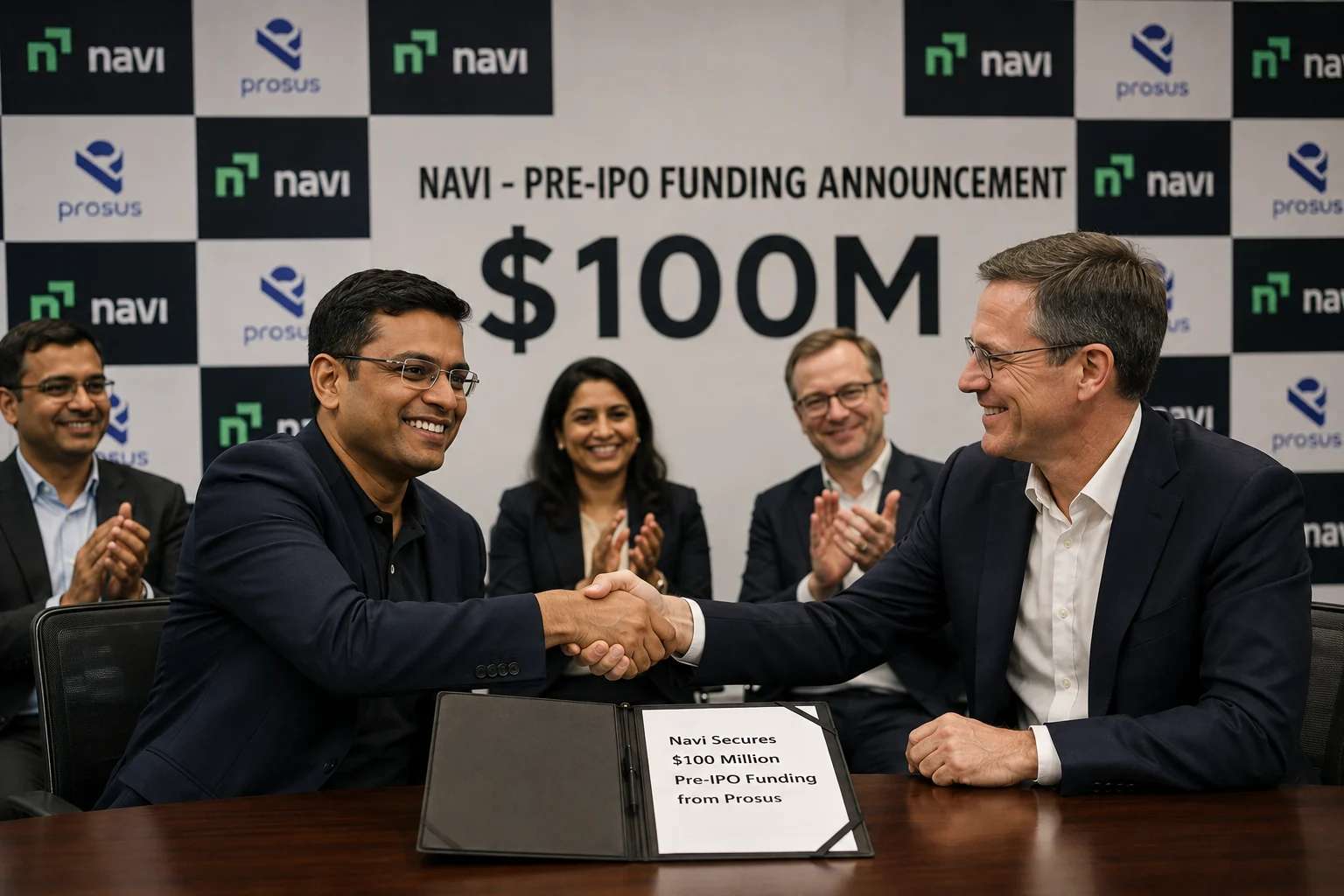
For eight years, Navi Technologies has been run almost entirely on one man's money. Sachin Bansal, the Flipkart co-founder who walked away from India's e-commerce giant after its $16 billion sale to Walmart, poured hundreds of millions of dollars of his own personal fortune into building Navi from the ground up — a digital financial services company spanning lending, insurance, mutual funds and UPI payments — without ever bringing in a single outside institutional investor. That changed this week. On August 19, 2026, Navi announced it has raised $100 million from Prosus, the Dutch technology investment giant, marking the company's first-ever external institutional funding round, and arriving at a moment when Navi is actively preparing to file for a public listing on Indian stock exchanges.
The deal is notable for what it represents as much as for its size. A founder who has spent nearly a decade deliberately avoiding outside capital — funding an eight-year-old, now multi-billion-dollar business almost entirely out of his own pocket — has finally opened the door to an institutional partner, and done so at a valuation that tells its own quietly humbling story: Prosus's $100 million values Navi at approximately $1.3 billion, comfortably below the roughly $2 billion valuation Bansal was reportedly seeking when he first went looking for outside capital back in 2024.
QUICK-LOOK SNAPSHOT
Company : Navi Technologies (Navi Group) Founder : Sachin Bansal, co-founder of Flipkart Headquarters : Bengaluru, India Founded : 2018 Investor : Prosus NV (Dutch technology investor) Investment Vehicle : MIH Payments Holdings BV, an indirect wholly owned subsidiary of Prosus Amount Raised : $100 million (~₹1,000 crore) Round Type : Navi's first-ever external institutional funding round Reported Valuation : ~$1.3 billion (~₹13,500 crore) Prior Valuation Sought (2024 attempt) : ~$2 billion Announced : August 18-19, 2026 (Tuesday/Wednesday) Regulatory Status : Cleared by the Competition Commission of India (CCI); subject to other customary closing conditions Planned IPO Size : ~₹30 billion (~$300-314 million) Planned IPO Filing : Draft papers targeted by December 2026 Bansal's Personal Investment in Navi to Date : ~$400 million (reported) Navi's UPI Market Rank (FY26) : 4th largest UPI app in India Navi Finserv AUM : Over $1.4 billion (lending arm)
WHAT NAVI ACTUALLY DOES
Navi describes itself as a digital-first financial services company, and its product suite spans a genuinely broad cross-section of consumer finance rather than concentrating on any single narrow niche. The company's core lending business, operated through its subsidiary Navi Finserv, provides personal loans and home loans directly to consumers and, according to the company's own disclosures, manages more than $1.4 billion in assets under management as of its most recent reporting. Beyond lending, Navi offers health and motor insurance through Navi Insurance, mutual fund investment products through Navi Mutual Fund, and — since August 2023 — Unified Payments Interface (UPI) transactions through the Navi app itself, a relatively late but notably successful entry into India's dominant digital payments rail.
That UPI push, in particular, has become one of Navi's most closely watched growth stories. Having launched UPI payments only in August 2023, Navi climbed the UPI leaderboard with striking speed: from processing less than 0.01% of the ecosystem's total transactions in December 2023, the company crossed the 1% market share threshold by December 2024 — becoming, at that point, the first firm outside UPI's traditional top three (PhonePe, Google Pay and Paytm) to reach that level in many months. The climb continued from there: Navi overtook Amazon Pay to become UPI's sixth-largest player by volume in September 2024, then climbed further to fifth place the following month, and by October 2024 had overtaken CRED to claim the fourth spot in the UPI ecosystem — a position the company has held onto through much of FY26, per NPCI (National Payments Corporation of India) data, even as it continues trailing the three dominant incumbents by a wide margin.
NAVI'S CLIMB UP INDIA'S UPI RANKINGS
Dec 2023 Sub-0.01% market share, just months after launch Aug 2024 Overtakes Amazon Pay — becomes 6th largest UPI app Sep 2024 Climbs to 5th largest UPI app Oct 2024 Overtakes CRED — becomes 4th largest UPI app May 2026 Holds 4th place with ~3.55% market share
UPI MARKET SHARE BY VALUE, MAY 2026 (approximate)
PhonePe ██████████████████████████████████████████████ 46.26% Google Pay ████████████████████████████████████░░░░░░░░░░ 32.75% Paytm █████████░░░░░░░░░░░░░░░░░░░░░░░░░░░░░░░░░░░░░░ 7.91% Navi ████░░░░░░░░░░░░░░░░░░░░░░░░░░░░░░░░░░░░░░░░░░░ 3.55% Others ██████░░░░░░░░░░░░░░░░░░░░░░░░░░░░░░░░░░░░░░░░░ 9.53%
That fourth-place position is a genuinely notable achievement in one of the most fiercely competitive, structurally lopsided markets in Indian fintech — one where PhonePe and Google Pay alone have, at various points, collectively controlled more than 80% of total transaction volume, leaving every other player in the ecosystem fighting over a relatively thin remaining slice. Navi's roughly 3.5% share, while modest set against the two dominant incumbents, represents real, hard-won traction achieved within a comparatively short window since launch.
THE DEAL ITSELF: WHAT'S KNOWN, AND WHAT ISN'T
According to reporting on the transaction, Prosus is investing through MIH Payments Holdings BV, an indirect wholly owned subsidiary structure the Dutch investor commonly uses for its financial services and payments-sector bets globally. The deal has already cleared one significant regulatory hurdle: India's Competition Commission (CCI) approved the transaction, having specifically examined potential competitive overlaps between Prosus and Navi across lending and other digital financial services, and concluding the deal was not expected to have an appreciable adverse effect on competition in the relevant markets.
Several details of the transaction remain undisclosed by the companies themselves, and are known only through reporting that cites people familiar with the matter rather than official company confirmation. Navi has not publicly confirmed the valuation, the size of the stake Prosus is acquiring, or precisely how the company intends to deploy the new capital. The Economic Times, whose reporting has been the primary source cited across most subsequent coverage, put the valuation at approximately $1.3 billion, or roughly ₹13,500 crore — a figure Reuters, in its own reporting on the deal, noted it was unable to independently confirm. What is consistently reported and less disputed is that this represents a minority stake acquisition, and that the transaction remains subject to customary closing conditions beyond the CCI approval already secured.
READING THE VALUATION: A NUMBER THAT TELLS ITS OWN STORY
The $1.3 billion figure attached to this round is, in one sense, simply the price at which Prosus and Navi agreed to transact. But set against Navi's own recent fundraising history, that number carries a more pointed narrative worth unpacking carefully.
NAVI'S VALUATION TRAJECTORY ACROSS ITS PUBLIC MARKET ATTEMPTS
2022 IPO attempt ████████████████░░░░░░░░░░░░░░ ~$440M IPO target (abandoned in 2023 as tech stocks slumped)
2024 fundraising talks ████████████████████████████░░ ~$2 billion sought (talks did not result in a completed deal)
2026 Prosus round ██████████████████░░░░░░░░░░░░ ~$1.3 billion (completed, Navi's first institutional round)
In April 2024, TechCrunch reported that Bansal was in talks with investors to raise Navi's first major outside funding at a valuation around $2 billion, seeking to bring in somewhere between $200 million and $400 million. Those talks, according to available reporting, did not result in a completed transaction at the time — leaving Navi to continue operating without institutional backing for another two years. That the company has now completed its first institutional round at roughly $1.3 billion — a full 35% below the valuation Bansal was reportedly targeting just two years earlier — suggests either that investor appetite for Navi's specific business model cooled somewhat over the intervening period, that Bansal ultimately prioritised closing a deal and securing a credible institutional backer ahead of the IPO over holding out for a higher headline number, or some combination of both dynamics playing out simultaneously.
It's also worth noting that this $1.3 billion figure, while the most widely and consistently reported valuation across multiple independent outlets, is not entirely uncontested: at least one source described the round as valuing Navi closer to $2 billion, a discrepancy that likely reflects the genuinely unconfirmed nature of a valuation neither company has officially disclosed, and one where different reporters' sources may have described the transaction's terms somewhat differently. Readers should treat the $1.3 billion figure as the best-corroborated estimate available, while recognising some uncertainty remains around the precise number until Navi's own IPO filings, expected later in 2026, make the details a matter of public record.
AN EIGHT-YEAR EXPERIMENT IN FOUNDER-FUNDED GROWTH
To appreciate why this deal marks such a significant departure for Navi specifically, it helps to understand just how unusual the company's financing history has been within India's broader startup ecosystem. Bansal founded Navi in 2018, shortly after exiting Flipkart, and rather than following the conventional path of raising successive rounds of venture capital to fund the company's growth — the path virtually every other Indian startup of comparable scale and ambition has followed — he chose instead to fund Navi's development almost entirely with his own capital, reportedly investing in the range of $400 million of his personal fortune into the business over the company's history.
That approach gave Bansal a degree of operational and strategic independence that few founders of comparably large private companies ever get to exercise: no board seats to negotiate away to venture investors, no quarterly growth targets imposed by outside capital providers, no pressure to prioritise the kind of rapid, top-line growth metrics that venture-backed startups often chase to satisfy their investor base ahead of an eventual funding round or exit. Industry commentary around this week's Prosus deal has specifically framed this dynamic in exactly those terms: that kind of patient, founder-only capital let Bansal build Navi without the pressure of investor expectations that typically shapes decision-making at venture-backed companies — but going public, by its nature, changes that calculus considerably, since a publicly listed company answers to a much broader, more demanding, and less patient universe of shareholders than a single, deeply committed founder ever needs to.
WHY BRINGING IN AN INSTITUTIONAL INVESTOR NOW MAKES STRATEGIC SENSE
Eight years of pure founder funding: Bringing in Prosus now, pre-IPO: Full strategic control A credible institutional No external growth pressure anchor investor's name attached No track record of dealing with to the company ahead of IPO institutional shareholders roadshow A tested relationship for navigating public-market investor expectations Reduced sole reliance on Bansal's own capital as Navi scales toward listing
Bansal's own public comments accompanying the deal frame the Prosus partnership in personal, relationship-driven terms rather than purely transactional ones. He described his association with Naspers and the Prosus Group — the two entities are closely linked, with Naspers as Prosus's South African parent — as dating back more than a decade, making the partnership particularly meaningful, and characterised the investment as a strong endorsement of Navi's business heading into its IPO process. That framing, combined with the specific timing of the deal — arriving just months ahead of Navi's planned draft IPO filing — suggests the round was conceived less as a pure capital-raising exercise (Navi, after all, had operated without any institutional funding for eight years already) and more as a deliberate step to bring a credible, experienced public-market-savvy institutional partner onto the cap table before the far more demanding scrutiny of an actual IPO roadshow begins.
WHO IS PROSUS, AND WHY ITS BACKING MATTERS
Prosus NV is one of the largest technology investors in the world, structured as the international investment arm of Naspers, the South African media and internet group. The firm's portfolio is genuinely vast, spanning a significant early and ongoing stake in Tencent (the Chinese technology giant behind WeChat and a vast gaming and internet services empire), along with substantial positions across e-commerce, food delivery, edtech, and — closely relevant to the Navi deal specifically — fintech and payments companies globally, including PayU, one of the more prominent global online payment processing platforms.
Within India specifically, Prosus has built a long track record of backing what industry commentary has characterised as a string of Indian consumer-internet success stories, giving the firm considerable, hard-won experience specifically in scaling technology and financial-services businesses across large, complex emerging markets — expertise that extends well beyond simply providing capital. For a company like Navi, heading toward the considerably more demanding scrutiny and reporting discipline that comes with operating as a publicly listed entity, that kind of experienced institutional partner brings something that pure capital alone cannot: a working playbook, informed by prior successful outcomes, for how a large consumer-facing technology and financial services business navigates the transition from founder-controlled private company to public-market participant.
THE FINANCIAL PICTURE: A MIXED, COMPLICATED RECENT TRACK RECORD
Navi's underlying financial performance in the period leading up to this funding round and its planned IPO presents a genuinely mixed picture — one that is worth examining honestly rather than glossing over, since it likely explains at least part of why Prosus's valuation landed below the level Bansal had previously sought.
Navi Finserv, the company's core lending subsidiary, reported standalone net profit of ₹292.21 crore for the financial year ended March 2026, up 31.6% from the prior year, with full-year revenue from operations growing 8.4% (per one set of disclosures) to approximately ₹2,461 crore — or, per a separate, slightly differently scoped disclosure, revenue from operations of ₹2,691.5 crore, up 17% year-on-year, alongside a considerably less flattering net profit figure of ₹93.32 crore, down 46% from the ₹172.27 crore reported the prior year.
NAVI FINSERV'S RECENT FINANCIAL PERFORMANCE: A STORY OF DIVERGING NUMBERS
Metric FY25 FY26 Change ───────────────────────────────────────────────────────────────────────── Standalone net profit ₹222 cr ₹292.21 cr +31.6% (per one disclosure)
Net profit (per separate ₹172.27 cr ₹93.32 cr -45.8% disclosure/reporting basis)
Q4 FY26 standalone net profit ₹30.33 cr ₹134.83 cr +344.5%
This is a genuinely confusing set of figures to reconcile, and it reflects a real ambiguity across public reporting on Navi's financials in the run-up to this deal, rather than any single, cleanly reportable profit trajectory. Different outlets appear to be citing different reporting bases — potentially standalone versus consolidated figures, or different fiscal-year comparisons — with at least one report from May 2026 describing Navi Finserv's FY26 profit as having "plunged 46% to ₹93 crore," even while the company's own quoted management commentary and a separate set of disclosures describe FY26 standalone net profit as having risen 31.64% to ₹292.21 crore, with a particularly strong Q4 FY26 showing a 344.5% year-on-year profit surge to ₹134.83 crore. What can be said with reasonable confidence, based on the consistency of the Q4 figures and management's own stated commentary, is that Navi Finserv's most recent quarterly performance showed strong, genuine improvement, driven by what the company's leadership has attributed to disciplined underwriting, improved collections efficiency, and continued investment in technology-led automation across its lending platform — even if the full-year, full-company picture remains harder to state with complete precision from public reporting alone.
It's also worth noting that Navi's FY25 was not without genuine operational turbulence: in April 2025, the Reserve Bank of India barred the company from sanctioning and disbursing new loans, citing excessive interest rate charges and non-compliance with RBI regulations — a serious regulatory action for any lending business, though one that was subsequently lifted in December 2025 after the company presumably addressed the regulator's concerns. That episode, coming relatively recently in the company's history, is the kind of regulatory event that prospective public-market investors — and, quite possibly, Prosus itself during its own due diligence process — would have weighed carefully in assessing both Navi's valuation and its readiness for the considerably heightened compliance scrutiny that comes with being a publicly listed financial services company in India.
NAVI'S FALSE START: THE 2022 IPO THAT NEVER HAPPENED
This is not, notably, Navi's first attempt at going public. The company filed draft papers for a $440 million IPO back in March 2022, a period when Bansal — then 40 years old and looking to repeat the bold public-market move that had defined much of his earlier career at Flipkart — was hoping to take the company public entirely through a fresh issue of new shares, with a possible pre-IPO placement also under consideration at the time.
That 2022 attempt arrived at a particularly difficult moment for technology listings globally and in India specifically: newly public Indian tech companies from the prior year's listing wave, including Zomato, Paytm, Nykaa and PolicyBazaar, were all trading near their lowest levels since debuting, as broader market sentiment toward loss-making, high-growth technology stocks soured considerably following a period of excessive investor enthusiasm the year before. Against that difficult backdrop, and with Navi's own financials at the time showing income of roughly $93.9 million against a loss of approximately $27.9 million for the nine months ending December 2021, the company ultimately abandoned its IPO plans the following year, choosing to wait for more favourable market conditions rather than push forward into a hostile listing environment.
WHAT'S DIFFERENT ABOUT NAVI'S SECOND IPO ATTEMPT
2022 attempt: 2026 attempt: Loss-making at time of filing Recent quarters show genuine profitability (albeit with some data inconsistency across reporting) Weak broader tech-IPO sentiment Stronger recent Indian following 2021 listing wave IPO market, including major successful fintech listings like Groww 100% founder-owned, no institutional Now backed by Prosus as validation a credible institutional anchor investor Abandoned amid market conditions Actively moving toward a planned December 2026 draft filing
Notably, per Navi's own 2022 IPO prospectus, Bansal held more than 97% of the company at that time — a striking figure that underscores just how genuinely unusual Navi's ownership concentration has been relative to comparable Indian startups, most of which typically dilute founder ownership considerably through multiple rounds of venture funding well before reaching a scale anywhere near Navi's.
THE COMPETITIVE LANDSCAPE: A CROWDED FIELD ACROSS EVERY BUSINESS LINE
Navi's multi-product strategy — spanning lending, UPI payments, insurance and mutual funds simultaneously — means the company faces a genuinely wide array of competitors, each specific to the particular product line in question, rather than a single, cleanly defined competitive set.
HOW NAVI'S COMPETITIVE LANDSCAPE BREAKS DOWN BY BUSINESS LINE
Business Line Key Competitors ───────────────────────────────────────────────────────────────────── UPI Payments PhonePe, Google Pay, Paytm, CRED, super.money, BHIM, Amazon Pay Digital Lending KreditBee, Moneyview, Fibe, PaySense, Bajaj Finserv, Kissht, mPokket Mutual Funds/ Groww, Zerodha Coin, ET Money, Kuvera, Investments Paytm Money Insurance Traditional and digital-first health and motor insurance providers across India's broader insurtech landscape
According to startup data platform Tracxn, Navi faces as many as 663 active competitors across its various business lines when counted comprehensively — a figure that underscores just how genuinely fragmented and intensely contested nearly every segment of India's digital financial services market has become. Within that crowded field, Navi's specific differentiation has generally rested on its multi-product breadth (relatively few competitors span lending, UPI, insurance and mutual funds simultaneously under one brand) and its technology-first, direct-to-consumer approach to underwriting and customer acquisition, an approach management has repeatedly emphasised in its public commentary around recent financial results.
That said, Navi's UPI business specifically operates within a market structure shaped by an important regulatory constraint worth understanding: the National Payments Corporation of India (NPCI), which oversees UPI, has instituted a 30% volume cap per app, specifically intended to prevent excessive market concentration in any single UPI provider. That cap has been a persistent point of industry discussion given that PhonePe and Google Pay have, at various points, collectively approached or exceeded levels that would put pressure on the intended market-diversification goals of the rule — a dynamic that, somewhat counterintuitively, may create more room for smaller, faster-growing challengers like Navi to continue gaining share over time, if regulators ultimately move to more strictly enforce the volume cap against the two dominant incumbents.
WHAT COMES NEXT: THE PATH TO AN ACTUAL LISTING
With the Prosus round now largely finalised (pending remaining customary closing conditions), Navi's next major milestone is its planned IPO, which the company is reportedly targeting to formally kick off with a draft prospectus filing by December 2026, aiming to raise approximately ₹30 billion — roughly $300 million to $314 million, depending on the specific source and prevailing exchange rate cited across various reports.
NAVI'S PATH TOWARD A PUBLIC LISTING
2022: Files for $440M IPO → abandoned in 2023 amid weak tech-IPO sentiment 2024: Seeks ~$2B valuation in first major outside fundraising attempt → talks do not result in a completed deal 2025: RBI lending restrictions imposed (April) → lifted (December) 2026: Prosus invests $100M at ~$1.3B valuation (August) → draft IPO papers targeted (December)
The funds raised from Prosus are reported to be intended, at least in part, to bolster Navi's corporate balance sheet and accelerate the company's pre-IPO operational compliance work — the often-unglamorous but genuinely essential work of tightening financial reporting systems, corporate governance structures, and regulatory compliance processes to the considerably higher standard public markets and their regulators demand, relative to what a purely founder-owned private company typically maintains. That framing reinforces the sense that this round's primary strategic purpose was less about the $100 million in fresh capital itself — a relatively modest sum for a company of Navi's scale — and more about the institutional credibility, public-market experience, and balance-sheet strengthening the Prosus relationship brings heading into what will be, on its second attempt, a considerably higher-stakes public listing process than the one Navi walked away from in 2023.
A GLOSSARY FOR READERS NEW TO THIS KIND OF STORY
For readers less familiar with the terminology that comes up repeatedly in coverage of pre-IPO funding rounds and Indian fintech, a few definitions are worth laying out plainly:
PRE-IPO ROUND — a funding round raised by a private company shortly before it plans to go public, often used to bring in credible institutional investors, strengthen the balance sheet, and prepare the company's financial and governance systems for the scrutiny of public markets.
UPI (UNIFIED PAYMENTS INTERFACE) — India's dominant real-time digital payment system, enabling instant bank-to-bank money transfers via mobile apps; the UPI ecosystem is overseen by NPCI and includes dozens of competing apps built by banks and private fintech companies alike.
NBFC (NON-BANKING FINANCIAL COMPANY) — a category of financial institution in India that provides banking-like services such as loans, but does not hold a full banking license; Navi Finserv operates as an NBFC.
MINORITY STAKE — an ownership position in a company representing less than 50% of total equity, meaning the investor does not gain outright control of the business, as distinct from a majority or controlling stake acquisition.
CCI (COMPETITION COMMISSION OF INDIA) — India's antitrust regulator, responsible for reviewing and approving mergers, acquisitions and significant investment transactions to ensure they do not harm market competition.
ASSETS UNDER MANAGEMENT (AUM) — the total value of loans, investments or other financial assets a company manages on behalf of, or extends credit to, its customers; commonly used as a scale metric for lending and investment businesses.
DRAFT PROSPECTUS / DRAFT RED HERRING PROSPECTUS (DRHP) — the initial regulatory filing a company submits when planning an IPO in India, disclosing detailed financial information, business risks, and the intended use of IPO proceeds, ahead of the company's shares actually being offered to the public.
FREQUENTLY ASKED QUESTIONS
WHAT EXACTLY DID NAVI ANNOUNCE? Navi announced it has raised $100 million from Prosus, the Dutch technology investor, marking the company's first-ever external institutional funding round in its eight-year history, ahead of a planned initial public offering.
WHY IS THIS DEAL SIGNIFICANT FOR NAVI SPECIFICALLY? Because founder Sachin Bansal had, until now, funded Navi's entire growth using his own personal capital — reportedly around $400 million — without bringing in any outside institutional investors, an unusual approach for a company of Navi's scale within India's startup ecosystem.
WHAT VALUATION DOES THE DEAL PLACE ON NAVI? Reports, citing people familiar with the matter, place the valuation at approximately $1.3 billion, though Navi has not officially confirmed this figure, and it represents a lower valuation than the roughly $2 billion Bansal reportedly sought in an earlier, uncompleted 2024 fundraising attempt.
HAS THIS DEAL BEEN FULLY COMPLETED? The transaction has cleared approval from India's Competition Commission but remains subject to other customary closing conditions, meaning it had not been fully finalised as of the announcement.
HOW DOES NAVI MAKE MONEY? Navi operates across several financial services lines: digital lending (personal and home loans through its Navi Finserv subsidiary), UPI payments, health and motor insurance, and mutual fund investment products.
HOW BIG IS NAVI'S UPI BUSINESS? Navi is India's fourth-largest UPI app by most recent data, holding roughly 3.5% market share by transaction value as of May 2026, behind PhonePe, Google Pay and Paytm.
WHEN DOES NAVI PLAN TO GO PUBLIC? The company is reportedly targeting a draft IPO filing by December 2026, aiming to raise approximately ₹30 billion (roughly $300-314 million) — its second attempt at a public listing, after abandoning a similar effort in 2023.
WHY DID NAVI'S FIRST IPO ATTEMPT FAIL? Navi filed for a $440 million IPO in March 2022 but abandoned those plans in 2023 amid a broader slump in technology stock valuations following a difficult period for previously listed Indian tech companies.
KEY FACTS AT A GLANCE
• Company: Navi Technologies, founded 2018 by Sachin Bansal, Bengaluru • Investor: Prosus NV, via subsidiary MIH Payments Holdings BV • Amount raised: $100 million — Navi's first institutional funding round • Reported valuation: ~$1.3 billion (unconfirmed by Navi) • Regulatory status: CCI-approved; other closing conditions pending • Prior fundraising attempt: Sought ~$2 billion valuation in 2024 talks • Bansal's personal investment in Navi to date: ~$400 million (reported) • Business lines: Lending (Navi Finserv), UPI payments, insurance, mutual funds • UPI ranking: 4th largest app in India, ~3.55% market share (May 2026) • Navi Finserv AUM: More than $1.4 billion • Planned IPO: ~₹30 billion (~$300-314M), draft filing targeted Dec 2026 • Prior IPO attempt: Filed for $440M IPO in 2022; abandoned in 2023
THE BOTTOM LINE
Navi's Prosus deal is a story about timing as much as it is about capital. For eight years, Sachin Bansal ran one of India's largest fintech companies as a genuinely solo financial project — an experiment in whether patient, founder-only capital could scale a multi-product financial services business to a multi-billion-dollar valuation without ever answering to an outside investor's board seat or growth targets. That experiment, by most measures, worked: Navi has become a top-four UPI player, built a lending business managing well over a billion dollars in assets, and reached a scale where a sophisticated global investor like Prosus was willing to write a $100 million cheque. But going public is a fundamentally different test than anything Bansal has faced with Navi so far, and this pre-IPO round reads, above all, as an acknowledgment of that reality: bringing in an experienced institutional partner now, on Prosus's terms rather than the higher valuation Bansal had once sought, in exchange for the credibility, discipline and public-market fluency that a solo founder — however successful — cannot easily manufacture on his own before the far less forgiving scrutiny of an actual IPO roadshow begins.
DISCLAIMER: This article is intended for general informational and news purposes only and does not constitute investment advice. Valuation figures, financial performance data and deal terms are drawn from public reporting current as of publication, much of which cites unnamed sources rather than official company confirmation, and may be subject to revision once Navi's own regulatory filings become public. Readers considering any investment decision related to the companies mentioned in this article should consult primary source disclosures and a licensed financial advisor.