StartupNews · Breaking News
Google Selects 20 AI-First Startups for the 2026 Class of Google Play Accelerator India
From healthcare and education to gaming and farming, the equity-free, three-month programme will pair founders with Google's mentors, technical audits, and AI stack, culminating in a Demo Day this November in front of investors and industry leaders.
By Startup news · Published · Updated
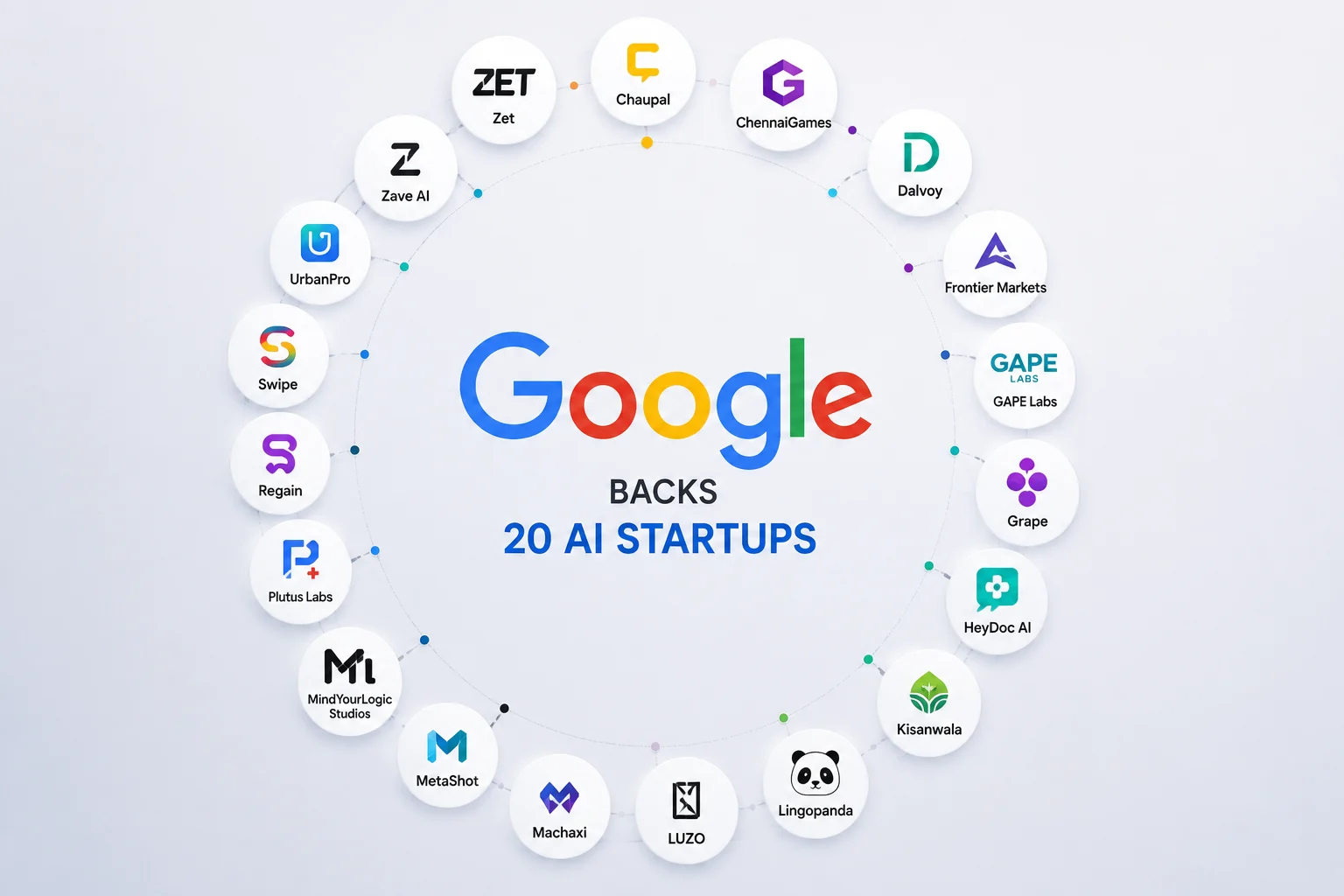
Google has announced the 2026 cohort of Google Play Accelerator India, selecting 20 AI-powered startups from across the country to join its equity-free, three-month mentorship programme. The selected companies span an unusually wide range of everyday sectors, education, healthcare, gaming, agriculture, finance, e-commerce, productivity, lifestyle, and entertainment, and were chosen specifically for how they are using artificial intelligence to solve practical, on-the-ground problems for Indian and international users alike.
The announcement, made in New Delhi, marks the third cohort of a programme that has quietly become one of the more closely watched startup support initiatives in India's app development ecosystem, precisely because it does not ask for anything in return. Unlike traditional accelerators or venture funds, Google Play Accelerator India takes no equity stake in any of the companies it works with. What founders get instead is direct, structured access to Google's own product, engineering, and go-to-market expertise, at a stage in a startup's life when that kind of guidance is often hardest to come by.
Who Made the Cut
The 2026 cohort includes Chaupal, ChennaiGames, Dalvoy, Frontier Markets, GAPE Labs, Grape, HeyDoc AI, Kisanwala, Lingopanda, LUZO, Machaxi, MetaShot, MindYourLogic Studios, MrMed, Plutus Labs, Regain, Swipe, UrbanPro, Zave AI, and Zet, twenty companies in total, each already operating a published app on the Google Play Store and using artificial intelligence in a core, functional capacity rather than as a superficial add-on feature.
Among the more clearly sector-tagged names in the group, healthcare platforms HeyDoc AI and MrMed are using AI to improve access to care and chronic disease management and medicine delivery respectively. Education-focused UrbanPro, a long-established tutoring marketplace, and Lingopanda, a language-learning platform, are applying AI to personalise how students prepare for exams and pick up new skills. On the gaming side, ChennaiGames and MetaShot are building new interactive entertainment experiences aimed at India's massive and rapidly growing mobile gaming audience. Agritech platform Kisanwala and rural commerce specialist Frontier Markets are using AI to help farmers access inputs, machinery, and markets more efficiently. And in fintech, Swipe and Zet are working on AI-driven tools aimed at helping small businesses manage payments and get paid faster.
Here is a simple visual breakdown of the sectors Google says this year's cohort spans:
Education • Healthcare • Gaming • Agriculture
Finance • E-commerce • Productivity
Lifestyle • Entertainment
That breadth is very much by design. Google has been explicit that this cohort is meant to reflect how deeply artificial intelligence has now embedded itself across India's everyday app economy, no longer confined to a narrow band of flashy consumer AI products, but showing up instead in the unglamorous, practical software that helps a farmer order the right seed variety, a small shop owner reconcile a day's payments, or a student in a smaller town access exam coaching that would once have required relocating to a bigger city.
What the Programme Actually Offers
Google Play Accelerator India runs as a three-month, equity-free programme structured in a hybrid format. It opens with an intensive, one-week in-person bootcamp, followed by roughly two months of virtual mentorship sessions and on-demand resources that founders can draw on as specific needs arise. The programme culminates in an in-person Demo Day scheduled for November 2026, where the twenty founders will pitch their companies directly to Google's own teams, along with investors, media, and other ecosystem partners, giving each startup a genuine visibility moment beyond the mentorship itself.
Each participating company is paired with a dedicated Google Startup Success Manager for the duration of the programme, alongside access to a broader network of Google experts and industry veterans who lead individual mentorship sessions. Startups also receive detailed technical audits covering app quality, Play Store optimisation, and security, along with customised reports assessing how their specific app is performing against Google's own benchmarks, the kind of granular, product-level feedback that is often prohibitively expensive or simply unavailable to early-stage founders operating without a large in-house engineering or growth team.
Here is a simple timeline of how the three months unfold:
Week 1 | In-person bootcamp
Weeks 2-12 | Virtual mentorship, technical audits, on-demand resources
November | In-person Demo Day, pitching to investors and media
The AI Integration Piece
A specific and increasingly central component of the programme is direct advisory support for integrating Google's own AI and cloud technology into each startup's product. That includes hands-on guidance around using Google Cloud infrastructure and Google's Gemini family of AI models within a company's existing app, help that can meaningfully shortcut the technical trial-and-error many smaller teams would otherwise face when trying to add genuinely useful AI capabilities to an existing product rather than simply bolting on a generic chatbot feature for the sake of having one.
This is not a purely theoretical benefit. Google has pointed to alumni from previous cohorts as evidence of what that kind of hands-on AI integration support can produce in practice. Toonsutra, a vernacular webcomics platform that went through an earlier cohort of the programme, integrated Google's Gemini, Lyria, and Veo models directly into its product to generate AI-powered visuals and speech for its comics, a concrete example of exactly the kind of practical, revenue-relevant AI integration the programme is designed to help founders execute.
What Google's Executives Said
Speaking about the announcement, Aditya Swamy, Managing Director of Google Play Partnerships, framed the cohort as evidence that the next wave of Indian app innovation is being built with artificial intelligence at its centre, describing the programme's intent to support founders across their full product journey, from improving app quality and integrating AI responsibly through to strengthening security, driving growth, and preparing companies for global expansion.
Paul Ravindranath, Regional Lead for Developer and Startup Programs at Google, echoed that framing, describing the accelerator as designed to give high-potential app and gaming startups practical support at a genuinely critical stage of their growth. He said Google's teams would work closely with the twenty founders over the coming three months on product quality, responsible AI integration, security, growth, and monetisation, specifically aimed at strengthening their apps for users both within India and in international markets.
A Programme Now in Its Third Year
This is the third cohort of Google Play Accelerator India since the programme was formally established, and the track record from its first two rounds gives some indication of what the twenty companies selected this year can expect. Previous cohorts collectively logged more than 300 hours of direct mentoring, and Google has reported that 95 percent of previous participants said the programme had a high impact on their app's overall quality and design, a notably strong satisfaction figure for a programme that asks nothing in return from the companies it supports.
The programme's eligibility criteria have remained consistent across its cohorts: it is open specifically to India-based startups at the Seed through Series A funding stage, meaning companies past the earliest idea stage but not yet at the scale of a well-established, heavily funded late-stage business, that already have a published, functioning app on the Google Play Store and are using artificial intelligence and machine learning in a core, meaningful capacity within their product, rather than as a superficial marketing add-on.
Real-World Problems, Not Just Novel Technology
What stands out about this specific cohort, based on how Google itself has described the selection, is the emphasis on practical, everyday utility over purely novel or experimental applications of AI. Company examples cited by Google span helping farmers access agricultural inputs and machinery more efficiently, supporting patients managing chronic health conditions, improving preparation for competitive government exams, building new kinds of interactive gaming experiences, and helping small businesses collect payments faster and more reliably.
That framing matters because it reflects a broader maturation within India's AI-powered app ecosystem more generally. Where earlier waves of India's AI-focused startups often centred on flashier, more attention-grabbing consumer-facing products, generative art tools, AI companionship apps, and novelty chatbots among them, the products represented in this specific cohort are, by design, oriented toward solving concrete, often unglamorous operational problems for people and businesses who may never think of themselves as using AI at all, even as they rely on it daily to run a farm more efficiently, manage a chronic illness, or get paid on time.
A Related, Separate Programme Worth Knowing About
It is worth flagging, for anyone following Google's broader startup support efforts in India, that Google Play Accelerator India is not the only major accelerator cohort the company has announced recently. A separate, broader initiative called the Google for Startups Accelerator: India 2026 Class was announced roughly a month earlier, marking the tenth anniversary of Google's global Accelerator programmes. That cohort, also comprising twenty AI-first startups, was selected from a highly competitive pool of roughly 2,500 applications and spans a different, more deep-technology-oriented set of sectors, including climate resilience, healthcare infrastructure, developer tooling, legal technology, and finance, with participating companies including Adalat AI, focused on automating court case workflows, Aikenist, a radiology optimisation platform, Aurassure, a hyperlocal climate-data company, and several others working on comparatively more technically advanced, infrastructure-level AI applications.
The two programmes, while related in spirit and both entirely equity-free, are structurally distinct and serve somewhat different segments of India's startup ecosystem. Google Play Accelerator India, the subject of this specific announcement, is focused squarely on consumer and small-business-facing apps and games already live on the Play Store, aimed at improving app quality, security, and monetisation for products already in front of real users. The broader Google for Startups Accelerator programme casts a wider net across deeper technology categories, some of which may not yet have a public consumer app at all, and places more emphasis on foundational technical mentorship and go-to-market strategy for companies still working toward scaled deployment.
Why Google Keeps Investing In This, Without Taking Equity
It is worth asking why a company as large as Google continues running equity-free accelerator programmes like this one, given that it receives no direct ownership stake or financial return from any of the participating startups. The strategic logic, widely understood across the technology industry, tends to rest on a few overlapping incentives. A thriving ecosystem of high-quality, AI-integrated apps built on the Android and Google Play platform directly benefits Google's own core advertising, cloud, and app store revenue streams over the long run, healthier, more successful third-party apps mean more Play Store transactions, more Google Cloud usage, and a stronger overall Android ecosystem relative to competing platforms.
There is also a reputational and relationship dimension to these programmes that matters over a longer time horizon than any single cohort. Founders who go through Google's accelerator programmes and build genuinely successful companies tend to remain closely tied to Google's broader technology stack, using its cloud infrastructure, its AI models, and its developer tools as their default choice as they scale, relationships that can prove considerably more valuable to Google over a company's full lifetime than any equity stake taken at an early, uncertain stage would have been.
What This Signals About India's App Economy
Beyond the specific fortunes of the twenty companies selected this year, the cohort itself serves as a useful, ongoing barometer of where India's broader app development ecosystem is heading. India has, for several years now, ranked among the largest markets globally by app downloads and by the sheer volume of active mobile app developers building for Android specifically, given the platform's dominant market share within the country. The steady increase in AI-native applications appearing within Google's own accelerator cohorts, across sectors as varied as agriculture, healthcare, gaming, and financial services, suggests that artificial intelligence has moved well past the experimental or add-on phase for a meaningful segment of India's startup builders, and is increasingly treated as foundational, core product infrastructure from day one rather than a feature bolted on after a company has already found initial traction.
That shift carries implications well beyond any single accelerator cohort. As more of India's next generation of consumer and small-business software gets built with AI woven directly into its core functionality, from personalised education content to AI-assisted farming decisions to automated small-business payment reconciliation, the country's app ecosystem is likely to increasingly differentiate itself not merely by the sheer number of apps being built, historically one of India's most cited strengths as a mobile-first market, but by how substantively artificial intelligence is being used to solve genuinely difficult, previously unaddressed problems for users who have often been underserved by earlier generations of software built primarily for wealthier, more urban, English-speaking market segments.
What Happens Next for the 2026 Cohort
Over the coming three months, the twenty selected startups will work through Google's structured programme, beginning with the in-person bootcamp and continuing through weekly virtual mentorship sessions, technical audits, and one-on-one guidance from Google's Startup Success Managers. Each company will be working toward the same eventual milestone: a polished pitch and product demonstration at the November 2026 Demo Day, where they will present their progress and growth plans directly to an audience of Google executives, external investors, media, and other ecosystem stakeholders, a moment that has historically served as a meaningful visibility and credibility boost for participating companies looking to raise their next round of funding or attract new enterprise partnerships shortly after completing the programme.
Whether this specific cohort produces the next widely recognised Indian AI success story in the way earlier Google accelerator alumni have gone on to build meaningful, scaled businesses remains to be seen, and will likely only become clear well after the programme itself concludes. What is already clear is that the pool of Indian founders building genuinely AI-native products, across sectors as varied and as unglamorous as farm input logistics and small-business payment collection, has grown large and sophisticated enough that Google now considers it worth running not one but two separate, substantial accelerator programmes simultaneously within the same country, a meaningful vote of confidence in where India's AI-powered software ecosystem is heading over the next several years.
Common Questions, Answered
Does Google take any equity or ownership stake in these startups?
No. Google Play Accelerator India is an entirely equity-free programme. Participating startups receive mentorship, technical support, and access to Google's technology at no cost and without giving up any ownership stake.
Who is eligible to apply for future cohorts?
The programme is open to India-based startups at the Seed through Series A funding stage that already have a published, functioning app on the Google Play Store and use artificial intelligence or machine learning in a core capacity within their product.
How long does the programme run?
Three months, structured as a one-week in-person bootcamp followed by roughly two months of virtual mentorship, technical audits, and on-demand resources, concluding with an in-person Demo Day.
What sectors are represented in the 2026 cohort?
Education, healthcare, gaming, agriculture, finance, e-commerce, productivity, lifestyle, and entertainment, spanning twenty startups including HeyDoc AI, MrMed, UrbanPro, Lingopanda, ChennaiGames, MetaShot, Kisanwala, Frontier Markets, Swipe, and Zet, among others.
Is this the same as the Google for Startups Accelerator programme?
No, though the two are related. Google for Startups Accelerator: India 2026 Class is a separate, broader programme covering deep-technology sectors like climate, legal tech, and developer infrastructure, selected from around 2,500 applications, distinct from the apps-and-games-focused Google Play Accelerator India cohort covered here.
When is the Demo Day for this cohort?
November 2026, where the twenty selected startups will pitch to Google teams, investors, media, and other ecosystem partners.
Quick Facts Recap
Google has selected 20 AI-powered startups for the 2026 cohort of Google Play Accelerator India
The three-month programme is entirely equity-free, requiring no ownership stake from participating companies
Sectors represented include education, healthcare, gaming, agriculture, finance, e-commerce, productivity, lifestyle, and entertainment
The programme includes a one-week in-person bootcamp, two months of virtual mentorship, and a November 2026 Demo Day
Each startup receives a dedicated Google Startup Success Manager, technical audits, and AI integration support using Google Cloud and Gemini models
This is the third cohort of the programme; previous cohorts logged over 300 hours of mentoring, with 95 percent of participants reporting high impact on app quality
Selected companies include HeyDoc AI and MrMed in healthcare, UrbanPro and Lingopanda in education, ChennaiGames and MetaShot in gaming, and Swipe and Zet in fintech
A separate, broader Google for Startups Accelerator: India 2026 Class, selected from roughly 2,500 applications, focuses on deep-tech sectors like climate and legal technology
For twenty founders across India, from a fintech app helping shopkeepers get paid faster to a healthtech platform supporting patients managing chronic conditions, the next three months will bring a level of hands-on product, technical, and go-to-market support that few early-stage companies ever get access to without giving up equity in exchange. Whether that support translates into breakout growth for any individual company in the cohort will take time to play out. What is already evident is how firmly artificial intelligence has become the organising theme of India's next generation of app-driven businesses, no longer a specialised niche, but increasingly the default foundation on which Indian founders across healthcare, education, agriculture, gaming, and finance are choosing to build.