StartupNews · Breaking News
GALAXEYE ACQUIRES STAROPS: INDIA'S PRIVATE SPACE RACE MOVES FROM LAUNCHING SATELLITES TO OWNING EVERY PART THAT BUILDS THEM
Bengaluru-Based Earth Observation Startup Absorbs a TeamIndus-Rooted Spacecraft Engineering Firm, Betting That Vertical Integration — Not Just a Working Satellite — Is What Will Let It Compete With Maxar, Planet Labs and ICEYE
By StartupNews · Published · Updated
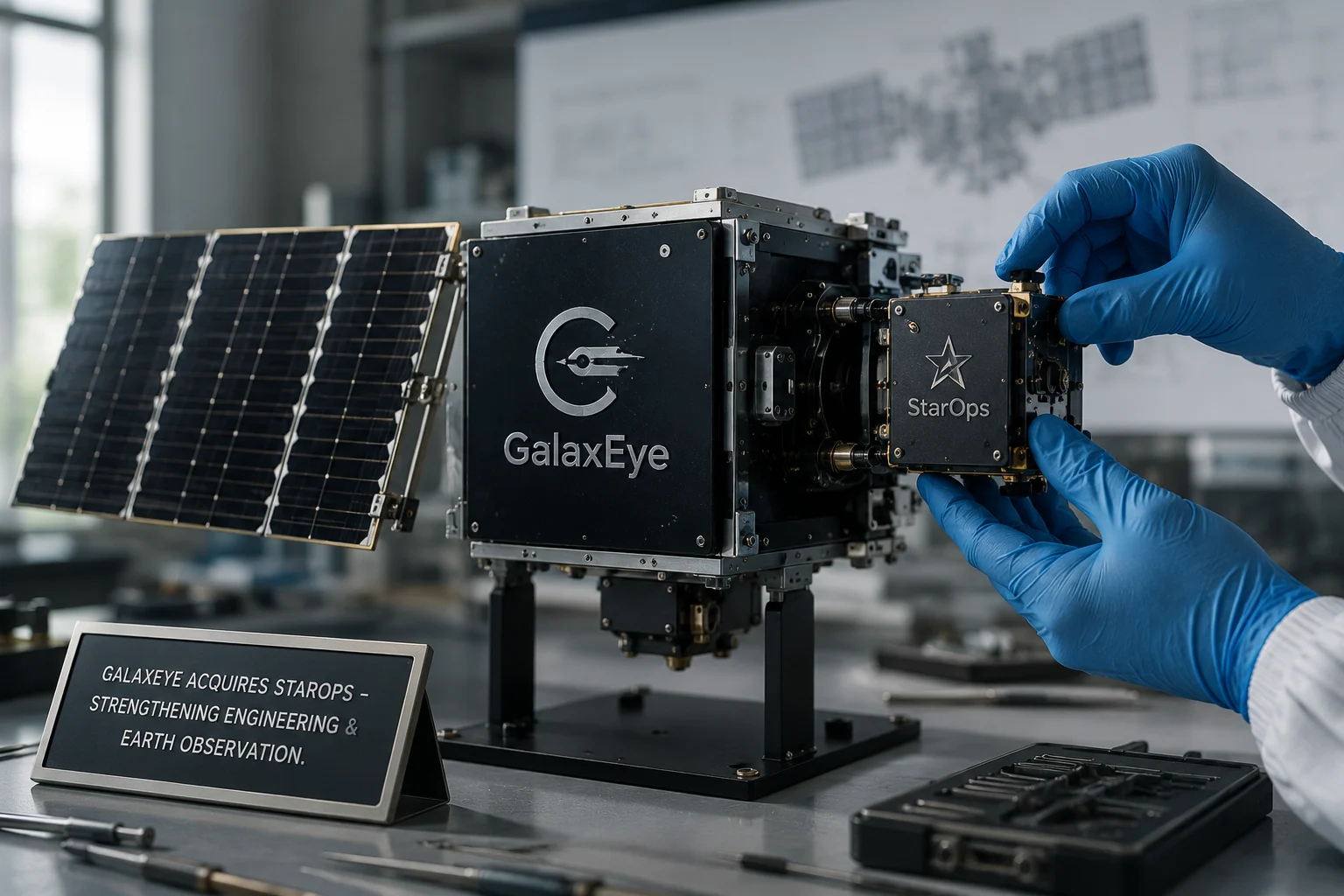
GalaxEye, the Bengaluru-headquartered space technology startup that made headlines in May 2026 by launching the world's first satellite to fuse optical and radar imaging on a single platform, has acquired StarOps, a fellow Bengaluru-based spacecraft engineering company. The deal, announced this month, brings StarOps' qualified satellite bus platforms, proprietary subsystem technologies and a deeply experienced spacecraft engineering team — several of whom cut their teeth on India's earliest private lunar mission — directly into GalaxEye's own operations.
On its surface, this is a relatively modest, financially undisclosed acquisition between two young Indian space startups, the kind of deal that might easily be overlooked amid louder headlines about satellite launches and billion-dollar funding rounds. But read in the context of where GalaxEye is trying to go — and where India's broader private space industry is racing to catch up to global Earth observation incumbents like Maxar Technologies, Planet Labs and ICEYE — the acquisition tells a more strategically significant story: a young company deciding, deliberately and early, that owning the entire spacecraft supply chain, rather than depending on external vendors for the hardware underneath its sensors, is the only way to compete at the pace this industry now demands.
QUICK-LOOK SNAPSHOT
Acquirer : GalaxEye Space Solutions Acquired Company : StarOps Acquirer Headquarters : Bengaluru, India Target Headquarters : Bengaluru, India Announcement Date : August 10, 2026 Deal Value : Not disclosed GalaxEye Founded : 2021, by IIT-Madras alumni StarOps Founded/Incorporated : 2022 StarOps Origins : Traces back to TeamIndus, an early Indian private lunar mission venture GalaxEye's Core Technology : OptoSAR — a proprietary fusion of optical (electro-optical) and Synthetic Aperture Radar (SAR) imaging on a single satellite platform GalaxEye's Flagship Mission : Mission Drishti — a planned 10-satellite Earth Observation constellation; first satellite launched May 3, 2026 GalaxEye Total Funding (pre-acquisition) : ~$18.8–20 million across Seed and Series A rounds StarOps' Satellite Bus Platforms Acquired : 50 kg, 150 kg and 250 kg weight classes StarOps' Indigenisation Level : More than 66% of satellite systems built using indigenous (India-developed) components
WHAT GALAXEYE ACTUALLY BUILDS
To understand why this acquisition matters, it helps to understand what has made GalaxEye one of the more closely watched names in India's private space sector over the past year. The company was founded in 2021 by a group of IIT-Madras alumni with a specific, technically ambitious thesis: that Earth observation satellites — the category of spacecraft that photograph and monitor the planet's surface for defence, agriculture, disaster response, infrastructure monitoring and intelligence purposes — had historically been forced to choose between two fundamentally different sensing technologies, each with a serious limitation.
Optical, or electro-optical, sensors — essentially very high-resolution cameras mounted on satellites — can capture sharp, detailed imagery, but only during daylight hours and only when cloud cover doesn't obscure the view, a serious constraint in a country like India, where monsoon season can render optical satellites functionally useless for imaging entire regions for weeks or months at a time. Synthetic Aperture Radar, or SAR, sensors solve that problem by using radar signals that can penetrate cloud cover and darkness, providing genuinely all-weather, day-and-night imaging capability — but SAR imagery is typically harder to interpret at a glance and captures different kinds of surface detail than optical cameras do.
GalaxEye's proprietary answer, which it calls OptoSAR, fuses both sensing technologies onto a single satellite platform, aiming to deliver continuous, all-weather, day-and-night Earth observation without the operational complexity and cost of maintaining two entirely separate satellite fleets — one optical, one radar — the way most established Earth observation providers currently do. The company demonstrated this technology was more than a slide-deck concept on May 3, 2026, when it successfully launched Mission Drishti, the first satellite in what it says will eventually become a ten-satellite constellation, aboard a SpaceX Falcon 9 rocket from California. At 190 kilograms, Mission Drishti became India's largest privately developed Earth observation satellite, and GalaxEye has described it as the world's first operational satellite to combine both sensing modes on a single platform — a claim that, if it holds, would represent a genuine technical first in the global Earth observation industry rather than an incremental improvement on existing approaches.
WHY THE ACQUISITION HAPPENED: FILLING A SPECIFIC, STRATEGIC GAP
Every satellite, regardless of what sensors it carries, needs a "bus" — the underlying spacecraft platform that houses propulsion systems, power generation and storage, onboard computing, communications equipment, and the structural framework that holds everything together and survives the extreme conditions of launch and orbit. The sensor payload — in GalaxEye's case, its OptoSAR imaging system — is, in a real sense, only as good as the spacecraft bus carrying it into orbit and keeping it operational for years afterward.
Until this acquisition, GalaxEye's own public statements and reporting on the company suggest it had been building its satellite platforms with a significant degree of dependence on external suppliers and partners for core spacecraft engineering — a common and often sensible approach for an early-stage space company focused primarily on proving out its differentiated sensor technology first. StarOps changes that equation directly. According to GalaxEye's own announcement, the acquisition brings in StarOps' already-qualified satellite bus platforms spanning three distinct weight classes — 50 kilograms, 150 kilograms, and 250 kilograms — along with proprietary subsystem technologies, established qualification heritage (meaning these platforms have already been tested and validated to the standards required for actual spaceflight, not merely designed on paper), dedicated testing infrastructure, and a broad suite of engineering tools.
WHAT STAROPS BRINGS: THE FULL SPACECRAFT ENGINEERING STACK
Spacecraft systems engineering ████████████████████████████ Propulsion ████████████████████████████ Avionics & flight computing ████████████████████████████ Guidance & navigation ████████████████████████████ Structures & mechanisms ████████████████████████████ Electrical systems ████████████████████████████ Mission & ground operations ████████████████████████████ Programme management ████████████████████████████
(Illustrative representation of the full breadth of engineering disciplines GalaxEye says StarOps brings into the combined company, spanning the entire spacecraft development lifecycle from design through in-orbit operations.)
GalaxEye co-founder and CEO Suyash Singh framed the acquisition explicitly in terms of this kind of full-stack capability, describing the deal as a step toward building a company capable of designing, engineering and operating advanced space systems entirely from within India, for customers around the world. The specific mention of "operating" alongside "designing" and "engineering" is notable — it signals that GalaxEye's ambitions extend beyond simply building satellites to also managing their entire operational lifecycle once in orbit, an end-to-end capability that only a small number of the most established global space companies currently offer at scale.
WHO IS STAROPS, AND WHY ITS TEAMINDUS LINEAGE MATTERS
StarOps itself carries a notable pedigree within India's private space industry, one that predates the company's own 2022 incorporation by several years. According to reporting on the deal, StarOps traces its origins to TeamIndus, one of India's earliest and most ambitious private space ventures, which gained international attention for its attempt to compete in the Google Lunar XPRIZE competition with a privately developed lunar lander and rover mission — an effort that, while it did not ultimately reach the moon before the prize competition's deadline lapsed, nonetheless built up a rare depth of genuine, hands-on spacecraft engineering experience within a small cohort of Indian engineers, at a time when almost no private-sector spacecraft development expertise existed anywhere in the country outside of India's national space agency, ISRO.
Several members of StarOps' engineering team, including co-founder and Missions Lead Nirmal Suraj Gadde, previously worked directly on TeamIndus' lunar lander and rover programme. In public comments accompanying the acquisition, Gadde described his own professional origin story in almost mythological terms for India's still-young private space industry: that his journey in space began at TeamIndus, where he learned to build missions from first principles — spanning both the technical work of developing the underlying technology and the commercial work of bidding for global space agency contracts — and that StarOps was built specifically to bring that hard-won experience to bear on developing indigenous satellite platforms and localising critical spacecraft technologies within India, reducing the country's historical dependence on imported components and foreign spacecraft engineering expertise.
That TeamIndus lineage matters for a reason beyond sentiment or narrative: it means the engineering team GalaxEye has just acquired did not learn spacecraft engineering purely through GalaxEye's own institutional experience or through formal aerospace industry apprenticeships at established companies, but through the genuinely difficult, largely unprecedented experience of building a private lunar mission from scratch in a country with almost no existing private-sector supply chain for spacecraft components at the time. That kind of first-principles engineering depth — solving problems with limited existing infrastructure to draw on — is precisely the sort of institutional knowledge that is difficult to hire for through conventional recruitment, and difficult to build quickly through organic internal growth alone, which is likely a meaningful part of why an acquisition, rather than simply hiring individual engineers away, was the mechanism GalaxEye chose to bring this expertise in-house.
THE INDIGENISATION ANGLE: WHY "MADE IN INDIA" SPACECRAFT COMPONENTS MATTER STRATEGICALLY
One of the more specific, quantifiable claims associated with this acquisition is StarOps' reported achievement of more than 66% indigenisation across its satellite systems — meaning roughly two-thirds of the components and subsystems that make up its satellite platforms are designed and manufactured within India, rather than sourced from foreign suppliers.
This detail carries real strategic weight beyond simple national pride. Spacecraft components sourced from foreign suppliers are subject to a range of practical vulnerabilities: export control regulations that can restrict or delay access to critical technology, particularly for satellites with any dual-use potential relevant to defence or intelligence applications; long international supply chains that can introduce significant delays into development timelines; currency exposure and cost volatility tied to foreign sourcing; and, in a worst-case scenario, outright supply disruption tied to geopolitical tensions between India and whichever country a given component originates from. A domestic supplier base with proven, qualified indigenous alternatives to these components directly reduces each of these risks, while also, GalaxEye and StarOps have both suggested, enabling faster development cycles and lower overall mission costs — since indigenous suppliers can typically be engaged, iterated with, and problem-solved alongside more quickly and cheaply than distant international vendors.
This indigenisation angle also aligns closely with a broader strategic priority within India's national space policy over the past several years: reducing the country's historical dependence on foreign space technology suppliers, both to strengthen defence and national security self-sufficiency and to position India's private space sector as a credible, independent global supplier of space technology and services in its own right, rather than merely a customer or assembler of foreign-designed components. GalaxEye's own statements around the acquisition explicitly connected the deal to this broader theme, noting that bringing spacecraft platforms and critical satellite subsystems together with its Earth observation payloads under one roof would support the development of integrated space systems specifically for defence, national security, and commercial applications.
VERTICAL INTEGRATION: THE STRATEGIC LOGIC BEHIND THE DEAL
The term industry analysts have used most consistently to describe the strategic significance of this acquisition is vertical integration — the practice of a company bringing more stages of designing, building and operating its product under its own direct control, rather than depending heavily on external suppliers and partners for critical components.
WHY VERTICAL INTEGRATION MATTERS FOR A YOUNG SPACE COMPANY
Without vertical integration: GalaxEye designs sensors → depends on external suppliers for spacecraft bus → coordinates across multiple vendor relationships → slower iteration, less control over cost and timeline
With vertical integration (post-acquisition): GalaxEye designs sensors AND spacecraft bus AND manages full mission lifecycle in-house → faster iteration → tighter cost control → full ownership of the technology stack
For a company at GalaxEye's stage — having successfully launched its first satellite only a few months before this acquisition, with a total lifetime funding history in the range of $18.8 million to $20 million, considerably more modest than the war chests available to established global Earth observation players — vertical integration is not merely a nice-to-have efficiency gain. It represents a deliberate strategic bet that owning more of the underlying technology stack, even at the cost of the operational complexity and capital required to absorb an entire additional engineering organisation, is a more durable long-term competitive position than remaining primarily a sensor-technology company that depends on a fragmented ecosystem of external suppliers for everything else a working satellite requires.
This logic becomes especially important when set against the scale of the competitors GalaxEye is ultimately trying to compete with. Global Earth observation incumbents like Maxar Technologies, which industry estimates place at around 21% global market share, and Airbus, at roughly 16%, along with fast-growing specialists like Planet Labs (a leader in high-frequency optical imaging) and ICEYE (a dedicated SAR specialist reportedly valued as high as $2.5 billion), have spent years, and in some cases decades, building out exactly the kind of deep, vertically integrated spacecraft engineering and manufacturing capability that GalaxEye is now attempting to build in a considerably more compressed timeframe, in part through targeted acquisitions like this one rather than purely organic growth.
GALAXEYE'S COMPETITIVE POSITION IN A CROWDED GLOBAL FIELD
GALAXEYE'S POSITION AMONG SELECTED GLOBAL EARTH OBSERVATION PLAYERS
Company Approx. Position Specialisation ────────────────────────────────────────────────────────────────────── Maxar Technologies ~21% global market share Broad optical & SAR EO services, separate fleets Airbus ~16% global market share Broad EO services, separate fleets Planet Labs High-frequency revisit Optical imaging specialist ICEYE Valued up to ~$2.5 billion Dedicated SAR specialist GalaxEye Ranked ~6th among 311 tracked Combined optical sector competitors (per one + SAR (OptoSAR) industry tracker); single on a single satellite launched to date platform
GalaxEye's core technical differentiation — combining optical and SAR sensing on a single satellite platform, rather than operating two separate fleets the way Maxar and Airbus do — is a genuine point of distinction in a crowded global market, and one that, if it scales successfully across a full ten-satellite constellation, could offer real advantages in data-fusion simplicity and potentially lower per-image processing costs for customers who currently need to source and reconcile optical and SAR imagery from entirely separate providers. But translating a single successful satellite launch into a fully operational, commercially competitive ten-satellite constellation over the coming years — while competing against considerably better-funded, more established rivals with existing long-term government and enterprise contracts already in place — remains a substantial execution challenge, one that industry analysts have flagged as the central open question hanging over GalaxEye's broader growth trajectory.
INDIA'S BROADER PRIVATE SPACE BOOM: THE CONTEXT BEHIND THE DEAL
GalaxEye's acquisition of StarOps arrives amid a broader surge of activity across India's private space technology sector, which industry estimates now place at roughly $8.4 billion in value, with projections suggesting it could grow to as much as $44 billion by 2033. More than 400 space startups are reportedly now active across India, collectively backed by more than $600 million in private investment over the past five years — figures that illustrate just how rapidly India's space sector has shifted from being almost entirely the domain of ISRO, the national space agency, toward a genuinely mixed ecosystem of private commercial ventures operating alongside, and increasingly in partnership with, government space infrastructure.
That government relationship has been particularly important to GalaxEye's own commercial strategy. The company has partnered with NewSpace India Limited (NSIL), the commercial arm of India's Department of Space, under an agreement that will see NSIL resell GalaxEye's entire Earth observation product portfolio to customers globally — a significant vote of confidence from India's space establishment that also gives GalaxEye access to a distribution channel and customer relationships it would likely take years to build independently as a young private company. GalaxEye's satellite constellation plans are also understood to form part of a broader ISRO initiative aiming to launch a total of 29 Earth observation satellites across various private and public missions, intended to provide advanced intelligence, surveillance and reconnaissance capabilities for both domestic Indian use and international customers.
WHAT COMES NEXT FOR THE COMBINED COMPANY
With StarOps' engineering team, qualified satellite platforms and testing infrastructure now integrated into its own operations, GalaxEye's most immediate practical priority is likely to be applying this newly internalised spacecraft engineering capability directly to accelerating development of the remaining satellites in its planned ten-satellite Mission Drishti constellation. The company has previously indicated it aims to build out this constellation over roughly the next two-and-a-half to five years, working toward an eventual goal of a two-day global revisit time — meaning any single point on Earth's surface could be imaged by the completed constellation at least once every 48 hours, a cadence that would put GalaxEye's Earth observation capability on a genuinely competitive footing against some of the more established global providers in terms of imaging frequency, if not yet in terms of overall constellation size or geographic coverage depth.
Beyond the immediate constellation build-out, the acquisition also appears aimed at positioning GalaxEye to pursue a broader set of commercial opportunities than Earth observation imagery alone. GalaxEye's own commentary around the deal specifically referenced building "advanced space systems" more broadly, and StarOps' spacecraft bus platforms — spanning the 50 kilogram, 150 kilogram and 250 kilogram weight classes — are, by their nature, generic satellite platforms that could, in principle, support a range of different mission types and customer payloads beyond GalaxEye's own OptoSAR sensors, potentially opening a path toward GalaxEye offering spacecraft platform and engineering services to other companies and organisations in India's growing private space sector, rather than remaining purely focused on operating its own proprietary satellite constellation.
A GLOSSARY FOR READERS NEW TO SPACE TECHNOLOGY
For readers less familiar with the technical vocabulary that comes up repeatedly in coverage of the space technology industry, a few terms are worth defining plainly:
SATELLITE BUS — the core structural and functional platform of a satellite that houses propulsion, power, communications, onboard computing and structural systems, distinct from the "payload" (such as a camera or sensor) that the bus carries and supports in orbit.
EARTH OBSERVATION (EO) — the broad category of satellite technology dedicated to imaging and monitoring the Earth's surface, used across defence, agriculture, disaster response, infrastructure monitoring, environmental tracking, and intelligence applications.
SYNTHETIC APERTURE RADAR (SAR) — a radar-based satellite imaging technology capable of penetrating cloud cover and operating in darkness, providing all-weather, day-and-night surface imaging, as distinct from optical cameras that require clear skies and daylight.
OPTICAL / ELECTRO-OPTICAL SENSOR — a high-resolution, camera-based satellite imaging technology that produces sharp, easily interpretable imagery but is limited to daylight hours and clear weather conditions.
VERTICAL INTEGRATION — a business strategy in which a company brings multiple stages of a product's design, development and operation under its own direct control, rather than relying on external suppliers or partners for those stages.
INDIGENISATION — the process of developing and manufacturing components domestically within a country, rather than relying on imports from foreign suppliers; a strategic priority across much of India's defence and space sector in recent years.
QUALIFICATION HERITAGE — a term referring to hardware or technology that has already been tested and validated to the rigorous standards required for actual spaceflight, as opposed to designs that exist only on paper or have not yet been proven in real-world conditions.
CONSTELLATION — a coordinated group of multiple satellites working together, typically to provide more frequent coverage of the Earth's surface (a shorter "revisit time") than any single satellite could achieve alone.
REVISIT TIME — the interval between successive opportunities for a satellite or satellite constellation to image the same point on Earth's surface; a shorter revisit time generally indicates a more capable, more frequently updated Earth observation system.
FREQUENTLY ASKED QUESTIONS
WHAT DID GALAXEYE ACTUALLY ACQUIRE? GalaxEye acquired StarOps, a Bengaluru-based spacecraft engineering company, gaining its qualified satellite bus platforms (in 50 kg, 150 kg and 250 kg weight classes), proprietary subsystem technologies, testing infrastructure, engineering tools, and its experienced spacecraft engineering team.
WHAT DOES STAROPS HAVE TO DO WITH TEAMINDUS? Several members of StarOps' engineering team, including co-founder Nirmal Suraj Gadde, previously worked at TeamIndus, an early Indian private space venture that developed a lunar lander and rover, giving the team deep, hands-on spacecraft engineering experience predating StarOps' own 2022 incorporation.
HOW MUCH DID GALAXEYE PAY FOR STAROPS? The financial terms of the acquisition were not disclosed by either company.
WHAT IS GALAXEYE'S CORE TECHNOLOGY? OptoSAR, a proprietary system that fuses optical (camera-based) and Synthetic Aperture Radar sensing onto a single satellite platform, aiming to provide continuous, all-weather, day-and-night Earth observation imagery without requiring two entirely separate satellite fleets.
HAS GALAXEYE LAUNCHED A SATELLITE YET? Yes. GalaxEye successfully launched Mission Drishti, its first OptoSAR satellite, aboard a SpaceX Falcon 9 rocket on May 3, 2026 — the first of a planned ten-satellite constellation and, at 190 kilograms, India's largest privately developed Earth observation satellite.
WHO ARE GALAXEYE'S MAIN GLOBAL COMPETITORS? Maxar Technologies and Airbus are the largest established players in global Earth observation, while Planet Labs (optical imaging) and ICEYE (SAR specialist) are among the fastest-growing specialised competitors GalaxEye is positioned against.
WHY DOES THIS ACQUISITION MATTER STRATEGICALLY? It moves GalaxEye toward full vertical integration — controlling spacecraft bus engineering as well as its own sensor payload technology — reducing dependence on external suppliers, strengthening India's domestic (indigenous) spacecraft component base, and positioning the company to build and operate its planned satellite constellation more quickly and with tighter cost control.
THE FOUNDING TEAM: WHO IS BUILDING GALAXEYE
GalaxEye's leadership team, drawn largely from IIT-Madras, has been a consistent presence in the company's public narrative since its 2021 founding, and understanding who they are helps contextualise the strategic thinking behind acquisitions like this one. Suyash Singh serves as co-founder and CEO, and has been the company's primary public spokesperson across its major milestones, from its earliest funding rounds through the Mission Drishti launch and now the StarOps acquisition. The broader founding team includes Denil Chawda as Chief Technology Officer, along with Kishan Thakkar as VP of Engineering, Pranit Mehta as VP of Sales Operations, and Rakshit Bhatt as VP of Product — a leadership structure that reflects a company organised, from its earliest days, around the dual challenge any hardware-and-sensor space startup faces: solving genuinely hard engineering problems while also building the commercial relationships and sales infrastructure needed to convert that engineering work into paying customers.
Notably, GalaxEye's advisory board has drawn in expertise spanning both India's defence and space research establishment and international technology and reinsurance sectors, reportedly including advisors connected to DRDO (India's Defence Research and Development Organisation), ISRO, autonomous vehicle company Waymo, and global reinsurance giant Swiss Re — a spread that signals the company's ambitions span not just Indian government and defence customers, but international commercial applications as well, including the kind of large-scale risk assessment and catastrophe modelling that reinsurance companies rely on satellite imagery to support.
HOW GALAXEYE VALIDATED ITS TECHNOLOGY BEFORE GOING TO ORBIT
One detail worth highlighting for readers trying to gauge how seriously to weigh GalaxEye's technical claims is the extensive testing regime the company undertook before ever attempting to put its sensor fusion technology into orbit. According to the company's own account, GalaxEye logged more than 500 aerial test flights, using a mix of drones, small Cessna aircraft, and high-altitude platforms, specifically to validate how its OptoSAR sensor fusion technology performed before committing to the far higher cost and risk of building an actual satellite around it. The company also flew a payload aboard an ISRO POEM mission — a platform that allows experimental payloads to be tested in orbit aboard the upper stage of an ISRO rocket after its primary mission is complete — giving GalaxEye genuine in-orbit validation data before Mission Drishti's own full satellite launch.
This kind of methodical, staged validation approach — extensive atmospheric testing, followed by a smaller in-orbit experimental payload, followed only then by a full satellite mission — is a meaningfully more conservative development path than some space startups pursue, and it may help explain why Mission Drishti's May 2026 launch succeeded on what appears to have been the company's first full orbital attempt, a genuinely difficult achievement in an industry where first-satellite failures remain relatively common even among well-funded, experienced teams.
THE FUNDING PICTURE: A CAPITAL-EFFICIENT PATH SO FAR, WITH BIGGER ROUNDS LIKELY AHEAD
GalaxEye's funding history to date reflects a company that has scaled its technical ambitions considerably faster than its capital base, at least relative to the scale of its eventual global competitors. The company raised an initial $3.5 million seed round in December 2022, led by Speciale Invest, a fund specifically focused on India's deep-technology sector. It has since raised additional capital from a notable roster of Indian strategic and institutional investors, including technology services giant Infosys, drone manufacturer ideaForge, Zerodha's venture arm Rainmatter, InfoEdge, and Speciale Invest again, among others — bringing total funding to roughly $18.8 million to $20 million prior to a further Series A extension of $4.8 million reported in March 2026 from investors including Mounttech Growth Fund, Anicut Capital, Navam Venture Fund and Faad Capital.
GALAXEYE'S FUNDING HISTORY
Seed Round (Dec 2022) ██████░░░░░░░░░░░░░░░░░░░░░░ $3.5 million Additional Rounds (2023-25) ████████████████░░░░░░░░░░░░ ~$14–16 million Series A Extension (Mar 2026) ████████░░░░░░░░░░░░░░░░░░░░ $4.8 million ───────────────────────────────────────────────────────────────────────── Total Funding to Date ~$18.8–20 million
Set against the scale of capital available to established global competitors — companies like Maxar and Airbus operate with balance sheets and government contract backlogs worth billions of dollars, while even newer specialised rivals like ICEYE have reportedly reached valuations as high as $2.5 billion on considerably larger funding totals — GalaxEye's roughly $20 million in lifetime funding represents a genuinely capital-efficient path to a working, launched satellite and, now, an acquisition that meaningfully expands its in-house engineering capability. That efficiency is likely to be tested significantly in the coming years, however, as the company works to fund the remaining nine satellites in its planned ten-satellite constellation — an undertaking that industry analysts have flagged will almost certainly require substantially larger funding rounds than anything GalaxEye has raised to date, given the capital intensity inherent to building, launching and operating a full satellite constellation at global scale.
READING BETWEEN THE LINES: WHAT THIS DEAL SIGNALS ABOUT INDIA'S SPACE STARTUP ECOSYSTEM
Beyond its direct commercial logic, this acquisition offers a useful window into how India's private space sector is beginning to mature and consolidate as it moves past its earliest, most experimental phase. In the sector's first several years, activity was dominated almost entirely by companies raising early funding rounds and racing to demonstrate that a specific novel technology could work at all — the same phase GalaxEye itself was in when it logged those 500-plus aerial test flights and secured its first ISRO POEM payload slot. What this deal suggests is that a second, more consolidative phase may now be beginning, in which companies that have successfully cleared that initial technical proof-of-concept hurdle begin looking to acquire complementary capabilities from peer companies, rather than each young space startup attempting to independently rebuild the full spacecraft engineering stack from first principles on its own.
That pattern, if it continues, would mirror a well-established trajectory in other capital-intensive, deep-technology sectors globally — semiconductors, biotechnology, and earlier waves of aerospace itself — where an initial explosion of independent startups each pursuing narrow technical bets is typically followed by a period of consolidation, as the strongest players acquire complementary teams and technologies to build more complete, competitive offerings faster than organic growth alone would allow. For India's roughly 400 active space startups, collectively still working with a modest $600 million in cumulative private investment over five years compared to the billions available to global incumbents, this kind of strategic consolidation may prove to be a more capital-efficient path to building genuinely globally competitive space companies than each startup continuing to compete purely on the strength of its own, individually raised funding rounds.
KEY FACTS AT A GLANCE
• Acquirer: GalaxEye Space Solutions, Bengaluru, founded 2021 • Acquired: StarOps, Bengaluru spacecraft engineering firm, incorporated 2022 • Announced: August 10, 2026; deal value undisclosed • StarOps origin: Traces to TeamIndus, India's early private lunar mission venture • Assets acquired: Satellite bus platforms (50kg/150kg/250kg classes), proprietary subsystems, testing infrastructure, engineering team • Indigenisation level: More than 66% of StarOps' satellite systems • GalaxEye's core tech: OptoSAR — fused optical + SAR imaging on one satellite • Flagship mission: Mission Drishti, a planned 10-satellite EO constellation; first satellite launched May 3, 2026 via SpaceX Falcon 9 • GalaxEye total funding to date: ~$18.8–20 million (Seed + Series A) • Strategic rationale: Vertical integration — controlling spacecraft engineering alongside sensor technology, reducing external supplier dependence • Distribution partner: NewSpace India Limited (NSIL), reselling GalaxEye's imagery portfolio globally
THE BOTTOM LINE
GalaxEye's acquisition of StarOps is a relatively small, financially undisclosed transaction between two young Indian space startups — but it captures something genuinely important about the maturing stage of India's private space industry more broadly. A few years ago, an Indian spacetech startup's central challenge was proving that a genuinely novel technology, like OptoSAR's fusion of optical and radar sensing, could actually work in orbit at all. GalaxEye cleared that bar with Mission Drishti's successful launch in May 2026. The challenge now, for GalaxEye and for the broader wave of Indian space startups following a similar trajectory, is a different and in some ways harder one: building the full, vertically integrated engineering and manufacturing capability required to turn a single proof-of-concept satellite into a genuinely competitive, operationally reliable constellation, fast enough and cheaply enough to matter against global incumbents that have had decades to build out exactly that kind of capability. By absorbing StarOps' TeamIndus-rooted engineering depth, indigenous spacecraft platforms and full-stack systems engineering expertise rather than continuing to build or source that capability piecemeal, GalaxEye is betting that the fastest way to close that gap is not to keep doing everything alone from scratch, but to buy deep, proven expertise wherever in India's still-young private space ecosystem it can be found.
DISCLAIMER: This article is intended for general informational and news purposes only and does not constitute investment advice. Financial terms of the GalaxEye-StarOps acquisition were not disclosed by either company, and figures relating to market share, funding history and industry projections are drawn from company statements and third-party reporting current as of publication and may be subject to revision.