StartupNews · Breaking News
From a Failed Idea in a Tier-2 City to a ₹6 Lakh Pre-Seed Round: The Aryan Singh Story
How a founder in Patna turned a shut-down startup into the lesson that built BookYourOrder
By StartupNews · Published · Updated
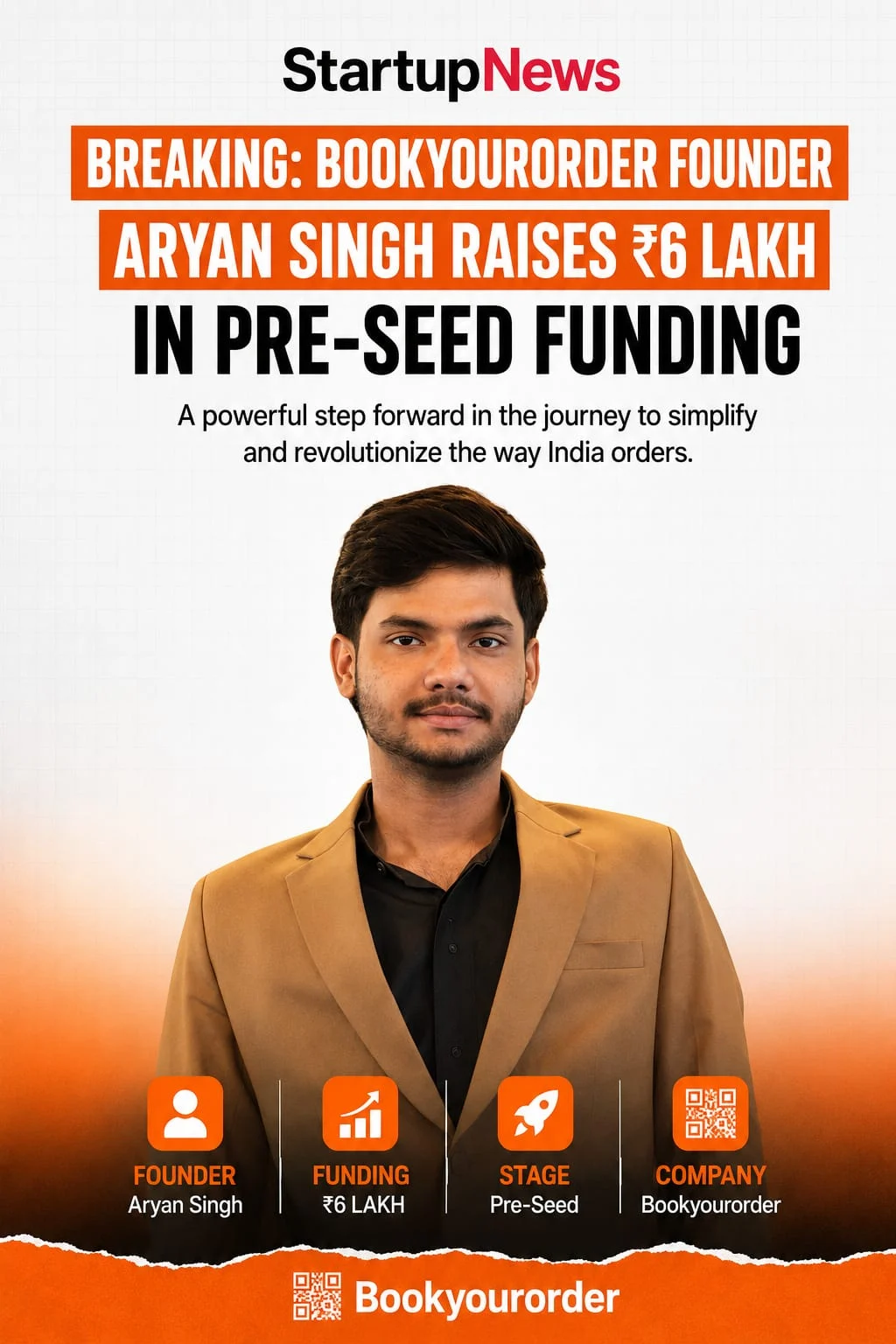
There is a particular kind of silence that follows a startup's failure — not the dramatic, headline-grabbing collapse of a company that burned through millions, but the quieter kind. The kind where a founder simply stops logging into the dashboard one day, watches the sign-ups flatten into a straight line, and has to decide, alone, whether to keep pretending or to call it.
Aryan Singh knows that silence well. Before BookYourOrder — the POS platform that has just closed its first pre-seed round of ₹6 lakh — there was livoz.in. And before there was a lesson to build on, there was simply a founder in Patna watching an idea he believed in fail to find its market.
This is the story of both. Not the polished, retrospective version where the failure is repackaged as an inevitable stepping stone, but the fuller arc — what Singh tried to build, why it didn't work, and how that specific, unglamorous failure shaped a second company that is now trying to solve a problem far more businesses actually have.
The First Idea: Making Vocalists Easy to Find
livoz.in was built around a simple observation. Cafes, restaurants, and small event spaces regularly want live music — a vocalist for a weekend evening, a performer for a themed night, someone to give a space a bit of atmosphere. But finding that person has traditionally meant word of mouth, Instagram DMs, a friend of a friend who knows someone who sings. There was no organized, searchable way for a local vocalist to say "I'm available, here's my range, here's what I charge" and for a cafe owner to say "I need someone for Friday night" and have the two find each other.
Singh's answer was a listing platform. Vocalists would create profiles — showcasing their style, availability, and rates — and cafe or restaurant owners could browse those profiles and book directly. No middlemen, no agents taking a cut, no relying on someone's cousin who "knows a guy." The vision, in Singh's own words, was to make vocalists easily accessible — to take something that had always run on informal networks and give it structure.
It's the kind of idea that sounds obviously useful the moment you hear it, which is exactly why it's dangerous. A lot of startups die not because the idea was bad in the abstract, but because "obviously useful" and "something enough people will actually pay for, regularly, in this specific market" turned out to be two very different tests. livoz.in didn't fail because Singh built it badly. It failed the second test.
Why livoz.in Didn't Work
Ask Singh directly what went wrong, and he doesn't reach for a comfortable excuse. The answer is plain: the market simply didn't need it — and that absence of need was sharpened by where he was building it. Patna is a tier-2 city, and tier-2 markets don't behave like the metros a founder might unconsciously be designing for.
In a large metro, a niche marketplace can survive on volume alone — enough cafes, enough vocalists, enough transactions happening in parallel that even a small conversion rate adds up to a real business. In a tier-2 city, that density isn't there yet. The pool of cafes and restaurants actively looking to book live vocalists on any given week is small. The pool of vocalists willing to formalize themselves on a platform, price themselves publicly, and wait to be discovered is smaller still. Two thin markets trying to find each other through a new platform, in a city where the old informal way — a phone call, a recommendation — still worked just fine for the handful of venues that needed it, was never going to generate the kind of activity a startup needs to survive.
There's a broader lesson buried in that specific failure, one that plenty of first-time founders learn the hard way: a real problem is not the same as a large, addressable, urgently-felt problem. Live-music booking for cafes was real. It just wasn't big enough, frequent enough, or painful enough in Patna's market to pull people away from doing it the old way. No amount of good design or clean onboarding fixes a demand problem that fundamental.
For a lot of founders, that kind of failure ends the story. The idea doesn't work, the energy drains out, and building quietly stops being something they do. Singh's path went differently — not because he had some unusual reserve of resilience that other founders lack, but because he treated the failure as data rather than a verdict. livoz.in told him something true and specific: don't build for a market this thin, and don't build something people can already solve with a phone call. What he needed next was a problem that was frequent, painful, and shared by nearly every small business owner he could find — not a niche one.
The Gap Between the Two
Singh didn't stumble into that next problem by accident. Through Peak Marketing — the digital growth agency he founded and runs as CEO & Director, working with several hundred brands on everything from digital marketing to e-commerce account management — he had a front-row seat to how small business owners across categories actually operate day to day. Cafes, restaurants, retailers, service businesses: the same operational friction kept showing up in conversation after conversation, client after client. Billing was manual or clunky. Menus were static pieces of paper or laminated cards, disconnected from whatever software the business used to track orders. Point-of-sale systems that did the job properly were often priced for businesses far larger than the ones actually asking for help.
That's a very different kind of gap than the one livoz.in tried to fill. It isn't a nice-to-have for a Friday night. It's the infrastructure a small business runs on every single day, for every single transaction. And unlike live-music booking, it's a problem that doesn't get thinner in a tier-2 city — if anything, it gets sharper, because small and mid-sized businesses in cities like Patna are exactly the ones priced out of the more expensive POS systems built for national chains and metro-first customers.
That's the seed BookYourOrder grew from.
What BookYourOrder Actually Is
At its core, BookYourOrder is a point-of-sale system — but the way Singh has positioned it is defined as much by what it's built to avoid as by what it does. Where a lot of the POS category has crept upmarket, bundling in enterprise features and enterprise pricing that make sense for large restaurant chains but not for a single cafe trying to keep its margins intact, BookYourOrder is built around a different premise: it's designed to be the most affordable option in the category, full stop.
That affordability isn't a stripped-down, bare-bones trade-off, either. The platform is built around unlimited cloud storage — a small but meaningful detail for business owners who have watched other software vendors quietly cap storage and then upsell them the moment they hit the ceiling. It includes scannable digital menus, letting customers pull up a restaurant's offerings on their own phone rather than handling a shared physical menu — a shift that both modern diners increasingly expect and that solves a genuine hygiene and operational headache for restaurant owners. And it generates e-bills automatically, cutting out the friction and errors that come with handwritten or manually tallied receipts, while giving business owners a cleaner digital paper trail for their own bookkeeping.
Put those pieces together and the pitch becomes coherent: a small business owner should be able to run their entire front-of-house operation — menu, ordering, billing, record-keeping — on one affordable system, without needing to be a large chain to justify the cost. It's infrastructure-first thinking, the same instinct that shaped the ambition behind livoz.in, but this time aimed at a problem with real, everyday, unavoidable demand behind it.
The First ₹6 Lakh
Every startup's first outside capital means something different depending on who's writing the check and why. For BookYourOrder, the ₹6 lakh pre-seed round it has just closed is not the kind of number that will make headlines next to the nine- and ten-figure raises that dominate startup news cycles. But for a founder building without a well-known name or a previous exit to point to, it represents something that raw capital size doesn't capture: a small circle of early backers looked at the idea, looked at the founder, and decided to bet on both.
That capital isn't earmarked for a splashy launch or an aggressive marketing push. It's going toward the unglamorous, essential work of any early-stage product: refining the platform based on real usage, onboarding the first meaningful cohort of cafes and restaurants, and building the operational discipline — clean metrics, real retention data, evidence of repeat use — that will matter far more than the pre-seed number itself when Singh eventually goes looking for a larger seed round.
It's worth sitting with how different this round is from what livoz.in ever achieved. livoz.in never got to the point of raising outside capital, because it never proved the kind of demand that makes a round worth writing. BookYourOrder, by contrast, has already cleared that first bar — not because the idea is flashier, but because it's solving a problem that businesses already know they have, rather than trying to convince them they have one.
What the Failure Actually Bought Him
It's tempting, in hindsight, to tell founder stories as though the failure was secretly a strategy all along — that Singh always knew livoz.in was step one of a plan that led to BookYourOrder. That would be a tidier story. It would also not be true, and it's worth resisting for exactly that reason.
What livoz.in actually gave Singh wasn't a strategy. It was a sharper set of questions. Is the problem frequent, or occasional? Is it painful enough that people will change their existing behavior, or just pleasant enough that they'll use a new tool if it happens to be convenient? Does the market I'm building in have the density this business model needs, or am I quietly assuming a metro-sized market while standing in a tier-2 city? Those are the questions that separate an idea that sounds good in a pitch conversation from a business that survives contact with a real market — and they're questions Singh didn't have, in any sharp or tested form, before livoz.in forced them on him.
That's the honest version of "he didn't waste time." It isn't that the failure didn't cost him anything — every founder who has shut a product down knows exactly what it costs, in time, in belief, in the harder conversations that come after. It's that he treated the cost as tuition rather than as a verdict on whether he should keep building. The gap between those two responses is, in the end, the entire difference between founders who get a second company off the ground and founders who don't.
Building for a Market That Actually Needs You
There's a specific kind of maturity in the shift from livoz.in to BookYourOrder that's easy to undersell because it isn't dramatic. It isn't a pivot into an entirely different industry, or a sudden change in ambition. It's the same founder, the same city, the same instinct toward infrastructure-first thinking — redirected at a problem that was actually waiting for a solution, rather than one that merely sounded like it should be.
That redirection matters more in a tier-2 city than it would almost anywhere else. Patna doesn't have the market density to forgive a founder for guessing wrong about demand — livoz.in is proof of that. But it also means that when a founder does find a problem with real, unforced demand behind it, the absence of the crowded competition you'd find in a metro market can work in their favor. Small business owners in cities like Patna are frequently underserved by software built with Mumbai, Delhi, or Bengaluru's price points in mind. A genuinely affordable, full-featured POS system isn't just a nice idea in that context — it's filling a gap that larger, metro-first competitors have mostly ignored.
What Comes Next
The months ahead for BookYourOrder will look, from the outside, almost identical to what every early-stage company goes through: onboarding early customers, listening closely to what breaks and what they actually use, building toward the kind of retention and usage data that makes a seed round possible. None of that is glamorous, and none of it is guaranteed to work. The overwhelming majority of pre-seed companies, in Patna and everywhere else, don't make it to a seed round — that's simply the arithmetic of early-stage building, not a reflection on any one founder's effort.
But Singh has already been through the version of this story where the idea doesn't work, where the sign-ups flatten out, where the honest answer is that the market never needed what he built. He knows what that costs, and he knows what it takes to get back to building afterward instead of walking away. That's not a guarantee that BookYourOrder succeeds where livoz.in didn't. It's simply the reason there's a second company to write about at all.
For a founder in a tier-2 city, without the safety net of a well-known name or a previous win, that may be the truest measure of the story so far — not the ₹6 lakh, and not the feature list, but the fact that after building something the market didn't want, Aryan Singh built something it does.