StartupNews · Funding
Freehand Secures $75 Million to Scale Autonomous AI Supply Chain Agents
Freehand has raised $75 million co-led by Battery Ventures and NewRoad Capital to deploy autonomous AI agents across Fortune 500 supply chains — and to press an unusually direct wager that software can now replace, not just assist, the people who decide which invoices get paid.
By Startup news · Published · Updated
DEAL TICKET — FREEHAND, INC. (Series B)
Amount raised: $75,000,000
Co-lead investors: Battery Ventures · NewRoad Capital Partners
Also participating: Nexus Venture Partners · PSP Growth
Total raised to date: $100,000,000
Prior round: $25M Series A · March 2024
Founded: 2023, as Pando
Relaunched: As Freehand, February 2026
Headquarters: San Francisco / Chennai
Founders: Nitin Jayakrishnan · Abhijeet Manohar
New board seat: Dharmesh Thakker, Battery Ventures
Named customers: Meta, Unilever, J&J, Pfizer, Dunkin', Cardinal Health
Every invoice a large company receives asks the same blunt question: pay it, dispute it, or push back and negotiate. For decades, the answer has come from rooms full of people — in-house accounts-payable clerks, outsourced back-office teams, contract specialists — reading purchase orders, cross-checking contracts, and typing a decision into an ERP system one line at a time. Inside a growing list of Freehand's customers, that room is emptying out. Ninety-nine percent of those decisions, the company says, are now made by software, without a human being asked to weigh in first.
That figure, more than the check size, is the real subject of this week's announcement. On Wednesday, San Francisco-based Freehand said it had raised $75 million in a Series B round co-led by Battery Ventures and NewRoad Capital Partners, with Nexus Venture Partners and PSP Growth — the growth fund chaired by former U.S. Commerce Secretary Penny Pritzker — joining in. The round brings Freehand's total funding to $100 million, roughly 29 months after the company was founded and just five months after it introduced itself to the public.
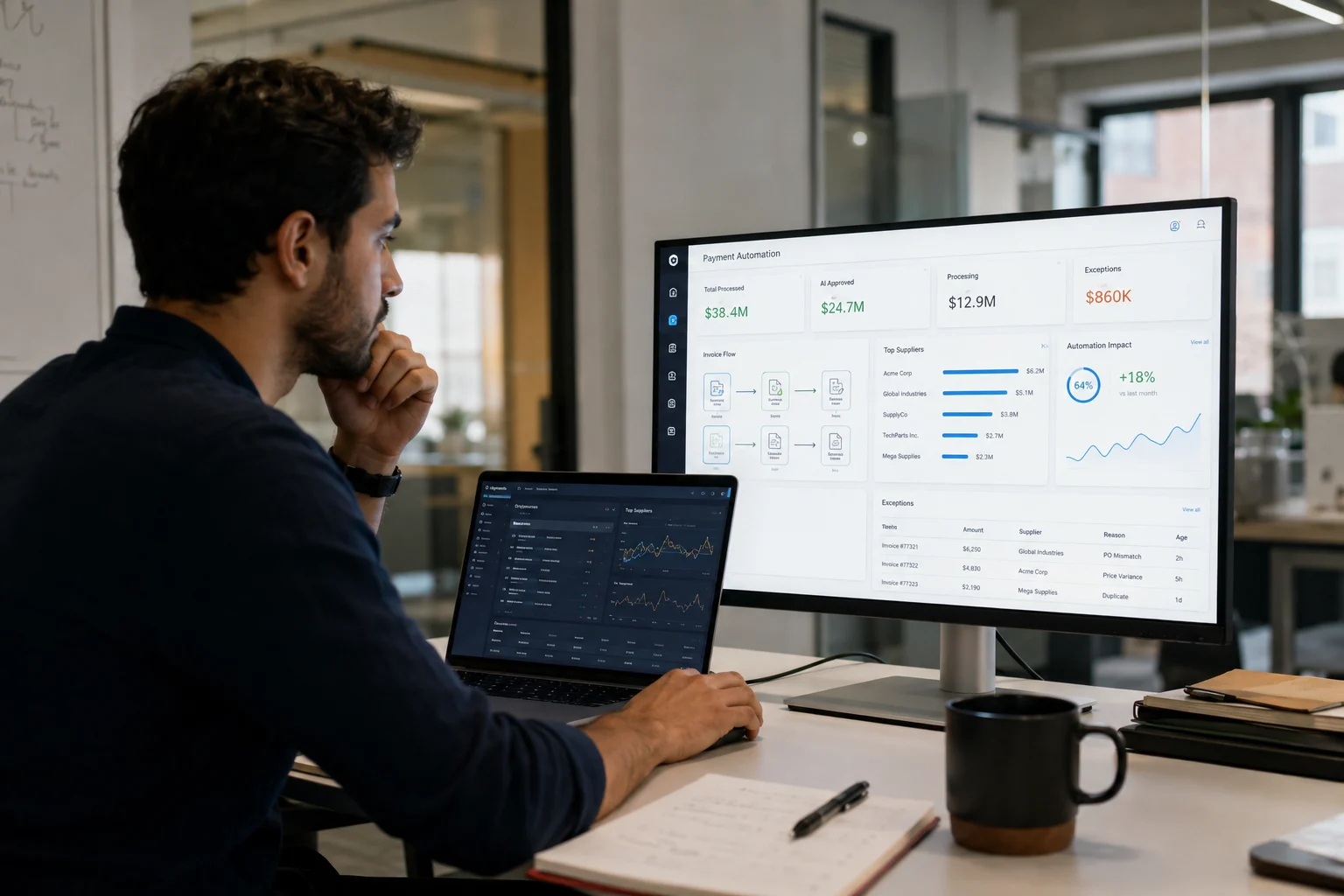
Freehand builds autonomous AI agents — it calls them "AI Teams" — that take over the accounts-payable and procurement decisions large enterprises have historically outsourced to people: which invoices to pay, which to dispute, when to renegotiate a supplier contract, and how to reconcile the sprawl of emails, PDFs and spreadsheets surrounding every one of those calls. Its customer list already includes Meta, Unilever, Johnson & Johnson, Pfizer, Dunkin' and Cardinal Health. What follows is a look at what Freehand actually built, who is paying for it, how it stacks up against a fast-multiplying set of rivals chasing the same $20 trillion opportunity, and where the pitch deserves a skeptical read.
The raise lands in the middle of enterprise software's most contested argument right now: whether the next generation of AI products should assist workers or replace the workflow entirely. Freehand's investors are explicit about which side they're betting on. Unlike copilots that simply answer questions, said Battery Ventures general partner Dharmesh Thakker, who is joining Freehand's board, "this agency unlocks millions in savings for enterprises." It's a wager that is simultaneously fashionable — nearly every enterprise AI startup now claims some version of "agentic" in its pitch — and, in Freehand's specific corner of the back office, unusually far along.
The headline numbers are eye-catching by design: customers recovering 5% to 10% of spend in complex categories, workflows completing five to seven times faster, and procure-to-pay cycles shortened by more than 70%, according to the company. Whether those figures hold up as independently audited benchmarks — or remain the kind of self-reported win every enterprise software vendor publishes — is one of the questions worth sitting with. First, the deal itself, and the problem it's meant to solve.
01 · WHY ACCOUNTS PAYABLE, WHY NOW
To understand why a credible investor syndicate wrote a $75 million check into a company most people had never heard of six months ago, it helps to sit inside the specific problem Freehand chose to attack first.
American companies spend more than $20 trillion a year on the raw materials, logistics, data centers and services that keep the economy running, according to Bureau of Economic Analysis figures cited in coverage of the round. A meaningful slice of that spend moves through accounts payable — the department that decides, invoice by invoice, whether a company actually owes what a supplier says it owes.
In theory, that decision is simple: check the invoice against the purchase order and the contract, confirm delivery, and pay. In practice, Freehand co-founder and CEO Nitin Jayakrishnan has argued, accounts payable is far less binary than outsiders assume. Pricing tiers change mid-contract. Volume discounts kick in only past certain thresholds. Rebates get negotiated over email and never make it into the ERP. Understanding whether an invoice is correct means understanding the full context of every contract and every supplier conversation — work that has historically required either a large internal team or an outsourced back office in a cheaper labor market.
"Armies of people and outsourced teams doing tactical work… is not strategic spend but margin erosion." — Nitin Jayakrishnan, Co-founder & CEO, Freehand
For twenty-some years, enterprises addressed that complexity by layering software on top of the labor rather than replacing it. ERP systems from SAP and Oracle recorded transactions; procurement platforms like Coupa and Ariba routed approvals; outsourcers in the Philippines and India actually made the judgment calls. The software improved. The headcount didn't meaningfully shrink — it simply moved to cheaper geographies. Freehand's pitch, and the pitch of a fast-growing set of rivals, is that this stacking model has hit its limit, and that AI capable of reading unstructured documents and rendering a bounded decision can finally remove the labor layer rather than just relocate it.
There's a specific trigger reinforcing that pitch in 2026: trade policy. Tariff schedules have shifted repeatedly over the past two years, and each shift ripples through supplier contracts, landed costs and payment terms in ways that used to take procurement teams weeks to unwind. When a tariff changes before breakfast, the argument goes, a company needs its pricing decisions restructured before the next meeting — not months later. That is a genuinely different speed requirement than the one most enterprise software was built to serve.
Freehand's backers frame the opportunity in similarly stark terms. One figure circulating among the round's investors puts the ratio between what large enterprises spend on software and what they spend on the people required to make that software actually work at roughly 21 to 1 — a gap agentic-AI vendors are explicitly trying to close by selling against a cost center that already has a budget line, rather than asking a company to find new money for a novel tool. Freehand is pricing itself against BPO contracts and internal AP headcount, not against other software subscriptions.
That reframing — sell against the cost of people, not the cost of software — is also why Freehand's product had to look less like a dashboard and more like a replacement worker. Which is what the company spent its first two years, largely out of public view, actually building.
02 · INSIDE THE MACHINE
At the center of Freehand's pitch is what the company calls a Category Context Graph — a living map that stitches together the unstructured material buried in email threads, Slack and Teams messages, PDFs and scanned contracts with the structured records sitting inside a company's ERP, procurement and payment systems. The premise is that most of the "why" behind a spend decision — why a supplier was granted an exception, why a rate was renegotiated, why last quarter's invoice was disputed — lives in conversation, not in a database field. Freehand's agents are built to read that conversation and treat it as decision-grade evidence.
On top of that graph sit what the company calls "AI Teams" rather than a single assistant: specialized agents handling different steps of the procure-to-pay workflow — matching invoices to contracts, flagging exceptions, negotiating with suppliers, processing payments, and reconciling results back into a customer's own systems. Freehand has said it orchestrates its agents across roughly eighteen underlying AI models rather than betting the product on a single foundation model, and gives customers some control over which models touch which categories of data — a detail that matters to security teams at companies the size of Meta or Pfizer, unlikely to hand sensitive contract data to a vendor locked into one model provider.
The design goal, in other words, is not a chatbot that drafts a recommendation for a human to approve. It is a system built to decide and act, with an audit trail detailed enough that a finance team can reconstruct exactly why an agent chose to pay, dispute or escalate any given invoice. Difficult or ambiguous cases still route to a person — which is where the 99% figure comes from: in production at customers like Meta and Pfizer, Freehand says, only about one in every hundred decisions needs that human circuit-breaker.
Freehand co-founder Abhijeet Manohar has described the underlying philosophy as building software "that is the user," rather than software built for a user to operate — a distinction that sounds like branding until you consider what it implies for staffing. A tool built for a user still requires the user. Software built to be the user is designed, explicitly, to let a company reduce the number of users it employs to do that job.
That is a more aggressive claim than most enterprise software makes, and it explains why the company frames its results in terms of headcount and outsourcing contracts rather than software efficiency alone. Customers, Freehand says, have redeployed internal teams to higher-value work and wound down outsourcing contracts entirely in some categories — a claim that reads, depending on where you sit, either as the logical endpoint of AI automation or as a fairly direct pitch to shrink roles that currently exist inside a Fortune 500 finance organization. Both readings are probably true at once, and neither is unique to Freehand — it is simply unusually explicit here.
03 · THE PANDO LINEAGE
Freehand did not appear from nothing in February, when it formally emerged from stealth with Fortune 500 customers already live. The company was originally founded in 2023 under the name Pando, built by Jayakrishnan and Manohar around an earlier product called Pi — an AI agent aimed at freight booking and logistics. That freight-and-logistics starting point matters for two reasons.
First, it means Freehand's founding team spent its earliest months inside the operational weeds of physical supply chains — carriers, freight rates, shipment exceptions — rather than starting from a general-purpose AI platform and searching for an enterprise problem to attach it to. The team's own account of that period describes Pando/Pi as the proving ground where they learned that the hardest part of supply-chain software isn't the software; it's reconciling what a contract says against what actually happened, across thousands of exceptions a human would otherwise adjudicate one at a time.
Second, the rebrand and relaunch as Freehand in early 2026 reads less like a pivot than a widening of aperture: the same context-stitching approach that worked for freight exceptions, applied to the far larger category of accounts-payable and procurement decisions. By the time Freehand introduced itself publicly, it wasn't pitching a hypothesis — it already had production deployments at Meta, Unilever, Johnson & Johnson, Pfizer, Dunkin' and Cardinal Health, landed during roughly two years spent largely out of public view.
That sequencing became a talking point among the round's investors. Most enterprise AI startups raise money on a demo, then spend a year or two chasing their first serious logo. Freehand inverted the order: it spent its stealth period embedded inside some of the most operationally complex companies in the world, then surfaced with reference customers most enterprise software vendors spend years trying to land. That is the sequencing Battery's Thakker pointed to in describing Freehand as an applied-AI company with a genuine vertical wedge, proven at some of the largest companies on Earth — not a research demo dressed up as a product.
04 · FOLLOW THE MONEY
The $75 million round is structured as a co-led Series B, though readers scanning different outlets this week may notice an inconsistency in how it's described — at least one major outlet characterized it as a seed round, while Crunchbase News, the company's own materials and most trade coverage describe it as a Series B bringing Freehand's total funding to $100 million. The weight of evidence, including Freehand's own reference to a prior $25 million Series A closed in March 2024, points to Series B as the accurate label — a small reminder that even well-resourced outlets occasionally muddle round-naming on a fast-moving embargo day, and that readers comparing headlines this week should check the underlying numbers rather than the label alone.
Battery Ventures and NewRoad Capital Partners co-led the round. Nexus Venture Partners and PSP Growth — the growth-stage fund chaired by Penny Pritzker, who served as U.S. Commerce Secretary under President Obama — participated alongside them. Dharmesh Thakker, a Battery Ventures general partner, is joining Freehand's board, a detail worth flagging on its own: Thakker and Battery are already investors in Levelpath, a rival procurement-AI startup discussed in more detail below, giving the firm two separate bets on adjacent parts of the same back-office overhaul.
For NewRoad's Gregoire Lehmann, the appeal wasn't the technology in isolation but the business outcomes attached to it. What stood out, Lehmann has said, is that Freehand is "delivering immediate ROI by helping enterprises reduce overpayments." That framing matters: it's the language growth investors use to underwrite expansion-stage SaaS, not early-stage AI research bets. Freehand is being financed less like a frontier-model company and more like a fast-growing vertical software business that happens to run on AI agents — a meaningfully different risk profile for a Series B check.
The capital arrived fast relative to the company's public track record. Freehand introduced itself to the world in February 2026; five months later, it closed a $75 million round at what its CEO has described only as "a significant step up" from its Series A valuation, without disclosing a number. In a funding environment where plenty of AI startups raise on narrative alone, Freehand leaned on delivered outcomes at named Fortune 500 accounts — a lower-risk, higher-conviction story that let a growth-stage firm like NewRoad and a generalist like Battery move together on the same term sheet.
[CHART — Figure 1: Freehand's Capital Trajectory] Round size and cumulative capital raised, Series A (Mar. 2024) through Series B (Jul. 2026). Series A, Mar 2024 — Round size: $25M | Cumulative raised: $25M Series B, Jul 2026 — Round size: $75M | Cumulative raised: $100M (Source: Crunchbase News, company disclosures)
Two data points don't make a trend line, but they do make a statement: Freehand raised roughly three times as much in its second institutional round as its first, in about 28 months, while its valuation multiple — undisclosed, but described by its own CEO as a "step up" — moved in the same direction. For a company built around a single, narrow wedge rather than a broad platform pitch, that's a fast capital ramp, and it puts pressure on Freehand to expand into the wider procurement and supply-chain categories it says it's eyeing next.
05 · THE NUMBERS FREEHAND WANTS YOU TO SEE
Every vendor pitch comes with numbers, and Freehand's are aggressive enough to deserve a closer look before they get repeated as settled fact.
The company says its customers are recovering 5% to 10% of spend in complex categories — spend that would otherwise leak out through overbilling, missed rebates, expired discounts and simple contract-reading errors. It says workflows that used to take teams of people days now complete five to seven times faster. It says procure-to-pay cycles — the time between receiving an invoice and closing it out — have shortened by more than 70% at some deployments. And it says its agents make 99% of invoice-related decisions without escalating to a human reviewer.
KEY STATS (company-reported)
Spend recovered: 5–10%
Faster workflows: 5–7×
Shorter procure-to-pay cycle: 70%+
Those are the kinds of numbers that, if independently verified across a representative sample of a customer's full invoice volume, would justify a great deal of investor enthusiasm. They are also, as reported, entirely self-disclosed — figures Freehand chose to publish, drawn from its own deployments, without a named third-party auditor, a specified sample size, or a stated comparison methodology. That's not unusual; it's how most enterprise software vendors report results, including Freehand's competitors. But it's worth naming plainly rather than passing the figures along as fact.
What lends the numbers more credibility than a typical vendor claim is the customer list attached to them. Meta, Unilever, Johnson & Johnson, Pfizer, Dunkin' and Cardinal Health are not logos a two-year-old startup typically lands, let alone puts into production making live payment decisions. Getting a pharmaceutical company or a consumer-goods giant to let software autonomously decide whether to pay a supplier — with real money and real audit exposure on the line — requires clearing procurement, security, legal and finance reviews that tend to be slow and skeptical by design. Clearing that bar at six recognizable enterprises is itself a meaningful signal that the product works well enough to be trusted with real financial decisions — a lower, but still significant, bar than "the specific percentages are precisely correct."
[CHART — Figure 2a: Procure-to-Pay Cycle Time] Indexed cycle time, before vs. after Freehand deployment (100 = baseline). Company-reported. Before Freehand: 100 (index) After Freehand: 30 (index)
[CHART — Figure 2b: Decision Autonomy Rate] Share of invoice decisions resolved without human escalation. Company-reported, across production deployments. Autonomous decisions: 99% Escalated to human: 1%
Read together, the two charts above tell a coherent story: a steep cut in cycle time, achieved by keeping the exception rate — the share of decisions requiring a human — extremely low. If Freehand can hold that exception rate roughly flat as invoice volume and customer count scale, the unit economics of the business improve every quarter without new headcount. If the exception rate creeps up as the customer base diversifies beyond six of the most sophisticated finance organizations in the world, the story gets more complicated — and the 99% figure that anchors this section becomes the single most important metric to watch heading into Freehand's next round.
06 · A LANE THAT'S FILLING FAST
Freehand is not alone, and it would be a mistake to read its raise in isolation. Enterprise procurement and accounts payable have become one of the most crowded corners of applied AI in 2026, and Freehand's own investors are, in at least one case, funding more than one horse in the race.
The closest comparison may be Levelpath, a San Francisco procurement platform founded by Stan Garber and Alex Yakubovich, the pair behind Scout RFP, which Workday acquired for $540 million in 2019. Levelpath has raised roughly $100 million across three rounds, including a Series B led by — notably — Battery Ventures, the same firm co-leading Freehand's round and now sitting on both companies' boards through partner Dharmesh Thakker. Levelpath's pitch sits one layer up the stack from Freehand's: sourcing, contract management and procurement workflow, with agentic features layered on top, and it earned a place in Gartner's 2026 Hype Cycle for Procurement and Sourcing Solutions as a sample vendor for generative AI. Where Freehand's wedge is the invoice decision, Levelpath's is the broader sourcing and contract relationship — overlapping territory, different entry points, the same investor writing checks to both.
Then there's Pivot, a Paris-based procurement and finance-operations platform that raised $40 million in an oversubscribed Series B in May 2026, led by Forestay Capital and Notion Capital, bringing its total funding to $70 million since its 2023 founding. Pivot processes roughly $3 billion in invoices annually for customers including DoorDash, Lemonade and Flix, across more than 25 countries, and pitches itself as an AI operating system spanning sourcing, approvals, purchasing, invoicing, payments, budgets and reporting. Its co-founder Marc-Antoine Lacroix has described the company's approach as one that "shifts the manual grind from a human burden to a machine burden" — language nearly interchangeable with Freehand's own pitch, right down to the framing of software replacing labor rather than merely assisting it.
Zoom out further and the list keeps growing: Zip, Ramp, Omnea, ORO Labs, Aerchain, Procure AI, Lio, Didero and Traza have all raised capital in 2026 describing some version of agentic procurement automation, according to an analysis of the year's procurement-software funding by research outlet New Market Pitch. That analysis makes a point worth sitting with: Ramp, the much larger corporate-card and spend-management company, alone accounts for roughly two-thirds of all capital raised across the procurement-software category this year. Strip Ramp out of the dataset, the analysis argues, and funding looks far more evenly distributed across sourcing, supplier-risk and vertical procurement plays — Freehand's actual competitive set.
[CHART — Figure 3: Total Capital Raised — Freehand vs. Direct Peers] Cumulative funding to date. Freehand: $100M (since 2023, as Pando/Freehand) Levelpath: ~$99.5M (since 2022) Pivot: $70M (since 2023) (Sources: Crunchbase News, Tracxn, Tech.eu)
[CHART — Figure 4a: Who Owns 2026's Procurement-AI Capital] Share of total 2026 procurement-software VC capital. Ramp (single company): 65.62% Rest of category: 34.38% (Source: New Market Pitch analysis)
[CHART — Figure 4b: Deals vs. Capital — PO Automation] Purchase-order automation's share of 2026 deal count vs. capital raised. Share of deals: 16.13% Share of capital: 2.68% (Source: New Market Pitch analysis)
Within that narrower set, a pattern emerges that should make founders in the category nervous even as it validates the thesis: capital is concentrating around orchestration and full-workflow platforms, not narrow point solutions. Purchase-order automation — a comparatively basic, single-function category — accounted for roughly 16% of 2026 deals but under 3% of total capital, per the same analysis, suggesting investors will fund plenty of narrow procurement tools but reserve serious money for the ones credibly positioned to expand into a broader decision layer.
That's the subtext running under Freehand's own positioning. The company has said, without much subtlety, that its initial focus on invoice decisions is a wedge rather than a destination — that it intends to use the trust and data built inside Meta's and Pfizer's finance organizations to expand into adjacent supply-chain categories over time. In a funding environment that visibly rewards orchestration over narrow automation, that expansion isn't optional positioning. It's close to a requirement for justifying a $100 million cap table.
07 · THE MACRO BET
Step back from any single company and the case for this entire category rests on a wager about where enterprise software budgets are headed. That wager has a specific, oft-cited number behind it: a Gartner forecast, cited in coverage of Freehand's raise, suggesting enterprise spending could migrate from conventional, non-AI software toward agentic systems at as much as 26 times today's scale within four years. Treat that figure as directional rather than precise — forecasts of this kind rest on adoption-curve assumptions that can swing considerably — but it captures the scale of reallocation investors are underwriting when they fund Freehand, Levelpath and Pivot within the same eighteen-month window.
[CHART — Figure 5: The Reallocation Bet, Illustrated] Illustrative index of enterprise budget migration from non-AI software toward agentic systems, indexed to a Gartner-cited forecast of up to 26x scale over four years. (Not an official Gartner chart — interpolated for illustration only.) 2026 (baseline): 1× ~2030 (Gartner-cited projection): 26×
Three forces are converging to make that reallocation plausible in 2026 specifically, rather than merely aspirational.
The first is labor economics. The ratio between what large enterprises spend on software licenses and what they spend on the people required to actually operate that software — configuring it, running exception queues, chasing down suppliers — has been estimated at roughly 21 to 1 in favor of headcount. That's the gap agentic-AI vendors are chasing: not incremental software efficiency, but a genuine shift of dollars from payroll and outsourcing budgets into AI-native tooling priced against the cost it replaces.
The second is trade policy. Tariff schedules have shifted with unusual frequency through 2025 and 2026, and every shift forces a re-pricing exercise across thousands of supplier contracts at once — exactly the kind of sudden, document-heavy, time-pressured decision that used to require weeks of manual reconciliation and, in principle, can now be handled by a system that already understands every contract in context. Enterprises facing that volatility have a harder time defending a purely human-driven procurement process on resilience grounds alone, independent of cost.
The third is simply proof of deployment. For roughly two years, "agentic AI" was mostly a marketing term applied to chatbots with slightly more autonomy than a search box. What changed in 2026, at least in procurement and finance, is a small cohort of startups — Freehand chief among them — demonstrating that agents can be handed decisions with real financial and legal consequences, with an audit trail sturdy enough that a Fortune 500 general counsel signed off on it. That's a harder bar than drafting an email or summarizing a document, and clearing it at multiple large enterprises is what's giving growth investors confidence to write Series B–sized checks into what is, functionally, still an early-stage company.
None of this guarantees Freehand specifically wins the reallocation Gartner is describing. It does suggest the reallocation itself — money moving out of static software and outsourced labor and into systems that act — is now something enterprise buyers are budgeting for rather than merely piloting, which is the precondition every company named in this piece needs to be true for its valuation to make sense.
08 · THE SKEPTIC'S LEDGER
Every part of Freehand's pitch that makes it exciting to investors is also the part that deserves the most scrutiny.
Start with accountability. Handing an AI system the authority to pay, dispute or renegotiate real invoices is a materially different risk than handing it the authority to draft a memo. A wrong decision doesn't just produce a bad paragraph — it moves real money, potentially breaches a contract, or creates an audit finding a public company has to disclose. Freehand's answer is a detailed audit trail and a human escalation path for the roughly 1% of decisions its agents don't resolve on their own. Whether that's sufficient governance at scale — across thousands of suppliers, in categories messier than the ones showcased in launch materials — is exactly the kind of question that tends to surface only after a company scales past its cleanest early customers, not before.
Then there's the customer-concentration question. Six marquee logos — Meta, Unilever, Johnson & Johnson, Pfizer, Dunkin' and Cardinal Health — are a genuinely strong proof point, and each one required clearing procurement, security and legal reviews most startups never get close to. But six logos are also, mathematically, six logos. The jump from "works brilliantly at six of the most operationally sophisticated companies on Earth, each likely receiving hands-on deployment support from Freehand's own team" to "works reliably across hundreds of mid-market customers with messier data and thinner budgets for white-glove onboarding" is one of the hardest transitions in enterprise software — and it's the transition this $75 million is explicitly meant to fund.
There's also an unresolved moat question. Freehand's Category Context Graph — the system stitching unstructured communication to structured ERP data — is real technical work, but it isn't a category of technology unique to Freehand; Pivot, Levelpath and several smaller 2026 entrants describe some version of the same idea, and the underlying foundation models doing the actual reading and reasoning are available to any well-funded competitor. Freehand's defensibility, for now, looks like it rests less on proprietary technology than on a head start in deployed, labeled, enterprise-specific data from live customers — a real advantage, but one that erodes if rivals close the deployment gap.
Worth naming plainly, too: Battery Ventures is now a financial backer of both Freehand and Levelpath — two companies pitching adjacent, partially overlapping visions of AI-run procurement to the same buyer, the enterprise CFO. That's not unusual venture behavior; large funds routinely place multiple bets across a category to hedge against picking the wrong winner. But it's a detail buyers and rival founders alike are entitled to weigh against Thakker's enthusiastic quotes about Freehand's category leadership.
And then there's the incumbent question hovering over every AI-native challenger in enterprise software: SAP, Oracle, Workday and Coupa are not going to watch a wave of two-year-old startups automate accounts payable without responding. Each has the customer relationships, the underlying transaction data and the balance sheet to bolt agentic features onto systems already inside the building. Freehand's bet is that incumbents move too slowly, and that owning the decision layer — rather than adding a feature to the system of record — requires a from-scratch architecture incumbents can't retrofit quickly. History in enterprise software is genuinely mixed on whether that bet pays off; sometimes the startup wins the category outright, and sometimes the incumbent eventually ships a "good enough" version its existing customers adopt for free rather than pay a new vendor to replace.
A note on methodology: Every figure in this piece attributed to "the company" or "Freehand says" is self-reported and has not been independently audited for this analysis. Third-party figures — total funding, competitor rounds, market-share estimates — are drawn from named outlets and research listed in the sources section below. Where reporting conflicted (notably, one outlet's description of this round as a seed raise), this piece defaults to the interpretation supported by the greater number of independent sources and the company's own funding history.
None of this is a reason to dismiss Freehand's raise. It's a reason to read the 99% and the 5-to-10% and the seven-times-faster as an impressive first chapter rather than a finished proof, in a category where the finished proof — reliable, audited, board-defensible autonomous financial decision-making at real scale — nobody has fully delivered yet.
09 · WHAT COMES NEXT
Freehand says the new capital will go toward expanding its customer base — particularly in retail, an industry with the kind of high-volume, thin-margin supplier relationships that reward exactly the sort of fraud detection and negotiation automation the company has already showcased in consumer goods and pharma. The company has also signaled, consistently, that invoice and procurement decisions are a beachhead rather than the whole plan: the stated ambition is to use the data and operating experience built inside its first customers to expand into other supply-chain challenges over time, following the same context-graph approach into adjacent workflows.
That expansion path will test the two things this deal is actually betting on. The first is whether Freehand's technology generalizes — whether a Category Context Graph built for invoice decisions transfers cleanly to supplier-risk scoring, logistics exceptions or inventory decisions, or whether each new category requires something closer to a fresh build. The second is whether a sales motion that has so far relied on landing a small number of extraordinarily well-resourced enterprise logos, with hands-on deployment support, can be repeated at the volume and margin a venture-scale outcome requires.
Freehand will also be watched closely by the rest of its category. A $75 million round with this investor list — a top-tier generalist in Battery, a growth specialist in NewRoad, and a politically connected late-stage fund in PSP Growth — sets a pricing and credibility bar the rest of the 2026 agentic-procurement cohort will be measured against, whether or not any of them asked to be.
10 · THE BOTTOM LINE
Strip away the round size and the investor names, and Freehand's raise is really a bet on a narrower, more falsifiable claim than most enterprise AI pitches make: that a specific, high-volume, financially consequential decision — should this invoice be paid — can be handed to software with enough context, and enough of an audit trail, that a Fortune 500 finance organization will trust it with real money at 99% autonomy. That's a more testable claim than "AI will transform the enterprise," and it's one Freehand has already cleared at six large companies, which is genuinely rare this early in a company's life.
What's less settled is everything the claim doesn't yet cover: whether the numbers hold up under outside audit, whether the moat survives contact with better-funded rivals and incumbent responses, and whether a company built around six extraordinarily sophisticated early customers can sell — and support — the same product to the thousands of mid-market companies it will need to justify a valuation built on category leadership.
For now, the $75 million says two things clearly. It says a credible set of investors, including a firm already backing a direct competitor, believe the agentic-procurement thesis is real enough to fund at growth-stage prices barely two years into a company's life. And it says the market for AI systems that act — rather than merely advise — has moved from conference-keynote abstraction to line items on a corporate balance sheet, one automated invoice decision at a time. Whether Freehand is the company that ends up owning that category, or simply the one that proved the category was fundable, is the question the next round will answer.