StartupNews · Breaking News
Fireworks AI Raises $1.5 Billion as Enterprise AI Bets Shift From Renting Intelligence to Owning It
The startup built by the team that created PyTorch at Meta has jumped from a $4 billion to a $17.5 billion valuation in nine months, crossing $1 billion in annualized revenue along the way — on a wager that the future of enterprise AI is thousands of specialized models running cheaply in production, not one general-purpose model everyone rents from the same handful of labs.
By Startup news · Published · Updated
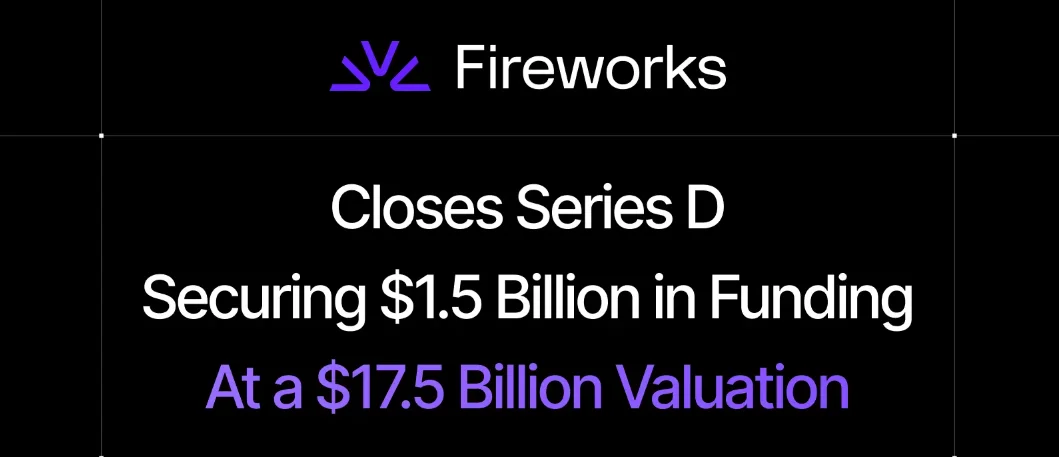
DEAL SNAPSHOT — FIREWORKS AI
Amount raised: $1,505,000,000 (Series D)
Valuation: $17.5 billion
Co-lead investors: Atreides Management · Index Ventures · TCV
Also participating: NVIDIA, Lightspeed Venture Partners, Evantic Capital, Bessemer Venture Partners, Menlo Ventures, Insight Partners, Ontario Teachers' Pension Plan, Lone Pine Capital, 20VC, Operator Collective, Original Capital, Prysm Capital, Quantum Capital, TIME Ventures
Total raised to date: approximately $1.83 billion across four rounds
Prior round: $250M Series C, October 2025, at a $4B valuation
Founded: October 2022, by seven former Meta and Google engineers
Headquarters: San Mateo, California
Founder & CEO: Lin Qiao, formerly Senior Director of Engineering at Meta, where she led the team that built and scaled PyTorch
Annualized revenue: crossed $1 billion in July 2026, up roughly 5x year-over-year
Daily token volume: more than 40 trillion, up from 15 trillion a year earlier
Headcount: approximately 200 employees, with plans to reach 600 by the end of 2026
Every large company now runs on some combination of AI models, and every one of those models has to run somewhere, for every request, every day, for as long as the product stays alive. Training a model is a one-time event. Serving it — answering millions of queries, powering coding agents, running customer-support bots, scoring fraud in real time — is a permanent operating cost that scales with usage. That distinction, unglamorous as it sounds, is the entire thesis behind Fireworks AI, and on July 16 it became a $17.5 billion one.
Fireworks announced a $1.505 billion Series D that week, co-led by hedge fund Atreides Management, venture firm Index Ventures, and growth investor TCV, with NVIDIA, Lightspeed Venture Partners, and more than a dozen other funds participating. The round arrived alongside two milestones the company was eager to publicize together: annualized revenue crossing $1 billion, up roughly fivefold from a year earlier, and daily token volume — the rough proxy for how much actual AI work is flowing through a platform — climbing past 40 trillion, up from 15 trillion twelve months prior. By that measure, Fireworks now processes more AI traffic per day than either Google or OpenAI report processing through their own developer platforms, according to figures each company has separately disclosed.
The headline number obscures a more specific and more interesting claim buried inside it. Fireworks says more than 95% of the tokens flowing through its platform today come not from off-the-shelf frontier models, but from open-source models its enterprise customers have fine-tuned on their own proprietary data — customer records, internal workflows, compliance documents, codebases. In other words, the company isn't primarily in the business of running someone else's general-purpose chatbot at scale. It's in the business of running thousands of narrow, customer-owned models that exist nowhere else, each one trained to be unusually good at exactly one company's exactly one problem. That's the "specialized intelligence" framing Fireworks has built its entire pitch around, and it's the reason a company most consumers have never heard of just became one of the most valuable privately held infrastructure startups in the world.
What follows is a look at what Fireworks actually built, why investors are willing to pay roughly 17.5 times trailing revenue for it, how it sits inside an increasingly crowded and fast-consolidating inference market, and where the pitch deserves a skeptical read before anyone treats a nine-month, 4.4x jump in valuation as a settled verdict.
01 · WHY INFERENCE, WHY NOW
For most of the last three years, the AI industry's attention — and the overwhelming majority of its capital — went to training: building bigger foundation models, buying more GPUs to train them, and racing a handful of labs toward the next benchmark win. Inference, the unglamorous work of actually running a trained model against real user requests, was treated as an afterthought bolted onto whichever cloud a company already used.
That framing has broken down for a simple structural reason: training happens once, but inference happens forever. A foundation model lab trains GPT-5 or Gemini 3 in a finite, if enormous, compute run. But every company that builds a product on top of that model — every chatbot response, every coding-agent suggestion, every AI-scored insurance claim, every voice assistant turn — generates a new inference request, indefinitely, for as long as the product exists and grows. As AI adoption has moved from pilot projects to production systems embedded in core business workflows in 2026, inference volume has scaled in a way training volume structurally cannot, because training is episodic and inference is continuous.
That shift alone would have been enough to make inference infrastructure a serious business. What has made it a venture-scale one is a second, more specific trend: enterprises increasingly don't want to rent intelligence from a small number of closed frontier labs. They want to own a version of intelligence trained specifically on what makes their business different. A generic frontier model can write competent code or draft a competent email, but it doesn't know a specific bank's internal compliance language, a specific retailer's return-policy edge cases, or a specific hospital system's documentation conventions — not unless someone trains it to. Open-weight models, now competitive with closed frontier models on many benchmarks and improving every few months out of labs in the U.S. and China alike, gave enterprises a starting point they could actually customize, rather than a black box they could only prompt.
That is the gap Fireworks is positioned inside: the infrastructure layer that lets a company take an open model, fine-tune it on data only that company has, and then run the resulting specialized model in production at a cost and latency a frontier API can't match, because the model is smaller, sharper, and purpose-built rather than general-purpose. Every enterprise, in this framing, ends up owning a small constellation of its own proprietary models rather than sharing one enormous rented one with every other company on earth. Whoever runs that constellation reliably, cheaply, and at scale captures a toll on nearly all of it — regardless of which foundation-model lab wins the underlying model race. That's the bet Fireworks investors are underwriting, and it's a meaningfully different bet than backing a frontier lab directly.
02 · INSIDE THE PLATFORM
Strip away the funding headline and Fireworks is, functionally, a cloud service: companies send it inference requests, and it runs those requests against models — its own hosted open-weight models, or a customer's fine-tuned variant of one — as fast and cheaply as its infrastructure allows, billed by the token, the GPU-hour, or the training run. What differentiates one inference platform from another, in a market where the underlying model weights are frequently open and shared across competitors, comes down almost entirely to execution: how fast the serving engine is, how efficiently it packs requests onto GPUs, how quickly it supports a newly released model, and how deep the tooling goes for the specific workloads enterprises actually run.
Fireworks' core product is its inference engine, tuned architecture-by-architecture for throughput and latency, paired with what the company calls FireOptimizer — a compilation and optimization layer that squeezes more performance out of the same underlying hardware. The platform supports more than 200 models spanning text, image, and multimodal formats, and the company has built a reputation for turning around support for major new open-weight releases — from Chinese labs' DeepSeek and MiniMax models to Moonshot AI's Kimi and Zhipu's GLM family — typically within hours of launch, a speed advantage that matters to developers racing to adopt whichever open model currently tops a benchmark leaderboard.
Beyond raw serving, Fireworks offers fine-tuning (training an open model further on a customer's own data), reinforcement fine-tuning billed by GPU-hour, and dedicated on-demand deployments for customers who need guaranteed capacity rather than shared serverless access. That range matters because it lets Fireworks capture a customer at multiple points in the same lifecycle — from a developer's first experimental API call through a Fortune 500 company's full production deployment — rather than only serving the top or bottom of that funnel.
The compute underneath all of this doesn't come from a single cloud. Fireworks says it draws capacity from more than 20 different suppliers, including Microsoft, giving it a multi-cloud, multi-vendor posture that both hedges against any single provider's GPU shortages and gives the company negotiating leverage that a startup locked into one hyperscaler wouldn't have. Enterprise security teams — the kind that gate access at companies the size of Uber or Shopify — have also pushed Fireworks toward model plurality rather than lock-in: customers can choose which underlying models touch which categories of sensitive data, rather than trusting all of it to a single vendor's single model.
The design goal, in short, isn't a single chatbot endpoint. It's a runtime — the layer every AI application quietly depends on to actually execute, the same way cloud computing became the invisible runtime beneath most web applications in the 2010s. Lin Qiao has described inference in exactly those terms in public interviews: the "new runtime" for AI-native software. Whether that framing holds up depends less on any single benchmark win and more on whether Fireworks can keep being the fastest, cheapest, most reliable place to run an open model as the field around it keeps multiplying.
03 · THE PYTORCH LINEAGE
Fireworks did not emerge from a garage or a hackathon. It emerged from the inside of Meta's own AI infrastructure, built by the people who had already solved a strikingly similar problem once, at a scale few startups ever touch.
Lin Qiao spent from July 2015 to September 2022 at Meta, rising to Senior Director of Engineering and leading a team of more than 300 engineers responsible for the company's AI frameworks and platforms. Her signature achievement there was overseeing the consolidation of Meta's earlier Caffe2 framework into PyTorch, and then rebuilding Meta's entire training and inference stack on top of it — a stack that came to support more than five trillion inference requests a day across Facebook, Instagram, WhatsApp, and Meta's Reality Labs hardware. PyTorch, in the years since, has become the dominant open-source framework underneath most of the modern AI industry, used inside labs as different as OpenAI, Google, and Meta itself. Before Meta, Qiao held engineering roles at LinkedIn, where she built the company's data-lifecycle management platform, and at IBM Research, working on database and data-infrastructure systems. She holds a Ph.D. in computer science from UC Santa Barbara and undergraduate and master's degrees from Fudan University in Shanghai.
In late 2022, Qiao left one of the most senior AI engineering roles in the industry to start over. She didn't do it alone: six other Meta and Google engineers who had worked alongside her left with her, including Dmytro Dzhulgakov, a PyTorch core maintainer at Meta; Dmytro Ivchenko, who led PyTorch's ranking systems; James Reed, who worked on the PyTorch compiler; Chenyu Zhao, who had led Google's Vertex AI; Benny Chen, from Meta's ads infrastructure team; and Pawel Garbacki, from Meta's newsfeed ranking systems. It is, on paper, one of the more technically credentialed founding teams to start an infrastructure company in this AI cycle — a group that had already built and operated the exact category of system, at a scale most competitors have never approached, before deciding to build a commercial version of it from scratch.
That lineage matters for more than pedigree. It shaped the company's founding thesis directly: having watched inference optimization become the binding constraint on Meta's own AI systems as usage scaled, the founding team bet early that the same bottleneck would hit every company adopting AI in production, and that a purpose-built inference platform could deliver order-of-magnitude improvements over general-purpose cloud infrastructure. That is a narrower, more falsifiable bet than "we understand AI" — and it's one the team had functionally already tested at Meta's scale before ever writing a line of Fireworks' own code.
It also explains why growth investors have been comfortable underwriting Fireworks the way they'd underwrite a proven operator rather than a research lab chasing a hypothesis. Sequoia Capital backed the company from its earliest rounds. By the time outside investors were evaluating a $17.5 billion valuation in mid-2026, they weren't betting on whether this team could build fast inference infrastructure — that had already been demonstrated, repeatedly, at a scale larger than Fireworks itself currently operates at. They were betting on whether the team could sell it, support it, and defend it commercially against a field of well-funded rivals making similar claims.
04 · FOLLOW THE MONEY
Fireworks' capital trajectory is one of the steepest of any infrastructure company in this AI cycle, and the pace of the step-ups says almost as much about investor appetite for the category as it does about the company itself.
The company closed a $25 million Series A in March 2024, led by Benchmark, with Sequoia Capital and Databricks Ventures participating — a relatively modest opening round for a team with this pedigree, reflecting how early-stage inference infrastructure still was as a category at that point. Four months later, in July 2024, Fireworks raised a $52 million Series B led by Sequoia Capital, with NVIDIA, AMD, and MongoDB joining, pushing its valuation to $552 million. Notably, two of the industry's most important hardware players — NVIDIA and AMD — were already writing checks at this stage, an early signal that the chip industry saw Fireworks as a channel worth owning a piece of, not just a customer to sell GPUs to.
The real inflection came in October 2025, when Fireworks closed a $250 million Series C at a $4 billion valuation, led by Lightspeed Venture Partners, Index Ventures, and Evantic Capital, with Sequoia Capital returning. That was roughly a 7.2x jump in valuation from the Series B, in a little over a year — already an unusually fast climb by the standards of enterprise infrastructure investing, driven by the company's revenue growth rather than narrative alone.
FUNDING TRAJECTORY Series A — March 2024 — $25M raised — $552M pre-Series-B baseline Series B — July 2024 — $52M raised — $552M valuation Series C — October 2025 — $250M raised — $4.0B valuation Series D — July 2026 — $1.505B raised — $17.5B valuation Total raised to date: ~$1.83B across four rounds in roughly 28 months
Then came the Series D. In the nine months between the Series C and the Series D, Fireworks' valuation climbed another 4.4x, from $4 billion to $17.5 billion — a jump that, on a percentage basis, dwarfs the already-fast Series B-to-C move. The round itself, at $1.505 billion, is larger than the company's three previous rounds combined by a factor of nearly five, and it was co-led by three investors with distinctly different mandates: Atreides Management, a hedge fund known for concentrated, high-conviction technology bets; Index Ventures, a venture firm that has backed the company since its Series C; and TCV, a growth-equity firm that typically writes checks into companies with demonstrated, scaling revenue rather than early-stage hypotheses. That combination of hedge-fund conviction, venture continuity, and growth-equity discipline in a single co-led round is itself a signal: this was priced and diligenced more like a pre-IPO growth round than a traditional venture Series D.
The rest of the syndicate reads like a cross-section of nearly every major pool of AI-adjacent capital active in 2026: NVIDIA doubling down as both an investor and, implicitly, a beneficiary of Fireworks' GPU consumption; Lightspeed and Evantic returning from the Series C; Bessemer Venture Partners, Menlo Ventures, and Insight Partners bringing traditional venture firepower; Ontario Teachers' Pension Plan and Lone Pine Capital bringing pension and hedge-fund-scale patient capital; and a long tail of smaller funds, including 20VC and several family-office-style vehicles, rounding out the cap table. At $1B-plus in annualized revenue, a $17.5 billion valuation implies a revenue multiple of roughly 17.5x — aggressive even by 2026's inflated AI-infrastructure standards, and meaningfully richer than the multiple implied by rival Together AI's reported fundraising talks earlier this year, which valued that company at closer to 7 to 8 times its own roughly $1 billion revenue run rate.
05 · THE NUMBERS FIREWORKS WANTS YOU TO SEE
Every growth-stage AI company arrives at its funding announcement with a stack of numbers designed to justify the multiple, and Fireworks' are aggressive enough to merit a closer look before they harden into consensus fact.
The centerpiece is the revenue trajectory: from roughly $130 million in annualized revenue in mid-2025, to about $305 million by the end of 2025, to roughly $800 million by May 2026, to more than $1 billion by the time the Series D closed in July — a climb that independent estimates from research firm Sacra roughly corroborate, alongside the company's own disclosed figure of 5x year-over-year growth. Token volume tells a parallel story: more than 40 trillion tokens processed per day, up from 15 trillion a year earlier, a figure Fireworks says now exceeds the daily developer-platform token volumes separately disclosed by both Google and OpenAI, based on those companies' own public statements about their processing rates.
KEY FIGURES (company-reported, as of July 2026)
Annualized revenue: $1B+ (up ~5x year-over-year)
Daily token volume: 40T+ (up from 15T a year earlier)
Share of tokens from customer-specialized models: 95%+
Enterprise customers: 10,000+
Models supported on-platform: 200+
Employees: ~200, targeting 600 by end of 2026
The customer list lends the numbers real weight. Uber, Shopify, Doximity, Elastic, GitLab, MongoDB, Revolut, Notion, Sourcegraph, DoorDash, and Upwork are named production customers, alongside AI-native companies building directly on the platform, including coding tool Cursor, search engine Perplexity, and legal AI company Harvey. Landing companies of that operational sophistication, in production, at meaningful volume, is a considerably higher bar than landing pilot users — each of those companies has its own procurement, security, and reliability requirements, and none of them are running experimental workloads on infrastructure they don't trust.
The single most interesting number in the whole announcement, though, is the 95% figure — the share of Fireworks' token volume that comes from models customers have fine-tuned on their own proprietary data, rather than off-the-shelf, general-purpose open models used as-is. That statistic is doing more work for the company's valuation than the headline revenue figure, because it's the empirical evidence for the entire "specialized intelligence" thesis the round was priced on. If most of Fireworks' business were simply reselling access to generic open models at a markup over raw GPU costs, it would look much more like commodity cloud infrastructure — a business investors would value at a fraction of 17.5 times revenue. The claim that customers are overwhelmingly building and running models nobody else has access to is what allows Fireworks to be pitched, and priced, as something closer to a platform business with real customer lock-in, rather than a wholesale reseller of compute.
As with any set of company-reported figures, it's worth naming the limits plainly: these numbers are self-disclosed, without an independent third-party audit, standardized definition of "annualized revenue," or disclosed methodology behind the 95% specialization figure. That's standard practice across the AI-infrastructure sector — none of Fireworks' direct competitors publish audited figures either — but it means the numbers should be read as a strong directional signal from a company with real, verifiable enterprise customers, rather than as independently certified fact.
06 · THE MICROSOFT ALLIANCE AND THE COMPUTE COALITION
If the Series D provided the capital, the months leading up to it provided the credibility, and the clearest marker of that came from Redmond rather than Sand Hill Road.
On March 11, 2026, Microsoft announced that Fireworks AI would be integrated into Microsoft Foundry, Azure's platform for building and deploying AI applications, in public preview. The arrangement gives Azure customers access to more than 20 open-weight models — including DeepSeek V3.2, Kimi K2.5, MiniMax M2.5, and GLM-5 — through a single Foundry endpoint, running on Fireworks' inference engine but billed through a customer's existing Azure account, with the usage counting toward the customer's Microsoft Azure Consumption Commitment. Enterprise governance, identity, and audit tooling are inherited from the customer's existing Azure tenant, which matters considerably to the security teams gatekeeping adoption at large regulated companies.
For a company the size of Microsoft — one with, in principle, unlimited internal engineering capacity to build its own open-model serving layer — choosing to partner with a three-year-old startup rather than build the equivalent in-house is a meaningful signal about the technical gap Fireworks has actually built. Qiao has described the arrangement in blunt terms: partnering with Microsoft gives Fireworks reach it couldn't otherwise achieve on its own. The deal also gives Fireworks a second identity beyond a standalone API provider — it becomes embedded infrastructure inside the world's second-largest cloud platform, a distribution channel that pure API-based competitors without a hyperscaler alliance don't have.
That partnership sits inside a broader compute strategy that has defined Fireworks' approach since its earliest rounds: rather than build or lease its own dedicated data centers the way a frontier lab might, Fireworks sources capacity from more than 20 different compute suppliers, including Microsoft and NVIDIA directly. That multi-supplier posture is partly a hedge against the GPU shortages that have periodically rattled the industry throughout 2025 and 2026, and partly a negotiating strategy — no single supplier can hold the company hostage on price if 19 others are competing for the same business. It also explains why NVIDIA, in addition to being a supplier, has now invested in Fireworks across two consecutive rounds: the chipmaker has a direct interest in which inference platforms succeed in routing demand toward its hardware, and backing multiple winners in that layer of the stack is a now-familiar NVIDIA pattern across the AI-infrastructure sector.
Fireworks has also been building outward through acquisition, not just partnership. In March 2026, days before the Microsoft announcement, the company acquired Hathora, a gaming-infrastructure startup, signaling an intent to expand from text and conversational inference into real-time and 3D workloads — a category with different latency demands than the chatbot and coding-agent traffic that has driven most of Fireworks' growth to date. And in April 2026, the company hired George Hu, a former Salesforce executive, as president, tasked explicitly with building a formal enterprise sales organization. That hire is itself a tell: for most of its history, Fireworks has grown through developers signing themselves up rather than a traditional enterprise sales motion. Assembling a sales team now suggests the company sees its next stage of growth requiring the kind of top-down enterprise deals that self-serve signups alone won't produce.
07 · A LANE THAT'S FILLING FAST
Fireworks is not competing in an empty category, and it would be a mistake to read a $17.5 billion valuation as evidence the field has already been won. Inference infrastructure is, by mid-2026 standards, one of the most heavily capitalized and fastest-consolidating corners of applied AI, and several rivals have posted growth numbers in the same order of magnitude over the same stretch.
Together AI is the closest direct comparison and the most instructive one. The Redwood City-based company offers a broader product than Fireworks — serverless inference, dedicated inference, GPU clusters, training, and fine-tuning under one roof — and had been in reported talks earlier in 2026 to raise around $1 billion at a $7.5 billion valuation. It ultimately closed an $800 million Series C on July 1, 2026, led by Aramco Ventures, at a valuation reported around $8.3 billion, on revenue in a similar range to Fireworks' own. The gap between the two companies' multiples on comparable revenue — Fireworks at roughly 17.5x, Together closer to 7-8x — is one of the more striking data points in the sector right now, and it suggests investors are pricing Fireworks' specialized-model thesis at a real premium over Together's broader, more horizontal open-model cloud positioning, rightly or not.
Baseten has carved out a related but distinct position, emphasizing developer experience and enterprise deployment tooling for custom and fine-tuned models rather than competing purely on raw model catalog breadth. The company's annualized revenue was estimated at roughly $600 million as of early 2026, following a $300 million Series E in January that valued it at $5 billion — itself just three months after a previous round — with reports since suggesting a further raise in the works at a considerably higher valuation. Groq has taken the most differentiated hardware approach: rather than running models on commodity GPUs, it built custom LPU chips optimized specifically for inference speed. NVIDIA effectively validated that approach in December 2025 by licensing Groq's LPU technology for a reported $20 billion and hiring founder Jonathan Ross, while Groq itself pivots from a chip company toward a full inference cloud, now claiming more than five million developers. Modal, DeepInfra, fal, OpenRouter, and Hugging Face round out a field that research outlet New Market Pitch counts as eight core companies competing directly in AI inference as of mid-2026 — each attacking from a slightly different angle: broader serverless compute, budget pricing, media-specific models, model-agnostic routing, or catalog convenience.
The wider infrastructure story around inference has also been unusually dramatic in 2026 even by AI-industry standards. Cerebras completed what was, at the time, the largest tech IPO of the year on May 14, listing on Nasdaq and raising $5.5 billion at a day-one market capitalization near $66 billion. Cloudflare acquired Replicate, folding its long-tail model catalog into Cloudflare's own Workers AI platform. And Microsoft — even as it partners with Fireworks on Foundry — separately launched its own AI deployment services arm in July with a reported $2.5 billion commitment, aimed at helping enterprise clients like Unilever, Land O'Lakes, and the London Stock Exchange Group actually implement AI systems, a reminder that hyperscalers are simultaneously partnering with and competing against nearly every layer of the AI infrastructure stack at once.
That last point is worth sitting with. Fireworks' own investor NVIDIA has, across this same period, invested and partnered widely across the inference and compute layer — a pattern echoed by other large funds and strategics writing checks into multiple, sometimes directly competing, infrastructure companies simultaneously. It is not unusual venture or strategic behavior — large capital pools routinely hedge across a category rather than picking a single winner — but it means the enthusiasm evident in any single company's cap table should be read as a bet on the category's growth more than a definitive verdict on which specific company ends up owning it.
08 · THE MACRO BET
Zoom out from Fireworks specifically, and the entire inference-infrastructure category is really a bet about how enterprise AI spending gets structured over the next several years — and the macro backdrop in mid-2026 has been unusually favorable to that bet.
Crunchbase recorded $510 billion in global venture funding in the first half of 2026 alone — more than the $440 billion invested across the entirety of 2025, and roughly 36% above the previous half-year record. More than 70% of that second-quarter capital went specifically to AI companies, up from just under half a year earlier, with OpenAI and Anthropic together absorbing $217 billion of the half-year total — 43% of everything raised across every sector, combined. Inside that torrent of capital, infrastructure companies sitting beneath the frontier labs — the inference platforms, the GPU neoclouds, the chip designers — have captured an increasingly disproportionate share, on the logic that they profit regardless of which specific foundation model wins any given benchmark cycle.
The specific version of that logic underpinning Fireworks' valuation is the shift from "renting" to "owning" intelligence. For the first several years of the generative AI boom, most companies building AI products did so by calling a frontier lab's API directly — paying per token for access to a single, shared, general-purpose model that every other company in the world was also calling. That model made sense when open-weight alternatives lagged badly behind closed frontier models on quality. By 2026, that gap has narrowed enough, on a growing range of tasks, that fine-tuning an open model on proprietary data can outperform a generic frontier model at a fraction of the running cost — particularly for narrow, repeatable enterprise tasks rather than open-ended reasoning. As Qiao has put it publicly, the industry faces two paths: one where intelligence belongs to a handful of large labs and everyone else rents it, and another where every company builds and owns a version specific to itself. Fireworks' entire valuation is a bet on the second path becoming the default for enterprise AI spending, not merely a niche alternative to it.
There's a second, related force at work: the economics of inference itself are improving faster than most public commentary tracks. Specialized, fine-tuned models are typically smaller than the frontier models they're derived from, which means they're cheaper and faster to run per request — a smaller model doing one job well beats a giant general-purpose model doing that same job adequately, at a fraction of the compute cost. As enterprises run these specialized models at genuine production scale — millions or billions of requests a month, embedded inside core products rather than experimental features — the cost delta between a rented frontier API and an owned, optimized, fine-tuned model compounds enormously. That compounding cost advantage, more than any single benchmark score, is what's pulling enterprise AI budgets toward the specialized-model approach Fireworks is built to serve.
None of this guarantees Fireworks specifically captures the resulting spending, any more than any single company is guaranteed to win a category simply because the category itself is growing. But it does suggest the shift Fireworks is betting on — toward specialized, owned, cheaply-run models rather than universally rented general intelligence — is now a structural trend enterprise buyers are budgeting around, not a hypothesis Fireworks alone is trying to will into existence.
09 · THE SKEPTIC'S LEDGER
Every element of Fireworks' pitch that excites investors is also the element that deserves the closest scrutiny, and a $17.5 billion valuation on roughly $1 billion of revenue leaves very little room for the story to go sideways without consequence.
Start with the multiple itself. At approximately 17.5 times trailing annualized revenue, Fireworks is priced at roughly double the multiple implied by Together AI's most recent raise on comparable revenue, and well above what public software companies of any category currently command. That premium is a bet not just on Fireworks' current growth rate continuing, but on the specialized-model thesis specifically justifying a structurally higher multiple than the broader open-model inference category around it. If that premium narrows — if the market comes to see specialized and general-purpose inference as more interchangeable than the current pricing implies — a meaningful markdown becomes mathematically possible at the next round, regardless of whether the underlying business continues growing.
Then there's the margin question sitting underneath every inference business, Fireworks included. Companies that sell tokens rather than dedicated deployments — Fireworks, Together, and Groq among them — carry a fundamentally different GPU utilization problem than companies selling committed capacity, because demand for any individual model is spiky and hard to forecast, and idle GPU capacity is pure margin loss. Fireworks' 200-plus model catalog and 20-plus-supplier compute strategy help diversify that risk, but the company is, at its core, still a business that buys wholesale compute and resells it at a markup on top of proprietary software — a structurally different, generally lower-margin business than the software-licensing model most of its investors are accustomed to underwriting at 17.5x revenue.
There's also a genuine competitive-moat question that Fireworks shares with nearly every company in this category. Its core serving-engine and optimization technology is real, differentiated engineering work — but it is not a category of technology unique to Fireworks. Together AI, Baseten, Groq, and Modal are all racing toward comparable performance on comparable open-weight models, and because the underlying model weights themselves are frequently open and shared across every platform, the actual defensible differentiation compresses to execution speed, uptime, and how quickly a given platform supports whatever model tops the leaderboard this month — an advantage that, by its nature, has to be re-earned continuously rather than banked once. Fireworks' current lead in support for new open releases and its 95% specialized-token figure are real advantages today, but they are advantages that erode the moment a well-funded competitor closes the same gap, and several are actively trying to.
Worth naming plainly, too: NVIDIA now sits on both sides of this market in a way that's structurally similar to the cross-portfolio dynamics that have drawn scrutiny elsewhere in AI investing this year — as a supplier of the GPUs every inference platform depends on, and as an investor across multiple platforms competing for the same enterprise customers. That's not unusual strategic behavior for a company with NVIDIA's balance sheet and market position, and it doesn't imply anything improper. But it does mean NVIDIA's enthusiasm for Fireworks specifically should be read partly as enthusiasm for the inference category broadly, rather than a definitive signal about which single company in that category ultimately wins.
And then there's the hyperscaler question hanging over every infrastructure startup sitting between enterprises and raw compute. Microsoft, Amazon, and Google each have every incentive — and, unlike a three-year-old startup, essentially unlimited balance-sheet capacity — to build comparable open-model serving directly into their own clouds rather than depend indefinitely on a third party. Microsoft's own Foundry partnership with Fireworks is, in one reading, a vote of confidence that building the equivalent in-house isn't worth the effort right now. In another reading, it's a low-cost way for Microsoft to offer the capability to customers today while it decides whether to build a fully owned version later — the same tension implicit in Microsoft launching its own separate AI deployment services arm with a $2.5 billion commitment in the same month it deepened the Fireworks partnership. History in cloud infrastructure is genuinely mixed on how that tension resolves: sometimes the specialized third party remains permanently ahead on execution and stays embedded for years; sometimes the hyperscaler eventually ships a "good enough" native version its existing customers adopt for free rather than pay a vendor to replace.
Finally, a geopolitical wrinkle specific to this company's catalog: a meaningful share of the open-weight models Fireworks serves — DeepSeek, MiniMax, Kimi, GLM among them — originate from Chinese AI labs. That's a genuine part of Fireworks' value proposition today, giving Western enterprises fast, compliant access to leading open models regardless of origin. It's also a dependency that sits directly inside an unsettled and actively shifting U.S.-China technology policy environment, where export controls, model-access rules, and enterprise compliance requirements around Chinese-origin AI systems have changed with some frequency through 2025 and 2026. A material regulatory shift on that front would touch Fireworks' catalog more directly than it would touch a competitor built primarily around Western open-weight models.
None of this is a reason to dismiss the round. It's a reason to treat the 95% figure and the 17.5x multiple as an impressive, real first chapter in a business built by a genuinely exceptional technical team — rather than as proof the specialized-inference category has already been won, in a field where three or four well-capitalized rivals are making structurally similar claims at the same time.
10 · WHAT COMES NEXT
Fireworks says the new capital will go primarily toward three things: expanding compute infrastructure and GPU access across its multi-supplier network, growing its engineering headcount, and deepening the cloud partnerships already underway with Microsoft and NVIDIA. The company has been explicit about the scale of that hiring ambition — growing from roughly 200 employees to 600 by the end of 2026, a threefold increase in headcount inside a single calendar year, spanning both engineering and the newly formed enterprise sales organization under president George Hu.
That expansion will test two things this round is actually betting on. The first is whether Fireworks' technology and go-to-market motion generalize beyond the specific niche — coding agents, conversational AI, enterprise search — where its early growth has concentrated, into the broader universe of enterprise workloads the company is explicitly targeting next, including the real-time and 3D inference use cases signaled by the Hathora acquisition. The second is whether a company that has grown primarily through developers signing themselves up can build, from scratch, the kind of enterprise sales organization capable of closing large, multi-year contracts with the Fortune 500 customers a $17.5 billion valuation ultimately requires.
Fireworks will also be watched closely by the rest of its category. A $1.5 billion round at this valuation, backed by this specific mix of hedge-fund, venture, and growth-equity capital, sets a pricing bar the rest of the 2026 inference-infrastructure cohort will be measured against — a bar that will pressure Together AI, Baseten, Groq, and Modal to either match Fireworks' growth trajectory at their next rounds or accept a materially lower multiple on comparable revenue. Some of that cohort may consolidate; Cloudflare's acquisition of Replicate earlier this year is a preview of the kind of roll-up several smaller players in this space may face if they can't independently sustain the growth rate the market currently demands at these valuations.
11 · THE BOTTOM LINE
Strip away the round size and the eye-catching valuation multiple, and Fireworks' raise is a bet on a specific, testable claim: that enterprises will increasingly prefer to own small, specialized versions of AI intelligence trained on their own data, running cheaply on infrastructure purpose-built for that job, over renting access to one enormous general-purpose model shared with every other company on the planet. That's a narrower and more falsifiable claim than "AI infrastructure is a good place to invest," and Fireworks has already produced real evidence for it: a customer list that includes some of the most operationally demanding companies in tech, a token volume that now reportedly exceeds what Google and OpenAI process through their own developer platforms, and a revenue base that grew fivefold in a single year without slowing down.
What's less settled is everything the claim doesn't yet cover: whether a 17.5x revenue multiple survives contact with a market correction in AI valuations more broadly, whether Fireworks' technical lead holds as Together AI, Baseten, Groq, and Modal race to close the same gap, and whether a company built primarily through self-serve developer adoption can execute the enterprise sales motion its next stage of growth now requires under a president hired specifically for that job.
For now, the $1.5 billion says two things clearly. It says a genuinely broad coalition of capital — hedge funds, venture firms, growth equity, a chipmaker, and a pension fund — believes the shift from rented to owned intelligence is real enough to price at a premium even most other AI infrastructure companies aren't commanding. And it says the inference layer of the AI stack, quietly overlooked for the first several years of the generative AI boom while attention and capital chased the frontier labs training the biggest models, has become one of the most fiercely contested and richly valued corners of enterprise technology — one token at a time. Whether Fireworks ends up the company that owns that category, or simply the one that proved, at record speed, that the category was fundable, is the question its next round will answer.