StartupNews · Breaking News
Emergent Hits Unicorn Status: AI Coding Startup Closes $130 Million Series C, Becomes India's 7th Unicorn of 2026
Founded just a year ago by twin brothers Mukund and Madhav Jha, the Bengaluru-and-San-Francisco-based "vibe coding" platform saw its valuation quintuple to $1.5 billion in under six months, as global investors race to bet on AI's takeover of software development.
By Startup news · Published · Updated
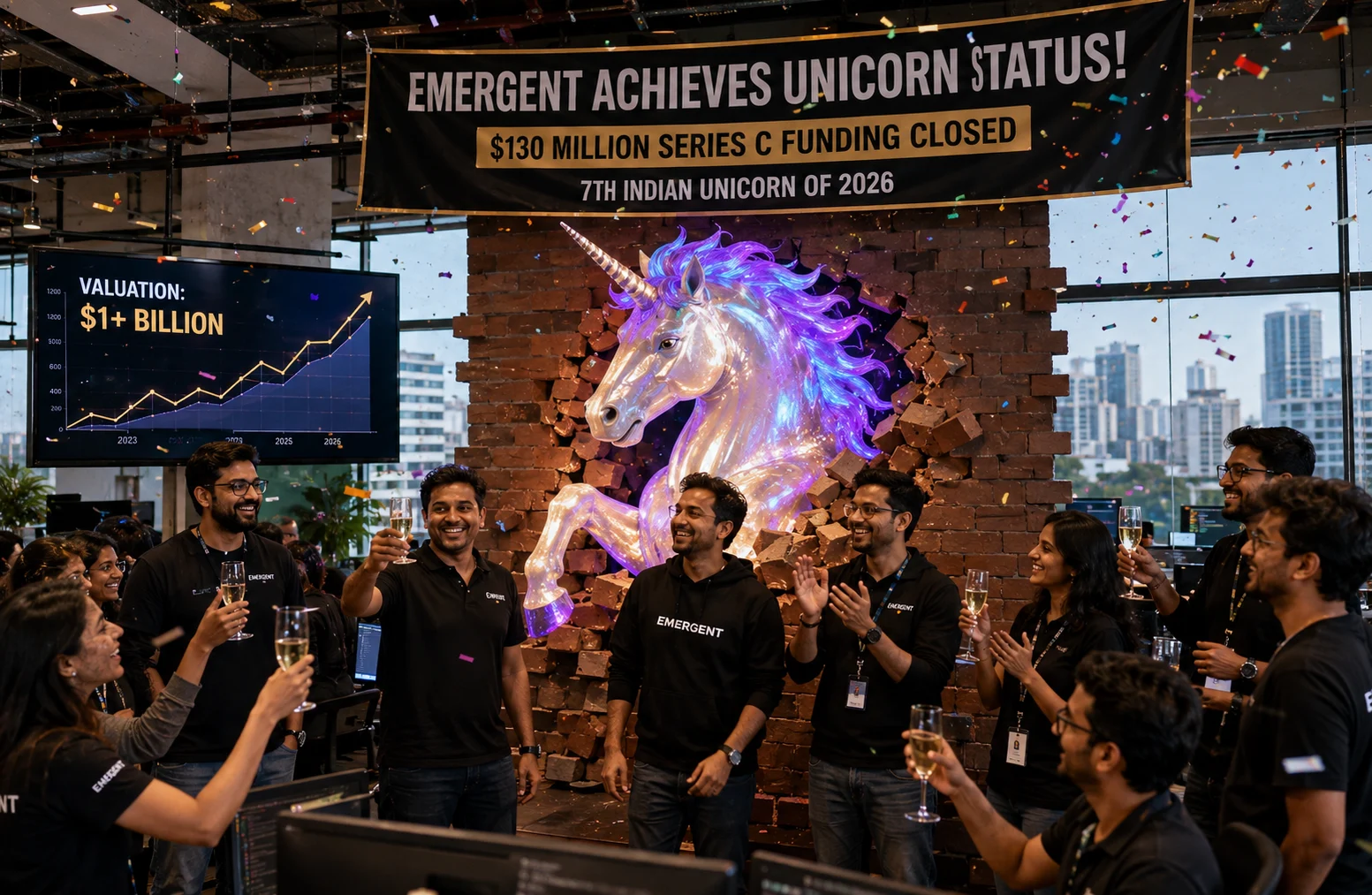
A little over a year ago, Emergent did not exist as a public product. Today, it is worth $1.5 billion. The Bengaluru-and-San-Francisco-based AI software creation platform has closed a $130 million Series C funding round led by private equity firm Creaegis, officially joining India's unicorn club as its seventh new entrant of 2026 and, more specifically, the third AI-focused startup to reach that milestone within the same year, following AI infrastructure company Neysa and sovereign-language-model builder Sarvam AI.
What makes Emergent's story worth pausing on is not simply the size of the round, $130 million is a large number but hardly unprecedented in a year that has already seen India produce a $900 million fintech mega-round and a $600 million AI infrastructure deal. It is the speed. Emergent went from a September 2025 Series A of $23 million to a $1.5 billion valuation in roughly ten months, a climb that puts it among the fastest companies in Indian startup history to cross the unicorn threshold, and one of the fastest globally in the current AI coding boom specifically.
What Emergent Actually Does
Emergent belongs to a category of software that has come to be known, somewhat informally, as vibe coding, AI-powered platforms that let people build functional, production-grade software applications simply by describing what they want in plain English, without writing a single line of code themselves. Rather than dragging and dropping interface elements the way older no-code tools required, a user on Emergent types out what they want built, and the platform's underlying system takes over from there.
Under the hood, that system is not a single AI model doing everything at once. It is a coordinated network of specialised, autonomous AI agents, each handling a distinct part of the software-building process. One agent focuses on designing the user interface. Another configures the backend database structure. A third writes the actual application code. Additional agents handle testing, deployment, and integration, working in sequence and in parallel to turn a plain-language prompt into a working, deployable piece of software, the kind of full development team a small business would traditionally have had to hire, or outsource to an expensive agency, compressed into a single automated pipeline.
This multi-agent architecture, rather than a single monolithic AI model attempting the entire task at once, reflects a broader shift that has taken hold across the AI industry over the past two years, as developers of these systems have increasingly found that breaking a complex task into smaller, specialised sub-tasks, each handled by an agent fine-tuned or prompted for that specific job, tends to produce more reliable results than asking one general-purpose model to handle everything simultaneously. In Emergent's case specifically, that architecture also allows the platform to iterate and improve individual components of the pipeline independently, refining how well the interface-design agent performs, for instance, without needing to retrain or adjust the agents responsible for backend logic or deployment.
The end result, from a user's perspective, is meant to feel closer to giving instructions to a capable technical co-founder than to operating a traditional software tool. A small business owner with no coding background can describe, in ordinary language, what kind of application they need, a booking system for their service business, an inventory tracker for their warehouse, a client portal for their consulting practice, and receive a working, deployable application without ever needing to understand what is happening underneath the request. That accessibility is the entire premise the company is built around, and it is also, notably, the same core premise driving investor enthusiasm across the wider vibe coding category globally.
The applications people have built using Emergent span a genuinely wide range of business needs. Trucking companies have used the platform to build shipment-tracking software. Factories have built internal operations tools. Construction businesses have created enterprise resource planning systems to manage projects and materials. Property managers have built customer relationship management tools to track tenants and maintenance requests. Beyond these more specialised, industry-specific tools, the platform has also been used to build digital storefronts, online marketplaces, and financial dashboards, essentially the full spectrum of software a growing small or mid-sized business might eventually need but historically could not easily afford to build from scratch.
The Funding Story: Three Rounds in Ten Months
Emergent's fundraising history reads like a study in acceleration. The company raised its first institutional round, a $23 million Series A, in September 2025, shortly after its public launch. By January 2026, barely four months later, it had raised a $70 million Series B, pushing its valuation to $300 million. And now, roughly six months after that, the company has closed a $130 million Series C at a $1.5 billion valuation, a fivefold increase from its Series B valuation in under half a year. Across all three rounds, Emergent has raised a combined $230 million in total funding.
Here is that trajectory laid out visually, round by round:
Series A (Sep 2025) | ███ $23M raised
Series B (Jan 2026) | █████████ $70M raised, $300M valuation
Series C (Jul 2026) | ████████████████ $130M raised, $1.5B valuation
Valuation growth across the same period:
Jan 2026 | ██ $300 Million
Jul 2026 | ████████████████████████████████ $1.5 Billion
One structural detail of the Series C round is worth flagging specifically, since it speaks to how investors are reading the deal. The full $130 million was raised as clean, primary capital, meaning the money goes directly onto Emergent's balance sheet to fund growth, rather than being used to buy out existing shares from founders, employees, or earlier investors looking for partial liquidity. Rounds structured this way are typically read by the market as a stronger signal of long-term investor conviction than rounds that include a meaningful secondary component, since every dollar in a clean primary round is a direct bet on the company's future rather than an exit opportunity for people already holding shares.
Who Is Backing the Round
The Series C was led by Creaegis, a private equity firm, with MNI Ventures-Claypond Capital and Sentinel Global joining as co-lead investors. Existing backers from Emergent's earlier rounds also returned to participate, including Khosla Ventures, SoftBank's Vision Fund 2, Lightspeed, and Y Combinator, the influential Silicon Valley accelerator through which Emergent likely built some of its earliest connections in the American venture ecosystem.
Speaking about the investment, Creaegis Managing Partner Prakash Parthasarathy framed the opportunity around small businesses now having a historic chance to build and automate using autonomous platforms in ways that were previously out of reach, addressing disadvantages smaller companies have long faced compared to larger, better-resourced competitors. That framing lines up closely with how Emergent's own founders have described the company's mission: making production-grade software accessible to people and businesses who could never have afforded to commission it through traditional means.
Creaegis's involvement as lead investor is itself worth a brief note, since private equity firms have traditionally been more associated with later-stage, cash-flow-generating businesses than with fast-growing, venture-style technology startups still burning capital to fuel growth. Its willingness to lead a round of this size into a company barely a year old reflects a broader blurring of lines that has taken hold across global investing over the past two years, as private equity firms increasingly compete directly with traditional venture capital funds for access to the highest-conviction AI deals, drawn by the outsized growth rates and revenue multiples the category has demonstrated so far.
Who Is Behind Emergent
Emergent was founded by twin brothers Mukund Jha and Madhav Jha, who built the company with a dual base spanning San Francisco and Bengaluru, a structure that has become increasingly common among the current wave of Indian-founded AI startups looking to combine access to Silicon Valley's investor networks and enterprise customer base with India's deep and comparatively cost-efficient engineering talent pool.
That dual-headquarters model has become something of a signature pattern among the most successful Indian-founded AI companies to emerge over the past two years, and it reflects a deliberate strategic calculation rather than a simple accident of where the founders happened to be living. Positioning fundraising, investor relations, and much of the go-to-market and customer-facing work out of San Francisco gives a company like Emergent direct proximity to the venture capital firms, enterprise customers, and broader AI industry conversation that still overwhelmingly centres on the Bay Area, while keeping core engineering and product development anchored in Bengaluru allows the company to build and scale its technical team more cost-efficiently than a purely US-based competitor could manage at the same funding level. Y Combinator's involvement as a backer fits this same pattern closely, the accelerator has increasingly served as a bridge specifically for this kind of dual-geography startup, helping Indian-founded companies establish credibility and connections within the Silicon Valley ecosystem from very early in their life.
According to remarks from co-founder Madhav Jha in coverage of the round, the company's customer base breaks down roughly into thirds, about a third of revenue currently comes from North America, another third from Europe, and the remainder from a mix of other markets, with the company noting particularly strong and growing traction in Southeast Asia, the Middle East, Australia, and South America. That geographic spread, unusually broad for a company barely a year past its public launch, is part of why the round drew as much investor interest as it did, Emergent is not simply a domestic Indian success story or a narrowly regional player, it has built genuinely global demand in a remarkably short window.
The Numbers Behind the Hype
Valuation multiples alone can sometimes obscure whether a company is actually generating meaningful business results, so it is worth looking specifically at Emergent's underlying traction metrics rather than just its funding headlines. According to the company, Emergent has surpassed 200,000 paying customers, an unusually large customer base for a company at this stage, and has reached a $120 million annualised revenue run rate. Users on the platform have collectively built more than 12 million applications since launch.
Those figures matter because they suggest Emergent's rapid valuation growth is being driven, at least in part, by genuine commercial traction rather than purely speculative enthusiasm about the AI coding category in the abstract. A $120 million annualised revenue run rate against a $1.5 billion valuation implies a revenue multiple in a range that, while certainly generous by traditional software industry standards, is not entirely disconnected from the company's actual business performance the way some of the more speculative AI valuations circulating in the broader market currently appear to be.
Why Businesses Are Choosing Emergent Over Traditional Development
The core economic pitch behind Emergent, and the broader vibe coding category it belongs to, comes down to cost and speed. According to the company, custom software development through traditional means, hiring developers directly, contracting a software agency, or working with freelance engineers, typically costs anywhere from $50,000 to $500,000 depending on the complexity of the project, timelines that often stretch across many months. Emergent's pitch is that platforms like its own can deliver broadly comparable outcomes, a working, production-ready application solving a specific business need, for somewhere between $1,000 and $5,000, a reduction of well over 90 percent in most cases.
Here is that cost comparison laid out simply:
Traditional custom software | ████████████████████████████████ $50,000 to $500,000
Emergent AI-built software | █ $1,000 to $5,000
That gap helps explain why the company's customer base skews so heavily toward smaller businesses, trucking operators, factory owners, property managers, and construction firms, the kind of companies that have historically been priced entirely out of custom software development and have instead had to rely on generic, off-the-shelf tools that only partially fit their specific operational needs. For that segment of the market, the difference between a five-figure-to-six-figure custom software budget and a four-figure one is not simply a discount, it is the difference between being able to commission custom software at all or not.
Where Emergent Fits Inside a Much Bigger Global Trend
Emergent is not operating in an empty field. AI-assisted and AI-driven coding has become one of the single hottest categories in global venture capital over the past two years, drawing enormous sums of capital into a small cluster of competing platforms. Companies including Lovable, Replit, and Cursor have each raised funding rounds worth billions of dollars collectively as they compete to build tools that let developers, and increasingly non-developers, build software faster with AI doing an ever-larger share of the actual coding work.
The scale of capital flowing into this category globally puts Emergent's own trajectory in useful perspective. Cursor's developer, Anysphere, has been valued in the tens of billions of dollars in recent funding rounds. Replit has similarly drawn major venture backing as it repositions itself around AI-assisted app creation for both professional developers and hobbyists. Lovable, a Swedish entrant into the same broad category, became one of Europe's fastest-growing startups in its own right, reportedly reaching a multi-billion-dollar valuation within roughly a year of launch, a timeline strikingly similar to Emergent's own path in India. Taken together, these companies represent a global venture capital land rush around the basic premise that a meaningful share of software development work, long considered one of the most durable, well-compensated professional skill sets in the modern economy, can now be substantially automated by AI systems capable of translating plain-language intent directly into working code.
What differentiates Emergent's specific positioning within that crowded field, according to its own framing and early coverage of the company, is its emphasis on serving non-technical founders, entrepreneurs, and small businesses directly, rather than primarily targeting professional software developers looking to speed up their existing workflows, which has been the more common starting point for several of its higher-profile, more developer-focused competitors. That distinction, targeting people who could not code at all rather than people who already can but want to code faster, is a meaningfully different market bet, one that trades a smaller, more technically sophisticated user base for a potentially much larger pool of small businesses and non-technical founders who have never previously been customers of any software development tool at all.
That positioning also means Emergent is, in some respects, competing less directly against the other AI coding unicorns and more against an entirely different, much larger incumbent: the traditional custom software development and IT services industry itself, an industry India knows intimately, having built much of its modern economy around exactly that kind of outsourced technical services work for global clients. If AI-driven platforms like Emergent genuinely succeed in compressing what used to be a $50,000-to-$500,000, multi-month software project into a $1,000-to-$5,000, same-day undertaking, the disruption implied extends well beyond the small cluster of venture-funded competitors chasing the same category, and into the much larger, less glamorous world of freelance developers, small development agencies, and boutique software consultancies that have long served exactly the small-business customer segment Emergent is now targeting directly.
India's Unicorn Class of 2026: A Full Accounting
Emergent's arrival brings India's 2026 unicorn count to seven, and the composition of that list tells its own story about where investor conviction has concentrated this year. Here is the full chronological rundown.
Juspay became India's first unicorn of 2026 in January, after a $45 million Series D round led by Kedaara Capital valued the Bengaluru-based payments infrastructure company at $1.2 billion. Founded back in 2012, Juspay had spent well over a decade building out payment processing technology before crossing the billion-dollar threshold, a notably longer runway than several of the companies that would follow it onto the 2026 list.
Neysa followed in February, an AI cloud infrastructure and GPU computing platform based in Mumbai and founded by Sharad Sanghi, which raised a large round led by Blackstone to become one of the year's largest single AI infrastructure bets in India, reaching unicorn status in under three years from founding, one of the fastest climbs on the entire 2026 list.
KreditBee joined the club on April 8, after a $220 million Series E round led by Motilal Oswal, Hornbill Capital, and Dragon Funds valued the Bengaluru-based digital lending platform at $1.5 billion, the same valuation level Emergent would later reach.
Skyroot Aerospace became India's first-ever private spacetech unicorn on May 7, after a $50 million Series C round led by Sherpalo Ventures and GIC valued the Hyderabad-based orbital launch vehicle manufacturer at $1.1 billion, a milestone widely covered as a symbolic marker of how far India's private space sector had come since the government first opened the industry to private participation.
Square Yards entered the club in late June, after a roughly $95 million round valued the proptech and real estate transactions platform at over a billion dollars, becoming one of the year's rare unicorns from outside fintech, AI, or deep tech specifically.
Sarvam AI crossed the threshold in early July, after closing the first tranche of a $234 million Series B round at a $1.5 billion valuation, becoming the year's second AI-focused unicorn and drawing global attention for its ambitious plan to build a trillion-parameter foundational AI model tailored to India's many languages.
And now Emergent completes the list as the seventh entrant, and the third AI-focused company to join in 2026 alongside Neysa and Sarvam.
Here is that full 2026 timeline laid out visually:
Jan 2026 | Juspay | $1.2B Payments infrastructure
Feb 2026 | Neysa | ~$1.4B AI cloud infrastructure
Apr 2026 | KreditBee | $1.5B Digital lending
May 2026 | Skyroot Aerospace | $1.1B Space launch vehicles
Jun 2026 | Square Yards | $1B+ Proptech
Jul 2026 | Sarvam AI | $1.5B Sovereign AI models
Jul 2026 | Emergent | $1.5B AI software creation
A few patterns jump out from that list. Three of the seven, Neysa, Sarvam AI, and Emergent, are AI companies, underscoring just how dominant artificial intelligence has become as a theme within India's highest-conviction venture bets this year. Two of the seven, KreditBee and Emergent, share an identical $1.5 billion valuation, purely coincidentally, but a useful marker of where a meaningful cluster of India's newest unicorns are currently priced. And the speed differential is stark: while KreditBee, Skyroot, and Square Yards each took somewhere between roughly eight and twelve years from founding to reach unicorn status, the normal timeline for most Indian startups historically, Neysa, Sarvam AI, and Emergent each did it in under three years, with Emergent's roughly one-year journey standing out as the single fastest of the entire group.
The sector composition of this year's list also marks a meaningful departure from the pattern that defined India's earlier waves of unicorn creation. During India's 2021 boom, when 45 startups joined the unicorn club in a single year, the list was dominated overwhelmingly by consumer internet categories, food delivery, e-commerce, edtech, and fintech apps chasing rapid user growth, often with limited attention paid to near-term profitability. The 2026 cohort looks structurally different. Alongside the three AI companies, the list includes a payments infrastructure provider, a digital lender, a space technology manufacturer, and a proptech platform, businesses spanning enterprise technology, deep tech, and financial infrastructure rather than consumer apps chasing daily active user counts. Investors and analysts covering the Indian startup ecosystem have pointed to this shift as evidence that capital is increasingly rewarding companies with clearer paths to sustainable revenue and defensible technology moats, rather than the growth-at-all-costs model that characterised much of the 2021 unicorn class, several of which have since struggled with down rounds, layoffs, or business model pivots in the years since.
Reading the Valuation Growth Honestly
A fivefold valuation increase in under six months is, by any reasonable standard, an extraordinary rate of growth, and it is worth applying a measure of scrutiny rather than simply repeating the number uncritically. Valuations at this stage of a company's life are determined by what a relatively small number of investors are willing to pay for a stake in a private company, based on their own read of the company's growth trajectory, competitive position, and the broader appetite in the market for exposure to the AI coding category specifically. They are not the same thing as a public market valuation arrived at through the trading activity of thousands of independent buyers and sellers, and they can move very quickly in either direction based on sentiment shifts that have little to do with a company's underlying fundamentals changing at anything like the same pace.
That said, the traction figures Emergent has disclosed, 200,000 paying customers and a $120 million revenue run rate, provide a meaningfully more concrete basis for evaluating the round than headline valuation multiples alone would offer. A company generating real, recurring revenue from a large and rapidly growing customer base is on fundamentally different footing than one whose valuation rests purely on projected future potential with little current commercial activity to point to. Whether $1.5 billion turns out to be a fair long-term valuation for that level of business activity will only become clear over the following several years, as the company either continues scaling revenue at a pace that justifies the multiple or, as has happened to other fast-rising startups before it, finds growth harder to sustain once the initial novelty and investor enthusiasm around a hot new category begins to cool.
What Emergent Plans to Do With the Money
According to the company, the fresh capital will go toward several specific priorities. Hiring is a major one, Emergent intends to expand its talent base across both the United States and India, building out engineering, research, and go-to-market teams on both sides of its dual headquarters structure. On the product side, the company plans to accelerate development work specifically aimed at improving the success rate of applications built on its platform, along with strengthening the core AI agent workflows that power the entire system, an acknowledgment, implicit in that framing, that not every AI-generated application currently works flawlessly on the first attempt, and that improving that reliability is a clear near-term priority.
The company has also said it is working to support more complex AI applications going forward, including ones that can run on local and open-source AI models rather than relying exclusively on proprietary, cloud-hosted models, a technically significant expansion that would let Emergent-built applications operate with more flexibility, potentially lower ongoing costs, and greater data privacy control for customers who need it. Geographic expansion is another stated priority, with the company specifically noting it is considering opening an office in Europe, where it says it has already been seeing significant customer traction well ahead of any formal local presence.
The emphasis on local and open-source model support is worth dwelling on briefly, since it points to a specific technical limitation many AI-generated software platforms currently face. Applications built entirely around proprietary, cloud-hosted AI models can carry ongoing per-use costs that scale with usage, and can raise data privacy or regulatory concerns for business customers operating in sensitive industries or jurisdictions with strict data residency requirements. A platform capable of building applications that run on local or open-source models instead removes some of that ongoing dependency, giving business customers, particularly larger enterprise customers Emergent may eventually want to court beyond its current small-business base, more control over where their data lives and how their software's underlying costs scale over time.
Risks and Open Questions
Enthusiasm around Emergent's rise should not obscure a few genuine open questions that will determine whether this becomes a durable, long-term business rather than a spectacular but short-lived beneficiary of a particularly hot funding cycle. The AI coding category as a whole is crowded and extremely well-capitalised, and competition for the same broad pool of small-business and non-technical customers is likely to intensify rather than ease as larger, better-funded rivals like Replit and Cursor continue expanding their own product offerings downward toward less technical users, narrowing the specific positioning gap Emergent has used to differentiate itself so far.
There is also a churn and retention question that matters more for this category than it might for more conventional software businesses. Building an application is, for many small-business customers, a one-time or infrequent need rather than an ongoing subscription relationship in the way, say, accounting software or a customer relationship management platform would be. Whether Emergent can convert its 200,000 paying customers into a genuinely durable base of repeat, ongoing revenue, rather than a large but comparatively transient pool of one-off project fees, is likely to be one of the more closely watched metrics among its investors over the coming year, even though the company has not publicly disclosed detailed retention figures alongside its headline revenue run rate.
Finally, there is a broader question hanging over the entire vibe coding category that extends well beyond any single company: how good, really, is AI-generated software at handling genuinely complex, mission-critical business logic, as opposed to more straightforward applications like storefronts, dashboards, and tracking tools. Emergent's own stated plan to invest fresh capital specifically into improving the success rate of applications built on its platform is itself a quiet acknowledgment that this remains a work in progress rather than a fully solved problem, and how quickly that reliability improves will likely shape how far up the complexity ladder the company, and the category as a whole, can credibly move.
Common Questions, Answered
What exactly does Emergent build?
Emergent is an AI platform that lets users build production-ready web and mobile software applications by describing what they want in plain English, using a network of autonomous AI agents that handle interface design, backend configuration, coding, and deployment, without the user needing any coding knowledge themselves.
How much funding has Emergent raised in total?
The company has raised $230 million across three rounds since September 2025: a $23 million Series A, a $70 million Series B at a $300 million valuation, and now a $130 million Series C at a $1.5 billion valuation.
Who is behind Emergent's Series C round?
Private equity firm Creaegis led the round, with MNI Ventures-Claypond Capital and Sentinel Global as co-lead investors, alongside returning backers Khosla Ventures, SoftBank Vision Fund 2, Lightspeed, and Y Combinator, all of whom had also participated in at least one of Emergent's two earlier rounds.
Is Emergent India's only AI unicorn this year?
No. It is the third AI-focused startup to reach unicorn status in India in 2026, following AI cloud infrastructure company Neysa in February and sovereign AI model builder Sarvam AI in July, both of which reached the milestone in under three years from their own founding.
How is Emergent different from competitors like Replit or Cursor?
Emergent has positioned itself around serving non-technical founders and small businesses directly, rather than primarily targeting professional developers looking to code faster, a different starting customer base than several of its higher-profile competitors in the broader AI coding category, most of whom built their initial products for engineers first.
How fast did Emergent become a unicorn compared to other Indian startups?
Very fast. Emergent reached a $1.5 billion valuation roughly a year after its public launch, compared to the 8-to-12-year timeline that has been typical for several of India's other 2026 unicorns, and even faster than fellow AI unicorns Neysa and Sarvam AI, both of which took under three years.
Was the Series C round structured any differently from typical late-stage rounds?
Yes, notably. The full $130 million was raised as clean primary capital, meaning none of it went toward buying out shares from founders, employees, or existing investors, a structure generally read as a stronger signal of investor conviction than rounds involving a secondary component.
What is Emergent's official annualised revenue run rate?
The company reports a $120 million annualised revenue run rate, alongside more than 200,000 paying customers and over 12 million applications built on its platform to date.
Quick Facts Recap
Emergent raised $130 million in a Series C round led by Creaegis, valuing the company at $1.5 billion
It is India's seventh unicorn of 2026 and the third AI-focused startup to reach that status this year
The company has raised $230 million total across three rounds since its September 2025 Series A
Its valuation grew fivefold, from $300 million to $1.5 billion, in under six months
Emergent reports more than 200,000 paying customers, a $120 million annualised revenue run rate, and over 12 million applications built on its platform
The company was founded by twin brothers Mukund and Madhav Jha, and is based in both San Francisco and Bengaluru
Emergent claims to deliver software for $1,000 to $5,000 that would traditionally cost $50,000 to $500,000 to build
The Series C was a clean primary round, with no secondary shares sold by founders, employees, or existing investors
Whether Emergent's remarkable first year proves to be the start of a genuinely durable, category-defining company or simply the fastest chapter in a broader AI coding gold rush that eventually cools, the milestone itself is already secure. A company that did not exist as a public product in mid-2025 is now, by private market measure, worth more than most of India's decades-old listed businesses, a fact that says as much about how quickly capital is now willing to move behind a compelling AI story as it does about Emergent specifically.
For India's broader startup ecosystem, Emergent's rise adds another data point to a 2026 narrative that has increasingly centred on artificial intelligence as the country's most credible current path to producing globally competitive technology companies, rather than the consumer-app-driven model that defined the previous decade. Whether that narrative holds up as durably as this year's headline numbers suggest will depend less on any single company's funding announcement and more on whether businesses like Emergent, Neysa, and Sarvam AI can convert their current momentum into the kind of long-term, profitable, globally relevant technology companies that outlast a single hot funding cycle, the real test still to come for all three of India's newest AI unicorns.