StartupNews · Breaking News
DPIIT Signs Strategic MoUs: Government Deepens Startup Ecosystem Support Through Five Landmark Partnerships
Agreements with Cashfree Payments, Darwin Dynamics, Vultr India, Cars24, and the Council for Startup India aim to widen access to digital infrastructure, cloud technology, mentorship, and global markets for India's recognised startups
By Startup news · Published · Updated
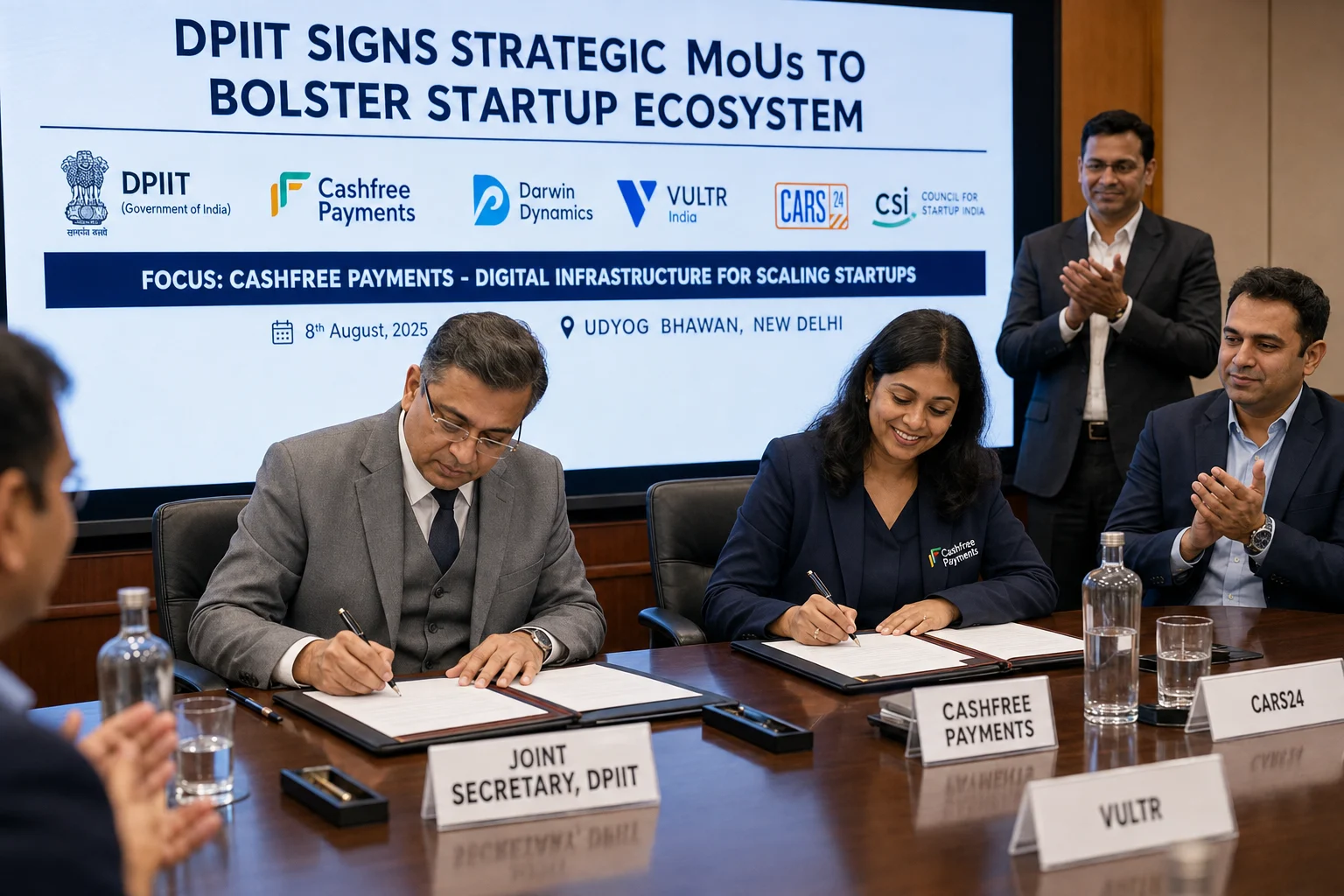
India's startup ecosystem, already the third largest in the world by most counts, just got a fresh round of institutional backing. The Department for Promotion of Industry and Internal Trade (DPIIT), operating under the Ministry of Commerce and Industry, has signed five strategic Memoranda of Understanding (MoUs) with a carefully chosen mix of private-sector leaders and ecosystem enablers: Cashfree Payments, Darwin Dynamics, Vultr India, Cars24 Services, and the Council for Startup India (CSI). The announcement was made through an official release from the Ministry of Commerce and Industry, and it represents one of the more comprehensive single-day pushes by the government to widen practical, on-the-ground support available to India's DPIIT-recognised startups.
What makes this announcement worth paying close attention to isn't just the headline count of five agreements — it's the specific, tangible nature of what each of them actually delivers. This isn't a broad, symbolic statement of government intent; each MoU spells out concrete benefits startups can expect to receive, from discounted cloud computing credits to preferential payment infrastructure to mentorship programs specifically designed for founders in India's smaller towns and rural regions. Together, these five partnerships touch nearly every layer of what an early-stage or scaling startup actually needs to survive and grow: financial infrastructure, cloud technology, mentorship, sector-specific skilling, and access to capital and global markets.
Let's break down exactly what was announced, what each partnership actually offers, and why this kind of institutional, enabler-focused support has become such a central part of how the Indian government approaches startup policy in 2026.
QUICK SNAPSHOT: THE FIVE MoUs AT A GLANCE
Signed By: Department for Promotion of Industry and Internal Trade (DPIIT), Ministry of Commerce and Industry Number of MoUs Signed: 5 Partners: Cashfree Payments India, Darwin Dynamics LLP, Vultr India Pvt Ltd, Cars24 Services Private Limited, Council for Startup India (CSI) Core Focus Areas: Digital payments infrastructure, cloud computing and technology, entrepreneurship in Tier II/III/rural regions, mobility and auto-tech innovation, investment and global market access Eligibility: DPIIT-recognised startups Announcement Date: August 8, 2026 Announcing Body: Ministry of Commerce and Industry, Government of India
THE BIG PICTURE: FIVE PARTNERSHIPS, ONE GOAL
Before diving into each individual agreement, it helps to see the full picture of what this announcement is trying to accomplish. According to the ministry's release, the overarching aim across all five MoUs is to expand access to digital infrastructure, technology, mentorship, investment, and global markets for startups — strengthening the support ecosystem available to DPIIT-recognised ventures and helping them scale sustainably. In other words, this isn't five disconnected deals; it's a coordinated attempt to plug several different gaps that founders commonly run into as they try to grow from an early-stage idea into a scaled, sustainable business.
WHAT EACH PARTNERSHIP PRIMARILY ADDRESSES
Cashfree Payments ████████████████████ Payments & Financial Infrastructure Vultr India ████████████████████ Cloud Computing & Tech Infrastructure Darwin Dynamics ████████████████████ Grassroots Entrepreneurship & Mentorship Cars24 ████████████████████ Mobility, Auto-Tech & AI Innovation Council for Startup India ██████████████ Investment & Global Market Access
Each of these five partners brings a genuinely distinct kind of value to the table, and together, they map fairly neatly onto the practical journey a startup typically goes through — from setting up basic financial and technical infrastructure, to finding mentorship and market access in its early years, to eventually connecting with investors and international opportunities as it scales.
PARTNERSHIP ONE: CASHFREE PAYMENTS — BUILDING FINANCIAL RAILS FOR STARTUPS
Perhaps the most immediately practical of the five agreements is the MoU with Cashfree Payments India, a well-established Indian fintech company known for its payment gateway and payout infrastructure. Under this partnership, DPIIT-recognised startups will gain access to secure and scalable payment and payout solutions, identity verification and risk management services, along with preferential onboarding support and commercial benefits — essentially a fast-tracked, discounted path to setting up the financial plumbing that virtually every consumer-facing or transaction-based startup eventually needs.
Beyond the direct product access, the collaboration goes further into capacity-building. It includes founder workshops, mentoring sessions, AI buildathons, hackathons, and knowledge-sharing programs specifically covering digital payments, regulatory compliance, fraud prevention, Know Your Customer (KYC) processes, cross-border transactions, and emerging financial technologies. For early-stage founders — many of whom are technically strong but less experienced navigating India's often complex financial compliance landscape — this kind of structured, hands-on education could meaningfully reduce the time and cost typically spent figuring out payments infrastructure from scratch.
The official framing from DPIIT describes this collaboration as an effort to combine the department's institutional reach with Cashfree Payments' deep expertise in digital payments, enabling startups to scale efficiently while contributing to India's broader innovation-led growth story. Given that digital payments remain one of the most universally required pieces of infrastructure across nearly every startup vertical — from e-commerce to SaaS to fintech itself — this partnership arguably has one of the widest potential reaches among all five agreements signed.
PARTNERSHIP TWO: VULTR INDIA — DEMOCRATIZING ACCESS TO CLOUD COMPUTING
The second major partnership addresses a cost center that can quietly cripple early-stage startups: cloud infrastructure. DPIIT's collaboration with Vultr India focuses squarely on improving access to cloud computing resources and digital infrastructure — an area where costs can scale unpredictably as a startup's user base and data needs grow, often catching founders off guard well before they've built sustainable revenue to cover it.
Under the partnership, eligible startups will gain access to cloud credits, preferential pricing, and technical support through Vultr's dedicated startup programs. Just as importantly, the collaboration also includes structured training sessions and technical handholding covering cloud computing fundamentals, storage systems, databases, Kubernetes (a widely used system for managing containerized applications), networking, and application deployment — the kind of foundational technical skill-building that can otherwise take founding engineering teams months of trial and error to develop on their own.
CLOUD SUPPORT COMPONENTS UNDER THE VULTR PARTNERSHIP
Cloud Credits ████████████████████ Preferential Pricing ████████████████████ Technical Support ████████████████████ Training: Cloud Computing ██████████████ Training: Databases & Storage ██████████████ Training: Kubernetes ██████████████ Training: Networking ██████████████ Training: Application Deployment ██████████████
Vultr has also indicated it will explore participation in Startup India and DPIIT-led events to further engage with the broader ecosystem and promote wider technology adoption. According to DPIIT's own framing, this partnership is expected to help startups leverage more advanced cloud infrastructure, reduce common barriers to adopting new technology, and accelerate the development of globally competitive digital products — a meaningful benefit given how central cloud infrastructure has become to virtually every category of modern software-driven business, from AI applications to e-commerce platforms to enterprise SaaS tools.
PARTNERSHIP THREE: DARWIN DYNAMICS — TAKING ENTREPRENEURSHIP BEYOND INDIA'S BIG CITIES
Of the five agreements, the MoU with Darwin Dynamics LLP is arguably the most explicitly focused on geographic and social inclusion. Its stated goal is to strengthen entrepreneurship development and foster a more inclusive, innovation-driven startup ecosystem in India — specifically by expanding the reach of the Startup India initiative into Tier II, Tier III, and rural regions, areas that have historically received a smaller share of India's startup investment and infrastructure compared to metro hubs like Bengaluru, Delhi-NCR, and Mumbai.
Under the collaboration, Darwin Dynamics will work to facilitate startup formalisation (helping informal or early-concept ventures navigate the process of becoming properly registered, DPIIT-recognised businesses), strengthen entrepreneurship awareness in underserved regions, support structured capacity-building programs, and promote innovation specifically in strategic sectors including clean energy, green hydrogen, artificial intelligence, climate technologies, and advanced manufacturing — several of which align closely with broader national policy priorities around energy transition and technological self-reliance.
WHY TIER II AND TIER III FOCUS MATTERS
According to broader industry data on India's startup landscape, more than half of all Indian startup activity — over 52% by some industry estimates — now originates from Tier II and Tier III cities, a significant decentralization trend compared to just a few years ago when startup activity was heavily concentrated in a handful of metro hubs. A partnership specifically designed to extend mentorship, institutional networks, market access, and capacity-building support into these regions is, in effect, doubling down on a shift that is already well underway — helping formalize and accelerate momentum that has been building organically across smaller Indian cities and rural areas.
This partnership also carries a notably broader mandate than the others in terms of sector focus, spanning everything from clean energy and green hydrogen to artificial intelligence and advanced manufacturing — suggesting DPIIT sees Darwin Dynamics less as a narrow, single-service provider and more as a broad-based entrepreneurship enablement partner working across multiple strategic sectors the government has prioritized in recent budget cycles.
PARTNERSHIP FOUR: CARS24 — DRIVING INNOVATION IN MOBILITY AND AUTO-TECH
The fourth agreement brings a distinctly sector-specific focus. DPIIT's partnership with Cars24 Services Private Limited — the well-known Indian used-vehicle marketplace and automotive technology company — is aimed at fostering innovation, entrepreneurship, and capacity-building specifically within India's mobility and automotive technology ecosystem.
Startups operating in this space will receive support through founder mentorship programs, mobility and auto-tech-specific skilling initiatives, AI-focused technology enablement, innovation challenges, and hackathons designed to surface new ideas and connect promising founders with relevant industry expertise. The collaboration will also help facilitate investment evaluation processes and broader ecosystem engagement — giving mobility-focused startups a more direct channel to both technical mentorship and capital access than they might otherwise have.
Notably, the partnership's scope also extends into road safety initiatives, according to some official descriptions of the collaboration — an interesting addition that reflects Cars24's position not just as a marketplace business, but as a company with genuine operational depth across vehicle inspection, safety standards, and automotive data, all of which could prove valuable to early-stage mobility and auto-tech startups trying to navigate India's complex vehicle safety and regulatory landscape.
CARS24 PARTNERSHIP: KEY SUPPORT AREAS FOR MOBILITY STARTUPS
Founder Mentorship ████████████████████ Mobility & Auto-Tech Skilling ████████████████████ AI-Driven Technology Enablement ████████████████████ Innovation Challenges & Hackathons █████████████████ Investment Evaluation Support ██████████████ Road Safety Initiatives ██████████████
Given India's rapidly evolving electric vehicle, connected mobility, and auto-tech landscape — sectors that have attracted substantial investor attention in recent years — a dedicated government-industry partnership focused specifically on this vertical could help address one of the more persistent challenges facing mobility startups: the need for deep, sector-specific technical mentorship that generalist startup accelerators often struggle to provide.
PARTNERSHIP FIVE: COUNCIL FOR STARTUP INDIA — THE CAPITAL AND GLOBAL MARKETS BRIDGE
The fifth and final agreement, signed with the Council for Startup India (CSI), rounds out the group by focusing on two areas the other four partnerships touch on only indirectly: investment access and international market expansion. DPIIT's MoU with CSI is designed to strengthen support for DPIIT-recognised startups by facilitating access to investment, strategic partnerships, mentorship, leadership development, and — notably — global markets.
This partnership is arguably the connective tissue that ties the other four together. While Cashfree, Vultr, Darwin Dynamics, and Cars24 each address a specific operational or sector-based need, CSI's mandate is broader and more forward-looking: helping startups that have already built a functioning product and business — potentially with the help of the other four partnerships — take the next step toward raising capital, forming strategic partnerships, developing stronger organizational leadership, and eventually expanding beyond India's borders into international markets.
For founders further along in their growth journey, this kind of dedicated investment and global-market-access support could prove just as valuable as the more foundational infrastructure support offered elsewhere in this package of agreements — addressing the later-stage challenges of scaling a business internationally, rather than just the early-stage challenges of getting one off the ground.
WHY THIS MATTERS: THE SCALE OF INDIA'S STARTUP ECOSYSTEM TODAY
To appreciate why the government continues to invest institutional energy into agreements like these, it's worth stepping back and looking at just how large India's startup ecosystem has become. As of 2026, DPIIT has issued recognition certificates to well over 2 lakh (200,000) startups — a figure that has grown dramatically from just around 350 recognised startups back in 2014, before the Startup India initiative was formally launched in January 2016.
INDIA'S DPIIT-RECOGNISED STARTUP GROWTH (Illustrative Timeline)
2014 ~350 Startups ▌ 2016 Startup India Launched █ 2021 Record 45 Unicorns Added in a Single Year 2025-26 55,200+ New DPIIT Recognitions (Highest Ever in a Single Year) 2026 2.3-2.4 Lakh+ Total DPIIT-Recognised Startups
The financial year 2025-26 alone was, by most measures, the strongest year since the Startup India initiative began, with more than 55,200 startups receiving DPIIT recognition — a year-on-year increase of over 51%, and the highest annual addition on record. Direct employment generated by DPIIT-recognised startups has also grown substantially, with official figures pointing to more than 23 lakh (2.3 million) direct jobs created as of early 2026, up more than 36% year-on-year.
India's broader startup landscape — extending beyond the more formal DPIIT-recognised category to include the full universe of startups tracked by private data providers — is estimated to include well over 600,000 ventures in total, with more than 34,000 of them having raised institutional funding, collectively pulling in hundreds of billions of dollars in venture capital and private equity over the years. India is now widely described as the world's third-largest startup ecosystem, trailing only the United States and China, and is home to well over 100 unicorn companies — startups valued at over $1 billion — a club that has grown from just a handful in the mid-2010s.
INDIA'S STARTUP ECOSYSTEM: KEY NUMBERS (2026)
DPIIT-Recognised Startups: Over 2.3 Lakh (230,000+) Direct Jobs Created: Over 23 Lakh (2.3 Million+) Unicorn Startups: 120+ Global Ranking: 3rd Largest Startup Ecosystem Startups from Tier II/III Cities: Over 52% FY26 New Recognitions: 55,200+ (highest ever in a single year)
It's against this backdrop of rapid, sustained growth that these five new MoUs make the most sense. As the sheer number of DPIIT-recognised startups has climbed past the 200,000 mark, the practical challenge for the government has increasingly shifted from simply encouraging more people to start companies, toward ensuring that this now-enormous base of registered startups can actually access the infrastructure, mentorship, and capital needed to survive their early years and scale into sustainable, competitive businesses. Partnerships with established private-sector players — who already have functioning products, technical expertise, and distribution — represent a far more efficient way to deliver that kind of practical support than the government attempting to build every layer of support infrastructure entirely on its own.
THE POLICY CONTEXT: A DEEPER GOVERNMENT PUSH INTO STARTUPS AND DEEP TECH
These five MoUs don't exist in isolation — they're part of a broader, intensifying policy push that has characterized India's approach to its startup ecosystem through 2025 and into 2026. Union Budget 2026 notably extended eligibility for deep-tech startups to claim certain tax and regulatory benefits from 10 years up to 20 years, reflecting a recognition that deep-technology ventures — those working in areas like semiconductors, advanced AI, biotechnology, and climate technology — typically require significantly longer development timelines before they become commercially viable, compared to more conventional consumer internet or software startups. The same budget also raised the revenue threshold for startups to remain eligible for certain benefits, and introduced a government-backed venture fund worth roughly Rs 10,000 crore (Rs 100 billion) specifically targeting high-risk, high-potential areas including artificial intelligence, advanced manufacturing, semiconductor design, and climate technology.
Speaking at National Startup Day events earlier in 2026, marking ten years since the Startup India initiative was launched, senior government leadership described the program's journey as having evolved well beyond a simple government scheme into what was characterized as a broader, defining movement within India's economic development story — pointing to the growth from fewer than 500 recognised startups in 2014 to well over 200,000 today, and from just a handful of unicorns a decade ago to well over 100 today, as evidence of how deeply entrepreneurship has become embedded in the country's economic mainstream.
Seen in that context, this week's five MoUs represent a continuation, rather than a departure, from the government's established playbook over the past several years: pairing broad, headline policy initiatives — tax breaks, funding schemes, recognition certificates — with more granular, partnership-driven support delivered directly through established private-sector players who already have the infrastructure, expertise, and reach to make a practical difference for individual founders.
A PATTERN, NOT A ONE-OFF: DPIIT'S GROWING NETWORK OF ECOSYSTEM PARTNERSHIPS
It's worth situating this week's announcement within a broader pattern that has become increasingly visible in how DPIIT operates. Over the past several years, the department has steadily built out a growing network of MoUs and formal partnerships with private companies, industry associations, and international bodies — each one narrowly scoped to deliver a specific kind of support, rather than attempting to be a single, all-encompassing government program.
This approach reflects a fairly deliberate shift in how Indian startup policy has evolved since the earliest days of the Startup India initiative back in 2016. In the program's initial years, the emphasis was heavily weighted toward formal recognition, tax benefits, and headline funding schemes like the Fund of Funds for Startups, managed by the Small Industries Development Bank of India (SIDBI), which invests in SEBI-registered Alternative Investment Funds that in turn deploy capital into individual startups. Those foundational programs remain very much in place and continue to matter enormously. But as the ecosystem has matured and grown by orders of magnitude — from a few hundred recognised startups to well over 200,000 — DPIIT's more recent strategy has increasingly emphasized these kinds of targeted, private-sector partnership MoUs as a complementary layer, designed to deliver more immediate, practical, day-to-day value to founders navigating specific operational challenges.
This week's five agreements fit squarely into that evolved playbook. Rather than announcing a new government fund or a new tax incentive, DPIIT has instead brought in specialized private partners — each already operating successful, proven programs of their own in payments, cloud infrastructure, mobility technology, and investment facilitation — and negotiated preferential terms specifically for the DPIIT-recognised startup community. It's a model that scales relatively efficiently: rather than the government building and staffing entirely new cloud infrastructure or payments systems from scratch, it instead leverages the Startup India brand, DPIIT's institutional recognition process, and its extensive reach across the founder community to negotiate better terms and awareness for programs that already exist.
SECTOR SNAPSHOT: WHERE INDIA'S STARTUPS ARE CONCENTRATED TODAY
Understanding which sectors these five new partnerships are likely to benefit most also requires understanding where India's startup activity is currently concentrated. According to various industry trackers, fintech, quick commerce, software-as-a-service (SaaS), healthtech, and electric-vehicle-related mobility remain among the fastest-growing categories within India's startup landscape as of 2026, alongside a rapidly expanding wave of startups building applied artificial intelligence products across nearly every vertical.
WHERE THIS WEEK'S MoUs ALIGN WITH KEY GROWTH SECTORS
Fintech / Digital Payments → Directly supported by Cashfree Payments MoU Cloud-Native SaaS & AI Startups → Directly supported by Vultr India MoU EV & Mobility / Auto-Tech → Directly supported by Cars24 MoU Clean Energy & Climate Tech → Directly supported by Darwin Dynamics MoU Deep Tech & Advanced Manufacturing → Directly supported by Darwin Dynamics MoU Cross-Sector Capital & Global Expansion → Directly supported by CSI MoU
This alignment is unlikely to be coincidental. Fintech and digital payments remain one of the largest and most mature segments of India's startup economy, built on the back of the country's rapid adoption of digital payment rails like the Unified Payments Interface (UPI) over the past several years — making a dedicated payments infrastructure partnership like the Cashfree MoU a natural fit for a huge proportion of India's consumer-facing startups. Similarly, the explosive growth of AI-native and cloud-native software startups across India has made access to affordable, well-supported cloud infrastructure an increasingly universal requirement — explaining why a partnership specifically focused on cloud credits and technical training, like the Vultr India agreement, is likely to see broad demand across a wide range of startup categories, not just those in a single narrow vertical.
INTERNATIONAL CONTEXT: HOW INDIA'S APPROACH COMPARES
It's also worth briefly considering how this style of government-industry partnership compares to approaches taken by other major startup ecosystems globally. In the United States, much of the equivalent support — cloud credits, payment infrastructure discounts, mentorship networks — is typically delivered directly by private accelerators, venture capital firms, and technology companies themselves, often with comparatively limited direct government coordination or branding involved. In contrast, several other major economies actively building out national startup strategies, including Singapore, the United Arab Emirates, and increasingly the United Kingdom, have moved toward models that more closely resemble India's approach here — using a central government body or agency to negotiate and coordinate access to private-sector resources on behalf of a broader, officially recognised startup community.
India's specific advantage in pursuing this model at scale lies largely in the sheer size of its DPIIT-recognised startup base. With well over 200,000 formally recognised startups now eligible to access benefits like these, DPIIT is in a position to negotiate meaningfully favorable terms with private partners — cloud credits, discounted payment processing rates, dedicated mentorship bandwidth — specifically because the potential customer base being unlocked for each partner is enormous. For companies like Cashfree Payments, Vultr India, and Cars24, in turn, these partnerships offer a low-cost, high-credibility channel to reach hundreds of thousands of potential future customers at the earliest stages of their business journey — a mutually reinforcing dynamic that likely explains why this kind of MoU has become such a consistent feature of DPIIT's broader strategy in recent years.
WHAT THIS MEANS FOR FOUNDERS: TURNING ANNOUNCEMENTS INTO ACTUAL BENEFITS
For the hundreds of thousands of DPIIT-recognised founders across India, the immediate practical question is simple: how do these partnerships actually translate into tangible support they can use? Based on the details released so far, the pathway appears to run primarily through each individual partner's own startup programs — meaning founders will likely need to apply directly through Cashfree Payments' startup partnership channels, Vultr India's startup program, or the respective onboarding processes for Darwin Dynamics, Cars24, and CSI, using their DPIIT recognition certificate as the qualifying credential.
This is a fairly standard model for how government-industry MoUs of this kind typically get implemented in India — the government's role is largely to negotiate favorable terms, lend institutional credibility, and help promote awareness of the programs, while the actual delivery of services, credits, mentorship sessions, and technical support happens directly through each private-sector partner's existing infrastructure and teams. For founders, this means the real-world value of these MoUs will likely become clearer over the coming weeks and months, as each partner organization rolls out specific application processes, eligibility criteria, and program details.
It's also worth noting that all five partnerships are explicitly restricted to DPIIT-recognised startups — meaning founders who haven't yet gone through the formal DPIIT recognition process will need to complete that step first before they can access any of the benefits outlined in these agreements. Given that DPIIT recognition itself unlocks a range of other benefits — including tax exemptions under Section 80-IAC, patent application fast-tracking, and simplified compliance requirements — this new round of MoUs adds yet another meaningful incentive for early-stage founders who haven't yet formalized their DPIIT status to do so.
UNDERSTANDING THE JARGON: A QUICK GLOSSARY FOR READERS
Government-industry partnership announcements often come with terminology that isn't always familiar to general readers. Here's a plain-English breakdown of the key terms in this story:
DPIIT (Department for Promotion of Industry and Internal Trade): A department within India's Ministry of Commerce and Industry responsible for formulating and implementing policies related to industrial development, including India's flagship Startup India initiative, which provides official recognition and associated benefits to qualifying startups.
Memorandum of Understanding (MoU): A formal but generally non-binding agreement between two or more parties outlining a shared intention to collaborate on specific goals. Unlike a legally binding contract, an MoU typically expresses mutual commitment and lays out a framework for cooperation, with the specific implementation details often worked out separately afterward.
DPIIT Recognition: An official certification granted by DPIIT to qualifying Indian startups — typically companies under 10 years old (or 20 years for deep-tech startups) with revenue below a specified threshold — that unlocks access to various government benefits, including tax exemptions, patent fast-tracking, simplified regulatory compliance, and, as this story illustrates, eligibility for partnership programs like the ones announced this week.
Tier II and Tier III Cities: A classification system used in India to categorize cities by population size and economic significance, distinct from "Tier I" cities such as Mumbai, Delhi, Bengaluru, and Chennai. Tier II cities include places like Jaipur, Lucknow, and Coimbatore, while Tier III typically refers to smaller cities and towns — categories that have seen rapidly growing startup activity in recent years as infrastructure and digital connectivity have improved nationwide.
Ecosystem Enabler: A broad industry term referring to organizations — whether private companies, industry bodies, or nonprofit institutions — that provide supporting infrastructure, services, mentorship, or capital access to startups, as distinct from the startups themselves or the venture capital firms that directly fund them.
Cloud Credits: A common industry practice where cloud computing providers offer new or early-stage companies free or heavily discounted access to computing, storage, and infrastructure resources, reducing the upfront cost burden of building and scaling a digital product before a startup has significant revenue.
Section 80-IAC: A provision in India's Income Tax Act that allows DPIIT-recognised startups to claim a 100% tax deduction on profits for three consecutive financial years out of their first ten years of operation (extended to twenty years for eligible deep-tech startups), provided they meet specific eligibility criteria.
WHAT TO WATCH NEXT
As these five partnerships move from announcement to actual implementation, a few developments will help indicate how meaningfully they end up impacting India's startup ecosystem:
Rollout of specific application processes: Each partner organization will need to publish clear, accessible details on how DPIIT-recognised startups can actually apply for and access the benefits outlined in their respective MoUs — the speed and clarity of this rollout will be an early signal of how seriously each partnership is being operationalized.
Uptake and usage data: Over the coming months, it will be worth watching whether DPIIT or its partners release any data on how many startups have actually accessed cloud credits, payment infrastructure support, mentorship sessions, or other benefits under these new agreements — concrete uptake numbers would offer a much clearer picture of real-world impact than the initial announcement alone.
Expansion of the enabler network: Given that this is far from the first set of ecosystem-partnership MoUs DPIIT has signed in recent years, it's reasonable to expect further agreements with additional private-sector partners across other underserved areas — such as legal and compliance support, specialized hardware and deep-tech infrastructure, or international market entry support — as the government continues to build out a broader network of specialized enablers.
Regional impact in Tier II and Tier III markets: Given the explicit focus of the Darwin Dynamics partnership on smaller cities and rural regions, tracking whether startup formation and DPIIT recognition rates in these areas continue to grow at a faster pace than metro hubs will be an important indicator of whether this specific partnership is achieving its stated inclusion goals.
Renewal and expansion terms: MoUs of this kind typically run for a defined initial period before being reviewed, renewed, or expanded based on how well they've performed. Whether DPIIT and its five partners eventually broaden the scope of these agreements — adding new benefits, extending eligibility, or bringing in additional co-partners — will be a useful longer-term signal of how successful this specific round of partnerships is judged to have been internally.
THE BOTTOM LINE
DPIIT's five new strategic MoUs represent a practical, if not especially flashy, continuation of India's decade-long effort to build institutional depth behind its startup ecosystem. Rather than a single sweeping policy announcement, this is a coordinated set of targeted partnerships — each addressing a distinct, tangible gap in what founders need to build and scale a business, from payment infrastructure and cloud computing to sector-specific mentorship in mobility and rural entrepreneurship, and finally to investment and global market access for startups ready to take their next big step.
With India's DPIIT-recognised startup base now well past the 200,000 mark, and with the ecosystem having added a record 55,200-plus new recognitions in the most recent financial year alone, the sheer scale of India's startup landscape has arguably outgrown what government policy and funding schemes alone can meaningfully support. Partnerships like these — pairing DPIIT's institutional reach and recognition framework with established private-sector expertise in payments, cloud infrastructure, mobility technology, and investment access — represent a pragmatic way to extend that support further, without requiring the government to build every layer of infrastructure entirely on its own.
Whether these five agreements ultimately translate into meaningful, measurable benefits for the hundreds of thousands of startups eligible to access them will depend heavily on execution over the coming months — how quickly and clearly each partner rolls out its programs, how many founders actually take advantage of them, and whether this becomes a template for further expansion, or simply one more entry in an already long list of government-industry MoUs. For now, though, this announcement adds another concrete layer of support to an ecosystem that, by nearly every available measure, continues to grow at a genuinely remarkable pace — one more building block in a decade-long effort to turn India's startup ambitions into durable, globally competitive businesses.
This is a story worth revisiting in a few months' time, once real numbers on startup uptake, program usage, and founder feedback begin to emerge.
(This article is based on the Ministry of Commerce and Industry's official announcement of DPIIT's five strategic MoUs, dated August 8, 2026, along with subsequent public reporting on the specific terms of each partnership and broader context on India's startup ecosystem as of mid-2026. Figures related to startup counts, unicorns, jobs created, and funding are drawn from publicly available government and industry data and are subject to periodic revision as official statistics are updated. Founders seeking to apply for benefits under any of these partnerships are encouraged to consult the official Startup India portal and each partner organization's own program pages for the most current eligibility criteria and application details.)