StartupNews · Breaking News
DeepSeek Resumes $8 Billion Funding Round: Chinese AI Giant Eyes $74 Billion Valuation Following V4 Flash Release
Hangzhou-based startup restarts its second fundraising push weeks after pausing talks over leaked founder comments, riding fresh momentum from a model that's reset expectations for AI cost efficiency
By Startup news · Published · Updated
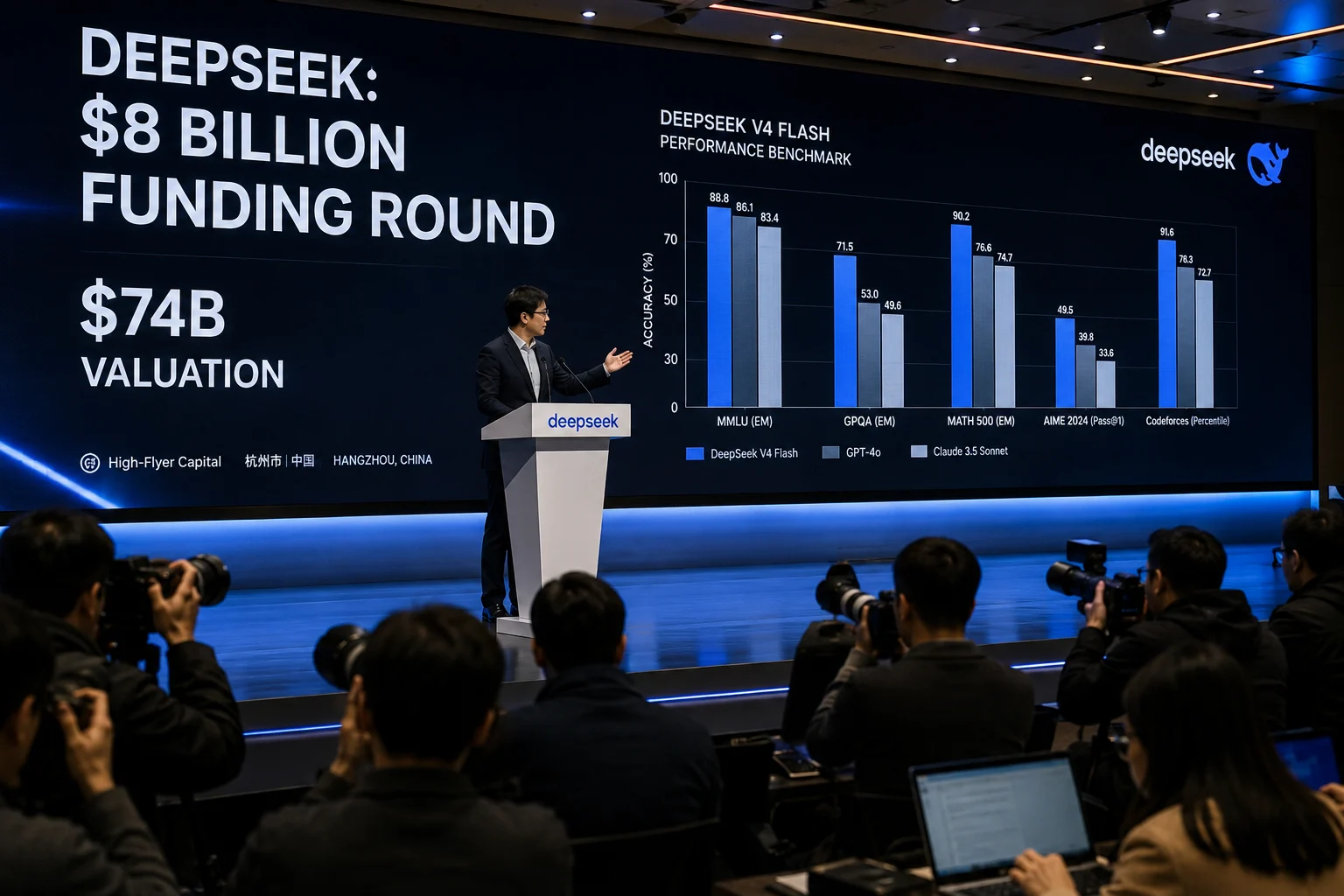
China's most closely watched artificial intelligence company is back at the fundraising table, and this time it's aiming even higher. DeepSeek has resumed its second round of outside funding, according to a Bloomberg report citing people familiar with the matter, targeting close to $8 billion in fresh capital at a valuation of roughly 500 billion yuan — approximately $74 billion. The Hangzhou-based AI lab, which stunned global markets in January 2025 with a model that upended assumptions about how expensive frontier AI development had to be, is once again positioning itself at the center of a conversation about cost, capability, and China's place in the global AI race.
The round comes with a notable backstory. DeepSeek had originally paused this same fundraising push in late July 2026, just days after viral comments attributed to founder Liang Wenfeng about US-China AI competition circulated widely online — comments the company never confirmed as authentic, but which reportedly frustrated both DeepSeek's leadership and some of the investors it was courting. Now, roughly two weeks later, the round is back on, and DeepSeek appears to be riding a wave of renewed momentum driven largely by the reception to its newly released V4 Flash model — an efficiency-focused AI system that has once again put competitors on notice about just how cheaply DeepSeek can deliver frontier-level performance.
This is the story of what's actually being reported, how DeepSeek got here, what triggered the funding pause and its subsequent resumption, why V4 Flash matters so much to this narrative, and what a $74 billion valuation would actually mean for one of the most consequential and controversial companies in global AI.
QUICK SNAPSHOT: THE DEEPSEEK FUNDING ROUND AT A GLANCE
Target Raise: Close to $8 billion Target Valuation: Approximately 500 billion yuan (~$74 billion), pre-money Previous Round: $7 billion raised in late May 2026 at a $52 billion valuation (~350 billion yuan) Round Status: Paused July 25, 2026; resumed on or around August 6, 2026 Reported Reason for Pause: Frustration over viral, unverified comments attributed to founder Liang Wenfeng Reported New Investor in Talks: Monolith Management (Hong Kong-based hedge fund, also a backer of Moonshot AI) Existing Syndicate Members: China's national AI investment fund, NetEase, JD.com, IDG Capital, Loyal Valley Capital, Shixiang Capital Key Catalyst for Renewed Momentum: Release of the V4 Flash AI model DeepSeek's Reported Annualized Revenue: Approximately $400-500 million Use of Proceeds: Data center construction, including a new multibillion-dollar facility in Inner Mongolia, and additional AI chip acquisition Potential Future Milestone: A mainland China IPO on the Shanghai STAR Market, possibly filed by end-2026 for a 2027 listing
THE FUNDING ROUND, IN DETAIL
According to Bloomberg's report, published Thursday, August 6, 2026, DeepSeek has reopened a fundraising effort it had quietly shelved just under two weeks earlier. The company is now seeking close to $8 billion in fresh capital, at a valuation close to 500 billion yuan — roughly $74 billion at current exchange rates. Sources familiar with the discussions, who were not authorized to speak publicly, told Bloomberg that Monolith Management, a Hong Kong-based hedge fund, is currently in talks to participate in the round.
Monolith may not be a household name to most readers, but its profile has grown considerably in recent months due to its position as a backer of Moonshot AI, the company behind the Kimi series of AI models. Moonshot's Kimi K3 model has had a disruptive effect on global AI markets similar in some respects to DeepSeek's own earlier breakthroughs — rattling US tech stocks by demonstrating, once again, that Chinese AI labs can move quickly and competitively on comparatively modest budgets. Monolith's potential involvement in DeepSeek's round, alongside its existing stake in one of DeepSeek's most direct domestic rivals, adds an interesting layer to this story: the same pool of sophisticated, forward-positioned capital appears to be spreading bets across multiple leading Chinese AI labs simultaneously, rather than backing a single "national champion" exclusively.
Beyond Monolith, the round's existing investor syndicate reportedly already includes a genuinely formidable mix of participants: China's national AI investment fund (a state-backed vehicle specifically created to support the country's AI industry), major internet and e-commerce players NetEase and JD.com, and venture investors IDG Capital, Loyal Valley Capital, and Shixiang Capital. According to at least one report, signing on this round is expected to be completed by late August 2026 — though it's worth treating specific timing details with some caution, since much of the granular reporting on this round remains single-sourced to Bloomberg and framed as informed reporting rather than official company disclosure.
FUNDING TRAJECTORY: FROM $52 BILLION TO A TARGETED $74 BILLION
First Round (Closed May 2026) $7 Billion raised Valuation: ~$52 Billion ████████████████ Second Round (Target, Aug 2026) ~$8 Billion targeted Valuation: ~$74 Billion ████████████████████████
The scale of the valuation jump here is worth sitting with for a moment. DeepSeek's first funding round, which closed near the end of May 2026, raised approximately $7 billion (around 50 billion yuan) at a post-money valuation of roughly $52 billion (about 350 billion yuan). This new round, targeting a similar amount of fresh capital — close to $8 billion — is being raised at a pre-money valuation approaching $74 billion, representing an increase of roughly 42% from the previous round's valuation in the space of just a few months. For context, industry commentary has pointed out that this specific pattern — raising a similar dollar amount to a previous round, but at a meaningfully higher valuation — means new investors in this round are effectively paying more for a smaller ownership stake than investors in DeepSeek's first round received for a comparable check size, a dynamic typically associated with genuinely intense, high-conviction investor demand.
THE PAUSE: WHAT HAPPENED IN LATE JULY, AND WHY
To understand why this round's resumption is itself newsworthy, it's worth revisiting exactly what caused DeepSeek to hit pause in the first place. According to a Bloomberg report from July 25, 2026, DeepSeek told prospective investors it was suspending its second fundraising round — just days after viral comments, widely attributed to founder Liang Wenfeng, began circulating online regarding US-China competition in artificial intelligence.
Crucially, these comments were never verified as authentic, and Bloomberg's reporting specifically noted this uncertainty. The remarks were said to originate from a transcript of a meeting Liang reportedly held with unidentified parties, in which he discussed DeepSeek's reliance on Nvidia's chips for AI development, along with comments suggesting China continues to lag behind the United States in AI sophistication — a notably candid, and politically sensitive, admission for the founder of a company that has become something of a national symbol of Chinese AI capability to make, whether or not the remarks were genuinely his.
TIMELINE: THE PAUSE-AND-RESUME SAGA
May 2026 DeepSeek closes first funding round: $7B raised at $52B valuation Jul 14, 2026 Preliminary talks reported for a second round, targeting ~$71B valuation Jul 15, 2026 Reports emerge of DeepSeek's annualized revenue nearing $500M Jul 25, 2026 DeepSeek pauses second funding round following viral, unverified comments attributed to founder Liang Wenfeng Jul 31, 2026 DeepSeek releases production version of V4 Flash model Aug 6, 2026 DeepSeek resumes second funding round, now targeting ~$74B valuation
Whatever the ultimate truth behind those leaked remarks, their circulation appears to have created enough discomfort — either for DeepSeek's leadership, its prospective investors, or both — that the company chose to pause an already-live fundraising process rather than push forward through the controversy. That's a notable decision in itself: halting a multibillion-dollar capital raise, even temporarily, is not something companies typically do lightly, and it suggests DeepSeek's leadership placed real weight on getting the surrounding narrative right before continuing to court new investors.
The resumption, roughly two weeks later, suggests whatever concerns triggered the pause have since been sufficiently addressed or simply faded from the immediate news cycle — helped along, it appears, by the far more positive story DeepSeek has since had to tell: the successful, well-received release of its V4 Flash model.
THE CATALYST: HOW V4 FLASH REIGNITED DEEPSEEK'S MOMENTUM
If the leaked comments controversy explains why DeepSeek's fundraising stalled, the release of its V4 Flash model goes a long way toward explaining why it's now back on track — and doing so at an even higher valuation than before. DeepSeek shipped the production version of V4 Flash on July 31, 2026, adding enhanced autonomous agent capabilities and notably lower API pricing as the company continues to compete aggressively against both domestic Chinese rivals and Western AI labs.
V4 Flash is, on paper, a genuinely efficient piece of engineering. It's built as a Mixture-of-Experts (MoE) model — an architecture where a large overall model is broken into specialized sub-networks, only a fraction of which are actively used for any given task, dramatically reducing computational cost per query. Specifically, V4 Flash carries 284 billion total parameters, but activates only about 13 billion of them for any individual inference request, and supports an unusually large 1-million-token context window, allowing it to process very long documents, codebases, or conversations in a single pass.
V4 FLASH: KEY TECHNICAL SPECIFICATIONS
Architecture: Mixture-of-Experts (MoE) Total Parameters: 284 Billion Active Parameters per Query: 13 Billion Context Window: Up to 1 Million Tokens Released: April 24, 2026 (preview); July 31, 2026 (production) License: MIT (open weights) Pricing (approx.): $0.14 per million input tokens, $0.28 per million output tokens
On independent benchmarking platforms like Artificial Analysis, V4 Flash has scored competitively against models costing many times more to run, landing well above the median score on composite intelligence benchmarks while pricing itself at a fraction of what comparable Western frontier models typically charge. Some analyses have pointed out that DeepSeek's pricing for V4 Flash sits at roughly one-tenth the cost of premium alternatives while still delivering what several independent reviewers have described as near-frontier performance for coding, reasoning, and agentic workloads — the kinds of tasks increasingly central to how businesses actually deploy AI models in production.
It's worth noting, however, that V4 Flash's reception hasn't been entirely uncritical. Some community leaderboards, including Code Arena, have ranked DeepSeek's V4 models notably behind other Chinese competitors like GLM 5.1 and Kimi K2.6, as well as behind the Western frontier — rankings that reportedly sparked some backlash from segments of the Chinese AI community when commentators characterized the V4 models as merely "mid" rather than genuinely groundbreaking. This tension — strong composite benchmark scores and remarkable cost efficiency on one hand, more mixed community rankings on specific tasks like coding on the other — is a useful reminder that DeepSeek's core value proposition has always rested less on being the single best model available, and more on delivering "good enough" frontier-adjacent performance at a price point that fundamentally reshapes the economics of deploying AI at scale.
THE "DEATH ZONE" PRICING DYNAMIC
Industry commentary following V4 Flash's release has invoked the idea of a "death zone" for rivals unable to match DeepSeek's combination of price and performance — a direct echo of the disruption DeepSeek caused in early 2025, when its earlier models first called into question the prevailing assumption that competitive AI development required enormous capital expenditure. That earlier moment prompted sharp declines in US technology stocks and forced a broader industry reckoning about AI infrastructure spending; V4 Flash appears to be replaying a similar dynamic, even if its market impact this time around has been comparatively more contained.
This pricing pressure cuts in an interesting direction for DeepSeek's own fundraising story. Even as the company pushes down prices for its models — a strategy that squeezes competitors who've built their businesses around charging premium rates for comparable capability — it is simultaneously asking investors to fund an ever-larger, ever-more-expensive AI infrastructure buildout. That apparent tension — aggressive price-cutting on the product side, aggressive capital-raising on the fundraising side — reflects a now-familiar playbook across the AI industry more broadly: accept thin or even negative margins on individual model usage in the near term, in service of capturing market share and usage data that can be monetized more effectively over the longer run.
WHAT THE MONEY WILL ACTUALLY FUND
According to reporting on the round, at least part of DeepSeek's targeted $8 billion is earmarked specifically for data center construction, including a multibillion-dollar facility planned in Inner Mongolia — a region increasingly favored by Chinese technology companies for large-scale data center development, thanks to relatively lower land and energy costs and proximity to renewable power sources. Beyond that specific facility, the broader capital raise reflects DeepSeek's evolving needs as it scales: continued acquisition of AI chips (a persistently sensitive topic given US export restrictions on advanced semiconductors to China), and general infrastructure buildout to support both ongoing model training and the surging inference demand generated by products like V4 Flash.
DeepSeek's unusually fast fundraising cadence — closing one multibillion-dollar round in May and pursuing another already by August — has been linked directly to these capital-intensive infrastructure needs. Building and operating the kind of large-scale AI data center infrastructure required to train and serve frontier-class models is enormously expensive, and DeepSeek's own approach, historically centered on maximizing computational efficiency to work around chip export restrictions, has not eliminated the underlying capital intensity of the business — it has simply changed where and how that capital gets spent.
DEEPSEEK'S BUSINESS: HOW THE COMPANY MAKES MONEY
Understanding why investors are willing to underwrite a $74 billion valuation requires understanding what DeepSeek's actual commercial traction looks like today. According to earlier reporting, DeepSeek had built an annualized revenue base approaching $500 million as of mid-July 2026 — a figure that, while still modest relative to its targeted valuation, represents meaningful and rapidly growing commercial traction for a company that, less than two years ago, was a relatively obscure offshoot of a Chinese hedge fund.
That revenue comes primarily from API access to DeepSeek's models — companies and developers building products on top of DeepSeek's technology and paying per-token usage fees, similar to how businesses pay to access models from OpenAI, Anthropic, or Google. Given V4 Flash's aggressive pricing and strong efficiency benchmarks, DeepSeek appears to be betting that continued price competitiveness will drive rapidly increasing usage volume, even if per-token margins remain comparatively thin — a strategy that mirrors, in some respects, how major cloud computing providers have historically approached market share growth in adjacent, infrastructure-heavy industries.
THE COMPANY BEHIND THE HEADLINES: DEEPSEEK'S ORIGIN STORY
DeepSeek's rise from relative obscurity to one of the most closely watched private companies in the world remains one of the more remarkable stories in recent technology history. The company originated as an offshoot of High-Flyer, a Chinese hedge fund founded by Liang Wenfeng that had built substantial internal expertise in quantitative trading and machine learning, well before pivoting more explicitly into frontier AI model development. That quantitative finance pedigree is often cited as part of the explanation for DeepSeek's distinctive engineering culture — a team with deep experience squeezing maximum performance out of computational resources under real financial constraints, rather than one accustomed to the comparatively lavish compute budgets available to many well-funded Western AI labs.
DeepSeek first captured global attention in January 2025, when one of its earlier models demonstrated performance broadly competitive with leading Western AI systems, but at a small fraction of the reported training cost — triggering a sharp selloff in US technology stocks and prompting an intense, ongoing debate about whether the enormous capital expenditure underpinning American AI development was genuinely necessary, or whether more computationally efficient approaches, like DeepSeek's, could achieve comparable results far more cheaply. That moment functioned as something of a wake-up call for the broader AI industry, and it established DeepSeek's now-familiar reputation: a company capable of repeatedly generating outsized attention and competitive anxiety relative to its actual scale, by consistently prioritizing efficiency and cost discipline over sheer computational brute force.
THE BROADER CHINESE AI LANDSCAPE: DEEPSEEK ISN'T ALONE
It's worth situating DeepSeek's fundraising story within the broader, increasingly competitive landscape of Chinese AI labs currently vying for both technical leadership and investor capital. Moonshot AI, the company behind the Kimi series of models, has emerged as one of DeepSeek's most direct rivals, with its Kimi K3 model having generated a disruptive market impact broadly comparable to DeepSeek's own earlier breakthroughs. The overlap in investor interest here is notable: Monolith Management, now reportedly in talks to join DeepSeek's round, is also a backer of Moonshot — suggesting sophisticated capital increasingly views China's leading AI labs less as mutually exclusive bets, and more as a basket of correlated opportunities within a single, rapidly maturing national AI ecosystem.
Beyond Moonshot, other Chinese AI labs — including those behind models like GLM 5.1, which reportedly outperformed DeepSeek's own V4 models on certain coding-specific community leaderboards — add further texture to a landscape that has grown considerably more crowded and competitive since DeepSeek's initial breakthrough in early 2025. If anything, this increasingly crowded field makes DeepSeek's ability to command a $74 billion valuation — and to attract a syndicate including China's national AI fund alongside major private investors — even more notable, suggesting the company remains viewed by sophisticated investors as a genuine category leader, rather than simply the best-known name in an increasingly commoditized field.
WHY DEEPSEEK'S VALUATION STANDS OUT
Industry commentary has pointed out that the specific mix of investors backing DeepSeek's valuation jump — a combination of Chinese state-linked capital, major domestic internet and e-commerce platforms, and offshore-linked investors like Monolith — is characteristic of how a "national champion" company typically gets priced, rather than how a standard venture-backed startup round is usually structured. That framing places DeepSeek in a valuation bracket more commonly associated with the very largest US AI labs, a genuinely striking position for a company that, prior to January 2025, was barely known outside specialist AI research circles.
THE PATH TOWARD AN IPO
Beyond this specific funding round, reporting has also pointed to DeepSeek actively preparing for a potential future listing on China's mainland stock market — specifically the Shanghai STAR Market, a Nasdaq-style exchange focused on technology and innovation-driven companies. According to earlier reports, DeepSeek has begun preliminary IPO planning and could potentially file paperwork as soon as the end of 2026, targeting a public listing sometime in 2027, with the company reportedly having already engaged investment banks to help prepare for that process.
Seen in that light, this current $8 billion private funding round takes on additional strategic significance: it isn't simply about funding near-term infrastructure needs, but about establishing a strong, well-documented valuation track record ahead of a future public listing — the kind of step-up in successive private valuations that can help build investor confidence and price discovery momentum heading into an eventual IPO process. A successful $74 billion private round, backed by a credible mix of state and private capital, would give DeepSeek a strong valuation anchor to point to when it eventually does approach public markets.
THE CAVEATS: WHAT WE DON'T KNOW, AND WHY SOME SKEPTICISM IS WARRANTED
For all the momentum behind this story, it's worth being appropriately cautious about several specific details that remain, at the time of writing, single-sourced or unconfirmed. Much of the granular reporting on this round — Monolith Management's specific participation, the precise $8 billion target figure, and the reported late-August signing timeline — traces back primarily to Bloomberg's sourcing, described in its own reporting as coming from people familiar with the matter who were not authorized to discuss the details publicly. DeepSeek itself has not issued detailed public confirmation of every specific term being reported, and as with any privately negotiated funding round still in progress, final terms could shift meaningfully before the round formally closes.
There are also legitimate, longer-standing questions hanging over DeepSeek's business that a successful fundraising round doesn't automatically resolve. Deep-seated concerns remain regarding the company's actual path to sustainable monetization at a scale that could plausibly justify a $74 billion valuation, alongside broader geopolitical risks tied to US-China technology tensions, ongoing export restrictions on advanced AI chips, and the inherently sensitive position DeepSeek occupies as a company whose technology, leadership commentary, and fundraising activity are all closely watched as informal barometers of the broader US-China AI competition — a dynamic underscored precisely by how much attention a single leaked, unverified comment attributed to its founder was able to generate just weeks ago.
Industry observers have specifically framed DeepSeek's ability to actually close this round at the reported terms as something of a litmus test for the broader trajectory of China's AI industry as a whole — a signal of whether investor enthusiasm for Chinese AI labs can continue building even amid an increasingly challenging and politically fraught global fundraising environment, or whether episodes like the recent leaked-comments controversy foreshadow more volatility ahead for companies operating at this particular geopolitical intersection.
WHY THIS MATTERS BEYOND DEEPSEEK ITSELF
DeepSeek's renewed fundraising push carries significance well beyond the fate of a single company. If completed at the reported terms, this round would make DeepSeek one of the most valuable privately held AI companies in the world, rivaling the valuations commanded by the very largest US-based AI labs — a milestone that would meaningfully reinforce the broader narrative that China's AI industry, despite operating under significant chip-export constraints, remains capable of producing globally competitive, frontier-adjacent technology companies.
For the broader global AI industry, DeepSeek's continued success also sustains an uncomfortable pressure that Western AI labs and their investors have had to reckon with repeatedly since early 2025: the possibility that highly capital-efficient, aggressively priced Chinese competitors could meaningfully compress margins and pricing power across the entire industry, regardless of how much capital expenditure Western labs continue to pour into ever-larger training runs and data center buildouts. Every time DeepSeek releases a new model that performs competitively at a fraction of prevailing market prices — as V4 Flash appears to have done once again — it reinforces the case that raw computational scale alone may not be a durable, defensible moat in frontier AI development.
THE GLOBAL CAPITAL EXPENDITURE DEBATE: WHY DEEPSEEK KEEPS RATTLING MARKETS
To fully appreciate why a single Chinese AI startup's funding round and model release can generate this much global attention, it's worth revisiting the broader debate DeepSeek first ignited back in January 2025 — a debate that, evidently, remains very much alive. In the years leading up to DeepSeek's initial breakthrough, the dominant assumption across the global AI industry was that building genuinely competitive frontier models required enormous, ever-escalating capital expenditure: massive clusters of the most advanced AI chips, sprawling data centers consuming vast amounts of electricity, and multibillion-dollar training runs conducted by a small handful of the world's best-capitalized technology companies.
DeepSeek's original breakthrough directly challenged that assumption, demonstrating that a comparatively resource-constrained team — one that had to work around US export restrictions limiting its access to the most advanced Nvidia chips — could still produce a model competitive with leading Western systems, reportedly at a fraction of the widely assumed training cost. That revelation triggered a sharp, if temporary, selloff in US technology stocks, as investors were forced to reconsider whether the enormous capital expenditure plans of companies like Nvidia's largest customers were actually justified, or whether more computationally efficient approaches could eventually erode the returns on all that infrastructure spending.
V4 Flash's reception suggests this same underlying tension hasn't gone away — it has simply evolved. Rather than a single dramatic "shock" moment, DeepSeek now appears to be engaged in an ongoing, iterative campaign of releasing progressively more efficient models at aggressively low prices, each new release reinforcing the same basic message to the broader industry: sheer computational scale, on its own, may not be the durable competitive advantage many Western AI labs have built their business models and valuations around. Whether that message ultimately proves correct over a longer time horizon — or whether Western labs' continued massive infrastructure investments eventually produce a decisive capability gap DeepSeek and its peers cannot close through efficiency gains alone — remains one of the central open questions shaping the entire global AI industry's trajectory through the second half of the decade.
INVESTOR PSYCHOLOGY: WHY CAPITAL KEEPS FLOWING DESPITE THE UNCERTAINTY
It's worth pausing to consider why sophisticated investors — including a state-backed national fund, major domestic technology platforms, and increasingly, offshore-linked capital like Monolith Management — remain willing to underwrite an eye-watering $74 billion valuation for a company whose annualized revenue, while rapidly growing, remains a small fraction of that figure, and whose long-term monetization path remains genuinely uncertain.
Part of the answer lies in how investors in category-defining technology companies have historically approached valuation during periods of rapid, structural market change. Rather than pricing DeepSeek purely on current revenue multiples — a conservative approach that would likely produce a dramatically lower valuation — investors backing this round appear to be pricing in DeepSeek's demonstrated ability to repeatedly reset market expectations around AI cost efficiency, its accumulating base of enterprise and developer usage built on genuinely competitive pricing, and its increasingly central position within China's broader national AI strategy, which brings with it a degree of implicit state backing and strategic importance that few purely commercial ventures can claim.
There is also a distinctly competitive dynamic at play among the investors themselves. With rival lab Moonshot AI already having demonstrated its own disruptive potential through Kimi K3, and with China's broader AI sector increasingly viewed by global investors as a genuinely investable, high-growth category in its own right, missing out on a position in what many consider the sector's most recognizable name carries its own opportunity cost — a dynamic that can push valuations higher even amid genuine underlying uncertainty about eventual returns.
UNDERSTANDING THE JARGON: A QUICK GLOSSARY FOR READERS
Stories about AI company fundraising and model releases come loaded with specialized terminology. Here's a plain-English breakdown of the key terms in this story:
Mixture-of-Experts (MoE): An AI model architecture that divides a large overall model into multiple smaller specialized "expert" sub-networks, activating only a relevant subset of them for any given task or query — dramatically reducing the computational cost of running the model compared to activating every parameter for every request, while still allowing the model as a whole to be very large and capable.
Pre-Money vs. Post-Money Valuation: Pre-money valuation refers to a company's estimated worth immediately before a new round of funding is added; post-money valuation adds the newly raised capital to that figure. DeepSeek's targeted 500 billion yuan (~$74 billion) valuation for this round is reported as a pre-money figure, meaning the company's actual post-money valuation, once the new capital is added, would be somewhat higher still.
Context Window: The maximum amount of text (measured in "tokens," roughly corresponding to word fragments) that an AI model can process or "remember" within a single conversation or task. A larger context window, like V4 Flash's 1-million-token capacity, allows a model to work with much longer documents, codebases, or extended conversations without losing track of earlier information.
Tokens: The basic units AI language models use to process and generate text, typically representing pieces of words rather than whole words. AI model pricing is usually calculated per million tokens processed (input) or generated (output), which is why token-based pricing comparisons, like those between DeepSeek's models and Western competitors, have become a standard way to compare cost efficiency across the industry.
STAR Market: Formally known as the Shanghai Stock Exchange Science and Technology Innovation Board, this is a Nasdaq-style stock exchange in mainland China specifically designed for high-growth technology and innovation companies, often featuring somewhat more flexible listing requirements than China's more traditional main board exchanges.
Funding Syndicate: The full group of investors participating together in a single funding round, typically including one or more lead investors who negotiate the core terms, alongside additional participating investors who join on similar terms.
National AI Fund: A reference to state-backed investment vehicles that the Chinese government has established specifically to channel capital into strategically important domestic AI companies, reflecting the state's direct interest in supporting the growth of nationally significant technology firms alongside private capital.
WHAT TO WATCH NEXT
A handful of developments will be worth tracking as this story continues to unfold:
Whether the round actually closes at the reported terms: Given that much of the specific detail here remains single-sourced reporting rather than confirmed disclosure, whether DeepSeek successfully closes this round at close to $8 billion and a $74 billion valuation — reportedly expected by late August 2026 — will be the clearest confirmation of whether investor appetite matches the reported ambition.
Monolith Management's final decision: Whether the Hong Kong-based hedge fund, already a backer of rival Moonshot AI, ultimately follows through on joining DeepSeek's round will be a notable signal of how sophisticated investors are thinking about portfolio exposure across China's competing AI labs.
Further model releases and competitive responses: Given how directly this round's renewed momentum has been tied to V4 Flash's reception, any further model releases from DeepSeek — or notable competitive responses from rivals like Moonshot, Zhipu (GLM), or Western labs adjusting their own pricing — will offer useful signals about whether DeepSeek's cost-performance advantage proves durable or gets rapidly matched by competitors.
Progress toward a STAR Market listing: Any concrete developments on DeepSeek's reported IPO preparations — including formal bank engagements, regulatory filings, or public confirmation of listing timelines — would mark a significant next chapter in the company's evolution from a hedge-fund AI offshoot to a potential publicly listed technology giant.
Broader geopolitical developments: Given how sensitive DeepSeek's position remains at the intersection of US-China technology competition, any further developments around chip export policy, or renewed scrutiny of comments attributed to Liang Wenfeng or other DeepSeek leadership, could once again introduce volatility into the company's fundraising and business trajectory, much as it did in late July.
THE BOTTOM LINE
DeepSeek's decision to resume its $8 billion fundraising push, just weeks after pausing it amid controversy over unverified comments attributed to its founder, tells a story about resilience, momentum, and the sheer competitive weight of a well-received product launch. The V4 Flash model's combination of strong composite benchmark performance and aggressively low pricing appears to have been enough to override whatever hesitation the earlier controversy generated among prospective investors — reinforcing a pattern that has now played out repeatedly since DeepSeek's initial breakthrough in January 2025: strong technology, delivered at a disruptively low price, consistently proves capable of generating investor enthusiasm even amid genuine political and reputational headwinds.
Whether DeepSeek ultimately closes this round at the full reported $74 billion valuation, and whether that valuation proves justified by the company's still-developing path to sustainable, large-scale monetization, remain open questions that will only be answered over the coming months and years. But for now, this fundraising story stands as a genuinely significant marker of where global investor confidence in China's AI industry currently sits — a confidence apparently strong enough to look past a real reputational stumble and continue betting heavily on a company that has, twice now, fundamentally reshaped the global conversation about what frontier AI development actually costs.
(This article is based on reporting from Bloomberg, PYMNTS, and other outlets regarding DeepSeek's resumed fundraising round, published between early July and August 6, 2026, along with publicly available technical documentation and benchmark data for the V4 Flash model. Many specific details regarding investor participation, exact terms, and timelines are drawn from sources described as familiar with the matter but not authorized to speak publicly, and should be treated as reported information rather than confirmed company disclosure. Figures are subject to change as the funding round progresses toward a final close.)