StartupNews · Breaking News
AMD Acquires AI Chip Startup Taalas: Tech Giant Moves to Hardwire AI Models Directly into Silicon
Toronto-based inference specialist joins AMD's arsenal as the chip giant looks to challenge Nvidia in the fast-growing business of running, not just training, artificial intelligence
By Startup news · Published · Updated
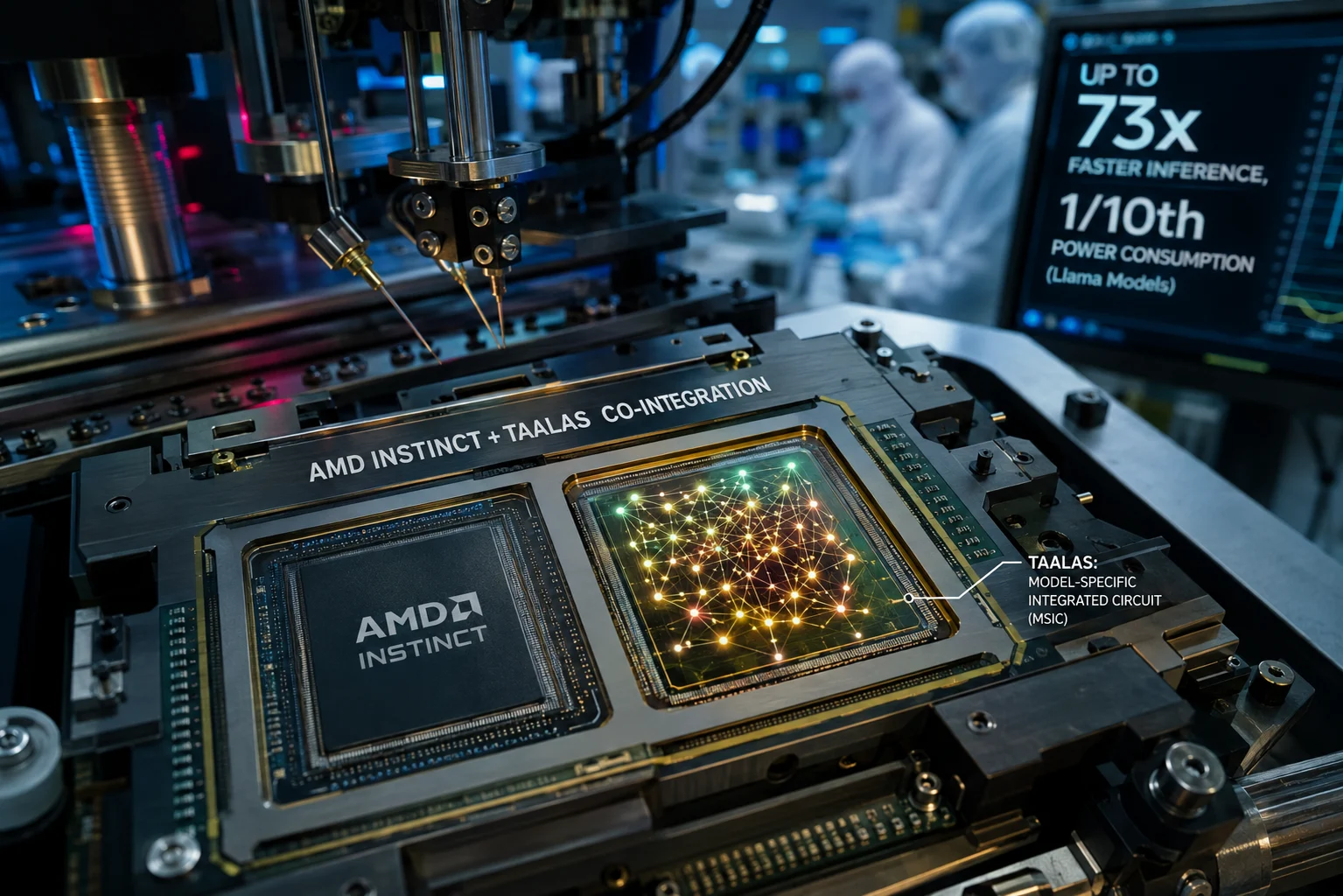
The AI chip wars just got a new battlefield, and it isn't about training massive models anymore — it's about running them, fast, cheap, and at scale. On Thursday, August 6, 2026, semiconductor giant AMD announced a definitive agreement to acquire Taalas, a Toronto-based AI hardware startup founded in 2023 that has built something genuinely unusual: chips that etch an AI model's weights directly into silicon transistors, rather than storing them in external memory the way virtually every other AI chip on the market does today.
Financial terms of the deal were not disclosed, and AMD has not provided a timeline for when the transaction is expected to close. But the strategic signal is unmistakable. Barely seven months after Nvidia spent roughly $20 billion acquiring assets and technology from rival inference-chip startup Groq — its largest transaction on record — AMD has now made its own move into the same corner of the AI hardware market: ultra-fast, ultra-efficient inference chips built for a world where running AI models in real time, at massive scale, has become just as important as training them in the first place.
This is the story of what Taalas actually built, why AMD wants it, how the technology works, what it means for the ongoing battle with Nvidia, and where the risks and trade-offs lie in a chip design so specialized that it can only ever run the exact model it was built for.
QUICK SNAPSHOT: THE AMD-TAALAS DEAL
Acquirer: AMD (Advanced Micro Devices) Target: Taalas, Inc. Target Headquarters: Toronto, Canada Founded: 2023 (came out of stealth in February 2026) Founders: Ljubisa Bajic (CEO), Drago Ignjatovic, Lejla Bajic Deal Announced: August 6, 2026 Financial Terms: Not disclosed Total Venture Funding Raised by Taalas: $219 million Core Technology: Model-Specific Integrated Circuits (chips with AI model weights etched directly into silicon) First Chip: HC1, running Meta's Llama 3.1 8B model Chip Fabrication: TSMC, 6-nanometer process Claimed Performance: Up to roughly 17,000 tokens per second per user on Llama 3.1 8B — multiples faster than comparable GPU-based hardware Claimed Power Efficiency: Roughly one-tenth the power consumption of standard hardware for equivalent workloads Planned Integration: AMD Instinct GPUs, EPYC CPUs, Helios rack-scale systems, ROCm software AMD Stock Reaction: Closed at $489.28 on announcement day, up about 1.5%
THE DEAL, IN DETAIL
AMD confirmed on Thursday that it has entered into a definitive agreement to acquire Taalas, describing the move as a way to strengthen its artificial intelligence portfolio with what it calls "differentiated inference performance and efficiency." Vamsi Boppana, Senior Vice President of AMD's Artificial Intelligence Group, framed the acquisition as part of a broader strategy: building what he described as a full-stack AI platform that gives customers the flexibility to deploy the right kind of compute for every AI workload — rather than forcing every task through the same general-purpose GPU architecture.
Under the terms of the deal — whose financial details AMD has chosen not to disclose — Taalas and its Canada-based engineering team will join AMD's AI organization under Boppana. Taalas co-founder and CEO Ljubisa Bajic, in a statement, said the company was founded specifically to rethink AI inference from the ground up by building hardware around the model itself, rather than the other way around, and that joining AMD would give the team the scale, engineering resources, and global reach to accelerate that work.
By most accounts, this appears to be a genuine acquisition of technology and talent rather than a simple "acquihire" — industry reporting suggests AMD is acquiring Taalas's intellectual property, its chip designs, and its team wholesale, with plans to fold the company's approach directly into AMD's product roadmap rather than simply absorbing engineers into existing teams.
WHO IS TAALAS, AND WHAT DID THEY ACTUALLY BUILD?
To understand why AMD wanted this company, it helps to understand what makes Taalas's approach to AI chips so different from virtually everything else on the market. Taalas was founded in 2023 by Ljubisa Bajic — a former chip architect who had previously worked at both AMD and Nvidia, and who also co-founded and later led AI chip company Tenstorrent — alongside engineers Drago Ignjatovic and Lejla Bajic. The company operated largely in stealth mode until February 2026, when it emerged with its first working test chip and raised $169 million in funding to support further development, bringing its total venture funding raised to $219 million.
Every mainstream AI chip today — whether it's an Nvidia GPU, an AMD Instinct accelerator, or most specialized AI hardware — works broadly the same way: the chip stores a model's "weights" (the enormous set of numerical parameters that define what the AI model has learned) in external high-bandwidth memory, then repeatedly shuttles those weights back and forth between memory and the actual compute engine every time the model processes information. This constant back-and-forth movement of data is one of the biggest bottlenecks in modern AI computing — it takes time, and it consumes enormous amounts of electricity.
Taalas took a radically different approach. Instead of storing model weights in external memory, the company's chips physically etch those weights directly into the silicon itself during manufacturing, using fast on-chip SRAM memory rather than the external high-bandwidth memory (HBM) that dominates the rest of the industry. In effect, the AI model isn't loaded onto the chip — it becomes the chip.
HOW TAALAS'S APPROACH DIFFERS FROM STANDARD AI CHIPS
Traditional GPU (Nvidia, standard AMD) Model weights stored in: External HBM memory Data movement each inference: Constant shuttling between memory and compute Flexibility: Can run many different AI models Speed on target model: Baseline
Taalas Model-Specific Chip Model weights stored in: Etched directly into on-chip silicon (SRAM) Data movement each inference: Minimal — weights are already where compute happens Flexibility: Locked to one specific model Speed on target model: Reported multiples faster than baseline
THE PERFORMANCE CLAIMS, DECODED
Taalas's first production chip, called the HC1, was built specifically to run a single model: Meta's Llama 3.1 8B, a relatively compact but widely used open-source large language model. According to benchmarks published when the chip was first demonstrated, the HC1 was able to generate somewhere in the neighborhood of 16,000 to 17,000 tokens per second per user when running that model — a number industry reporting has described as multiples faster than what comparable Nvidia hardware, including the H200 and B200 chips, can achieve on the same task, alongside similarly large speed advantages over other specialized inference chips from companies like Groq, SambaNova, and Cerebras.
WHAT "TOKENS PER SECOND" ACTUALLY MEANS
For readers unfamiliar with AI hardware benchmarks, a "token" is roughly a small chunk of text — often close to a word or part of a word — that an AI model generates one at a time when producing a response. The faster a chip can generate tokens, the faster an AI system can respond to a user in real time, and the more users or requests a single chip can serve simultaneously without slowing down. In applications like AI coding assistants, real-time voice agents, or high-volume chatbot services, tokens-per-second performance directly determines both user experience and the total cost of running the service at scale.
Alongside this speed advantage, Taalas has claimed its chips consume roughly one-tenth the power of standard hardware while delivering this performance — a claim that, if it holds up under independent, real-world deployment at scale, would represent a genuinely significant efficiency breakthrough at a moment when data center electricity consumption from AI has become one of the industry's most pressing operational and environmental concerns.
CLAIMED PERFORMANCE VS STANDARD HARDWARE (Illustrative)
Standard GPU Inference (baseline) ████ Taalas HC1 on Llama 3.1 8B ████████████████████████████
Power Consumption for Equivalent Workload Standard GPU Inference (baseline) ██████████ Taalas HC1 (claimed) █
It's worth being precise about what these numbers do and do not tell us. These are figures reported by the company itself, based on its own benchmarks on a specific, relatively small AI model. Independent, third-party verification across a broader range of real-world production workloads — the kind that will matter once this technology is actually deployed inside AMD's commercial products — is something the industry will be watching closely for in the months ahead.
THE CATCH: WHY MODEL-SPECIFIC CHIPS ARE A DOUBLE-EDGED SWORD
Here is the trade-off at the heart of Taalas's entire approach, and it's a significant one: because the model's weights are physically etched into the silicon, each chip can only ever run the exact model it was designed for. Want to upgrade to a newer, better AI model, or switch to a different one entirely? You cannot simply update the software — you need an entirely new chip, manufactured from scratch.
In an industry where new AI models are released on a near-monthly basis, and where the state of the art shifts constantly, this is a real constraint. Committing to model-specific silicon means committing, at least for the working life of that hardware, to the AI model it was built around — a much higher-stakes decision than choosing which software to run on a general-purpose GPU.
Taalas has pushed back on how limiting this sounds in practice. The company has said that fewer than a handful of a chip's more than one hundred silicon layers actually need to change from one model design to another, which it believes allows it to move relatively quickly — from design to finished chip — compared to a full from-scratch chip development cycle. Even so, this remains fundamentally less flexible than a general-purpose GPU, which can run virtually any AI model a customer chooses, simply by loading different software and weights.
This is precisely why industry analysts see Taalas's technology not as a wholesale replacement for GPUs, but as a complementary tool — best suited for large-scale, high-volume, latency-sensitive applications built around a single, well-established model that a customer is confident won't need to change anytime soon. Real-time AI coding assistants, high-traffic customer service agents, and other applications running massive volumes of inference on a stable, well-understood model are the kinds of use cases best suited to this trade-off.
WHY AMD IS MAKING THIS MOVE NOW
To understand the timing and strategic logic of this acquisition, it helps to zoom out to the broader battle AMD is fighting against Nvidia — a battle that, for years, centered almost entirely on training: the process of building and refining large AI models in the first place, which requires enormous banks of powerful, general-purpose GPUs running for weeks or months at a time.
But nearly four years into the generative AI boom, the center of gravity in AI computing has been steadily shifting from training toward inference — the ongoing, everyday business of actually running trained models to serve real users, at massive scale, around the clock. AMD itself projects that the inference market may grow at more than 80% annually in the years ahead, a growth rate that dwarfs even the torrid pace of AI training infrastructure spending, and one that both AMD and Nvidia clearly see as the next major battleground for AI hardware dominance.
Nvidia made its own move into this space roughly seven months before AMD's Taalas deal, spending approximately $20 billion to acquire assets, technology, and talent from Groq — another specialized inference-chip startup whose hardware, like Taalas's, could generate tokens far faster than standard GPUs, though through a different underlying architecture that requires linking together dozens of chips to run larger models. Nvidia has said it plans to use the acquired Groq technology in a "disaggregated" setup, where Groq-derived chips handle only the fastest, most latency-sensitive part of the inference process — known as the decode stage — while Nvidia's own GPUs continue to handle the earlier, more computationally intensive prefill stage of processing a request.
THE ESCALATING RACE FOR SPECIALIZED INFERENCE HARDWARE
Nvidia + Groq (Dec 2025) Deal size: ~$20 Billion ████████████████████████████████████ AMD + Taalas (Aug 2026) Deal size: Undisclosed ████████████
AMD's move with Taalas appears to follow a strikingly similar playbook. According to industry reporting, AMD intends to pair its Instinct-based Helios rack-scale systems with Taalas-derived chips in a similarly disaggregated architecture — using AMD's general-purpose GPUs to handle the heavier prefill workload, while Taalas's ultra-fast, model-specific silicon accelerates the decode stage, the part of the process most sensitive to speed and responsiveness. Notably, AMD has also separately announced a related collaboration with wafer-scale AI chip maker Cerebras on a comparable disaggregated design — suggesting the company is pursuing multiple complementary paths toward the same broader goal of building a genuinely full-stack, workload-flexible AI hardware platform.
WHAT AMD PLANS TO DO WITH THE TECHNOLOGY
AMD has said it intends to integrate Taalas's technology across several parts of its existing AI product lineup, rather than launching it as a standalone product line. Specifically, the company has pointed to four areas of integration: its Instinct line of AI accelerator GPUs, its EPYC server processors, its Helios rack-scale AI systems, and its ROCm open software platform, which developers use to build and deploy AI workloads on AMD hardware.
WHERE TAALAS TECHNOLOGY FITS INTO AMD'S AI STACK
Instinct GPUs General-purpose AI training and broad inference workloads Taalas Chips Ultra-fast, model-specific inference for stable, high-volume workloads EPYC CPUs Server-side processing and system orchestration Helios Systems Rack-scale integration combining all of the above ROCm Software Developer tools to deploy across the full combined stack
This "system-level" framing matters. Rather than positioning Taalas's chips as a competitor to its own Instinct GPUs, AMD appears to be betting that the future of AI infrastructure isn't a single type of chip doing everything, but a heterogeneous mix of specialized hardware, each handling the part of the AI workload it's best suited for — general-purpose GPUs for flexibility and training, and ultra-efficient, model-specific silicon for the highest-volume, most latency-sensitive inference tasks running at massive scale.
THE FOUNDER: A CHIP ARCHITECT WHO'S WORKED ON BOTH SIDES OF THE AMD-NVIDIA RIVALRY
Taalas CEO Ljubisa Bajic brings an unusually well-rounded résumé to this deal — one that, in a strange way, makes AMD acquiring his company feel almost like a homecoming. Bajic previously worked as a chip architect at both AMD and Nvidia, giving him direct, hands-on experience with the design philosophies of the two companies that have dominated the AI hardware conversation for years. He later co-founded Tenstorrent, another AI chip company, where he eventually became CEO before an unusual leadership swap: in October 2022, Bajic traded roles with Tenstorrent's then-CTO, the well-known chip designer Jim Keller, before ultimately stepping down from Tenstorrent entirely in March 2023 to start Taalas.
That background matters for understanding Taalas's technical approach. Having seen the inner workings of both AMD's and Nvidia's general-purpose GPU architectures up close, and having then spent years building a different kind of AI chip company at Tenstorrent, Bajic and his co-founders arrived at Taalas with a specific thesis: that the industry's default approach — building increasingly large, increasingly general-purpose chips and hoping software and memory bandwidth could keep pace — was hitting real physical and economic limits for inference specifically, even if it remained the right approach for training. Taalas's entire product philosophy, hardwiring models directly into silicon, is a direct response to that thesis.
Now, with the acquisition, Bajic and his Toronto-based team will operate from within the very company where his chip design career began, reporting into AMD's AI organization under Vamsi Boppana rather than running an independent startup. How much autonomy the team retains, and how quickly AMD moves to fold Taalas's design philosophy into its broader roadmap, will be an early test of how well this kind of founder-led, deeply technical acquisition integrates into a company as large as AMD.
WHY POWER EFFICIENCY HAS BECOME THE INDUSTRY'S DEFINING CONSTRAINT
To fully appreciate why Taalas's claimed one-tenth power consumption advantage matters so much to AMD, it helps to understand just how central energy consumption has become to the entire AI industry's growth story — and its growing list of headaches. Data centers running AI workloads at scale have become some of the largest and fastest-growing consumers of electricity in the world, to the point where power availability, not chip supply, has increasingly become the binding constraint on how quickly cloud providers and AI labs can expand their infrastructure. Utilities in major data-center hubs across the United States and elsewhere have reported unprecedented demand growth driven specifically by AI infrastructure buildouts, in some cases straining local power grids and drawing scrutiny from regulators and communities alike.
Against that backdrop, a chip architecture that claims to deliver dramatically more inference performance per watt isn't just a nice engineering achievement — it goes directly to one of the most consequential bottlenecks facing the entire industry's ability to keep scaling AI deployment. Cloud providers and large AI labs today are not simply choosing hardware based on raw speed; they are increasingly optimizing for performance-per-dollar and performance-per-watt simultaneously, because power costs and power availability have become as important to their expansion plans as chip procurement itself. This is precisely the value proposition AMD is betting Taalas's technology can deliver at scale — and precisely why efficiency claims like "one-tenth the power" carry outsized commercial weight in today's market, well beyond what a similar efficiency claim might have meant just two or three years ago, before AI power consumption became a mainstream infrastructure and policy concern.
MARKET AND INDUSTRY REACTION
Wall Street's initial reaction to the news was modestly positive rather than dramatic. AMD shares closed at $489.28 on the day the deal was announced, up roughly 1.5% — a reflection, analysts suggest, of a market that views this as a sensible, strategically sound move rather than a transformative one on its own. Retail investor sentiment tracked on platforms like Stocktwits characterized the acquisition as a clear strategic step toward building a more complete, end-to-end AI hardware ecosystem, strengthening AMD's competitive positioning against Nvidia without representing a single make-or-break bet.
Industry analysts have generally struck a similarly measured tone, describing the deal as unlikely to immediately challenge Nvidia's overall dominance of the AI accelerator market — a dominance built not just on raw chip performance but on Nvidia's deeply entrenched CUDA software ecosystem, which remains far more flexible than the rigid, model-specific approach Taalas's chips require. Even so, analysts broadly view the acquisition as a meaningful strategic foothold for AMD in the rapidly growing inference market, offering a genuine, differentiated efficiency advantage for cloud-scale customers running massive volumes of AI workloads built around stable, well-established models.
THE BIGGER PICTURE: THE SHIFT FROM TRAINING TO INFERENCE
It's worth stepping back to appreciate just how significant this broader shift — from training-centric to inference-centric AI infrastructure spending — really is for the semiconductor industry as a whole. For the first several years of the generative AI boom, the overwhelming majority of attention, capital, and hardware innovation focused on training: building bigger, more powerful models by throwing ever-larger clusters of GPUs at the problem for weeks or months at a stretch. Nvidia's dominance in that phase of the AI boom was, and largely remains, close to total.
But training a model, however expensive and resource-intensive, is fundamentally a one-time (or periodic) cost. Inference — the ongoing work of actually running that trained model to answer billions of user queries, generate code, power voice assistants, and drive an ever-expanding universe of AI-powered products — is a continuous, compounding cost that scales directly with usage. As AI products have moved from experimental novelties to core, heavily used features embedded across consumer apps, enterprise software, and industrial systems, the sheer volume of inference workloads running globally at any given moment has grown enormously — and every fraction of a cent saved per query, every millisecond shaved off response times, and every watt of power saved per token generated compounds into massive differences at scale.
This is exactly the dynamic that has made specialized inference hardware — from Groq's chips to Cerebras's wafer-scale engines to Taalas's model-specific silicon — increasingly attractive to the industry's biggest players, even as they continue to rely heavily on general-purpose GPUs for training and for workloads that require greater flexibility. Both Nvidia's Groq deal and AMD's Taalas acquisition reflect the same underlying recognition: the company that wins the inference era of AI computing may not be decided purely by who builds the fastest general-purpose chip, but by who builds the smartest, most efficient combination of specialized and general-purpose hardware working together.
UNDERSTANDING THE JARGON: A QUICK GLOSSARY FOR READERS
AI hardware stories come loaded with technical terminology that isn't always familiar outside the semiconductor industry. Here's a plain-English breakdown of the key terms in this story:
Inference: The process of actually running a trained AI model to generate a response — as opposed to "training," which is the earlier, separate process of teaching the model in the first place using massive amounts of data. Every time you ask an AI chatbot a question and it responds, that's inference happening in real time.
Model Weights: The enormous set of numerical parameters, often numbering in the billions, that an AI model "learns" during training and then uses to generate responses. In most chips, these weights are stored in memory and loaded as needed; in Taalas's chips, they're etched directly into the silicon itself.
Tokens Per Second: A standard benchmark for measuring how fast an AI chip can generate output. Higher tokens-per-second generally means faster responses for users and more requests a single chip can handle at once.
High-Bandwidth Memory (HBM): A type of fast external memory used in most modern AI chips to store model weights and other data, positioned physically close to the compute engine but still separate from it — creating the data-shuttling bottleneck that Taalas's approach specifically aims to eliminate.
SRAM (Static Random-Access Memory): A very fast type of memory that can be built directly onto a chip itself, rather than as a separate external component. Taalas uses on-chip SRAM as part of its approach to keeping data close to where computation actually happens.
Model-Specific Integrated Circuit: An industry term for a chip designed and manufactured to run one specific AI model, as opposed to a general-purpose chip capable of running many different models through software changes alone.
Disaggregated Inference: An architecture where different parts of the AI inference process — such as the initial "prefill" stage and the later "decode" stage of generating a response — are handled by different, specialized pieces of hardware working together, rather than a single chip doing the entire job.
Prefill and Decode: The two broad stages of AI inference. Prefill involves processing the input and initial context, and is generally more computationally heavy; decode involves generating the response one token at a time, and is generally more sensitive to speed and latency — which is why specialized chips like Taalas's are often positioned specifically for this stage.
A HANDFUL OF DEVELOPMENTS TO KEEP AN EYE ON
Before diving into specifics, it's worth framing why the next several months matter so much for judging whether this deal ultimately succeeds. Chip acquisitions of this kind are easy to announce and hard to execute — folding a small, founder-led startup's unconventional technology into a company the size of AMD, with its own established product cycles, customer relationships, and engineering culture, is a process that typically takes years rather than months to fully play out. The following markers should give outside observers a reasonably clear read on how that integration is progressing.
WHAT TO WATCH NEXT
A handful of developments will likely shape how this acquisition plays out over the coming months and years:
Deal closing and integration timeline: AMD has not disclosed when the transaction is expected to close, nor a detailed roadmap for when Taalas-derived chips will actually appear in commercially available AMD products. The pace of that integration will be an early signal of how seriously AMD is prioritizing this technology.
Independent performance verification: The dramatic speed and efficiency claims associated with Taalas's chips have so far come primarily from the company's own benchmarks on a single, relatively small model. Independent, real-world verification at production scale — ideally across a broader range of workloads — will be important in determining whether these advantages hold up outside controlled demonstrations.
Which models get the "silicon treatment": Given the model-specific nature of this technology, which AI models AMD and its customers choose to commit to hardwiring into silicon will be a telling signal of where the company sees the most durable, high-volume commercial demand — likely widely used, relatively stable open-source or enterprise-standard models rather than rapidly shifting frontier models.
Nvidia's response: Having already made its own major inference-specialization move with the Groq acquisition, Nvidia's next steps — whether further acquisitions, internal development, or partnership announcements — will be an important indicator of how central this specific battleground has become to the broader AMD-Nvidia rivalry.
Customer adoption: Ultimately, the success of this acquisition will be measured not by benchmark numbers or press releases, but by whether major cloud providers, AI labs, and enterprise customers actually choose to deploy Taalas-derived chips at scale for their highest-volume inference workloads — a decision that will hinge as much on cost, reliability, and ease of integration as on raw performance claims.
Broader industry consolidation: This deal is unlikely to be the last of its kind. As both Nvidia and AMD have now made significant moves to acquire specialized inference technology rather than build it entirely in-house, smaller AI chip startups working on novel architectures may increasingly find themselves viewed as acquisition targets rather than long-term independent competitors — a dynamic worth watching across the broader semiconductor startup ecosystem in the months ahead, particularly for well-funded but pre-revenue companies pursuing similarly unconventional approaches to the inference bottleneck.
AMD VS NVIDIA: TWO DIFFERENT PATHS TO THE SAME INFERENCE BET
Placed side by side, the AMD-Taalas and Nvidia-Groq deals reveal two companies converging on a remarkably similar strategic conclusion through different paths. Both have concluded that general-purpose GPUs alone won't be enough to win the inference era of AI computing, and both have chosen to acquire, rather than build from scratch, specialized chip technology capable of dramatically accelerating the most latency-sensitive part of running AI models at scale.
TWO APPROACHES TO SPECIALIZED INFERENCE HARDWARE
Nvidia's Approach (via Groq) Architecture: Multiple chips linked together to run larger models Flexibility: Can handle larger, more complex models via chip clusters Integration Plan: Handles decode stage alongside Nvidia's own GPUs Deal Size: Approximately $20 billion
AMD's Approach (via Taalas) Architecture: Single chip per model, weights etched into silicon Flexibility: Limited to one specific model per chip design Integration Plan: Handles decode stage alongside AMD's Instinct GPUs Deal Size: Undisclosed, presumed smaller
The difference in disclosed deal size alone is telling. Nvidia's roughly $20 billion Groq transaction dwarfs whatever AMD is paying for Taalas, reflecting both Nvidia's vastly larger market capitalization and cash reserves, and perhaps a difference in how mature and proven each acquired technology was at the time of purchase. Groq had already been selling inference services commercially for some time before Nvidia's deal; Taalas, by contrast, had only emerged from stealth mode with a working demonstration chip a few months before AMD's acquisition — making this very much a bet on early-stage, promising technology rather than a mature, battle-tested product.
That said, the smaller scale of the AMD-Taalas deal shouldn't be read as a lack of ambition. If anything, it reflects AMD's broader competitive position: as the clear number-two player in AI accelerators behind Nvidia, AMD has consistently pursued a strategy of targeted, technically ambitious acquisitions and partnerships — including its parallel collaboration with Cerebras on disaggregated inference — rather than attempting to outspend Nvidia head-on. Whether a series of smaller, more surgical bets like this one can meaningfully close the gap with a rival that just spent $20 billion on a single deal remains one of the central open questions hanging over AMD's broader AI strategy heading into the rest of 2026 and beyond.
THE BOTTOM LINE
AMD's acquisition of Taalas is a relatively small deal in dollar terms — so small that AMD hasn't even disclosed the price — but it carries outsized strategic significance. It represents AMD's clearest statement yet that the next major front in its rivalry with Nvidia won't be fought purely over who builds the fastest general-purpose GPU, but over who builds the smartest, most efficient combination of specialized and general-purpose hardware for a world where running AI models, not just building them, has become the industry's dominant and fastest-growing cost.
Taalas's core innovation — etching AI models directly into silicon to eliminate the memory bottleneck that slows down virtually every other chip on the market — is genuinely novel, and the performance and efficiency claims associated with it, if they hold up at scale, would represent a significant leap forward for the specific, high-volume, latency-sensitive inference workloads this approach is best suited for. But the fundamental trade-off — rigid, model-specific hardware that can't simply be upgraded to a new AI model the way software can — means this technology is unlikely to replace general-purpose GPUs anytime soon. Instead, it looks set to become one more specialized tool in a rapidly diversifying AI hardware toolkit, deployed selectively for the workloads where its unique advantages matter most, alongside rather than instead of the general-purpose GPUs that continue to anchor most of the industry's AI infrastructure spending today.
Coming just over seven months after Nvidia's own $20 billion move into the same corner of the inference market with Groq, AMD's Taalas acquisition confirms that both of the industry's dominant chipmakers now see specialized inference hardware as too important a battleground to ignore — even as the much larger question of who ultimately wins the broader AI hardware race remains very much unresolved. For an industry still working out exactly how the economics of running AI at global scale will shake out, this deal is another data point in an unfolding story that is likely to see many more twists before it settles.
(This article is based on AMD's August 6, 2026 announcement of its agreement to acquire Taalas, along with public statements from AMD and Taalas executives and subsequent reporting on the deal's technical, competitive, and market implications. Performance and efficiency figures cited are as disclosed by the companies involved and have not been independently verified at production scale. Financial terms of the transaction were not disclosed by AMD as of the time of this report. Readers with a financial interest in AMD, Nvidia, or related companies should consult independent research and primary company disclosures before making any investment decisions based on the claims summarized here.)