StartupNews · Breaking News
ACCEL BETS $550 MILLION ON INDIA'S AI FOUNDERS
Silicon Valley's Most Successful India Investor Closes Its Ninth Local Fund Months Ahead of Schedule, Betting That — For the First Time — India Isn't Playing Catch-Up to a Global Technology Wave
By Startup news · Published · Updated
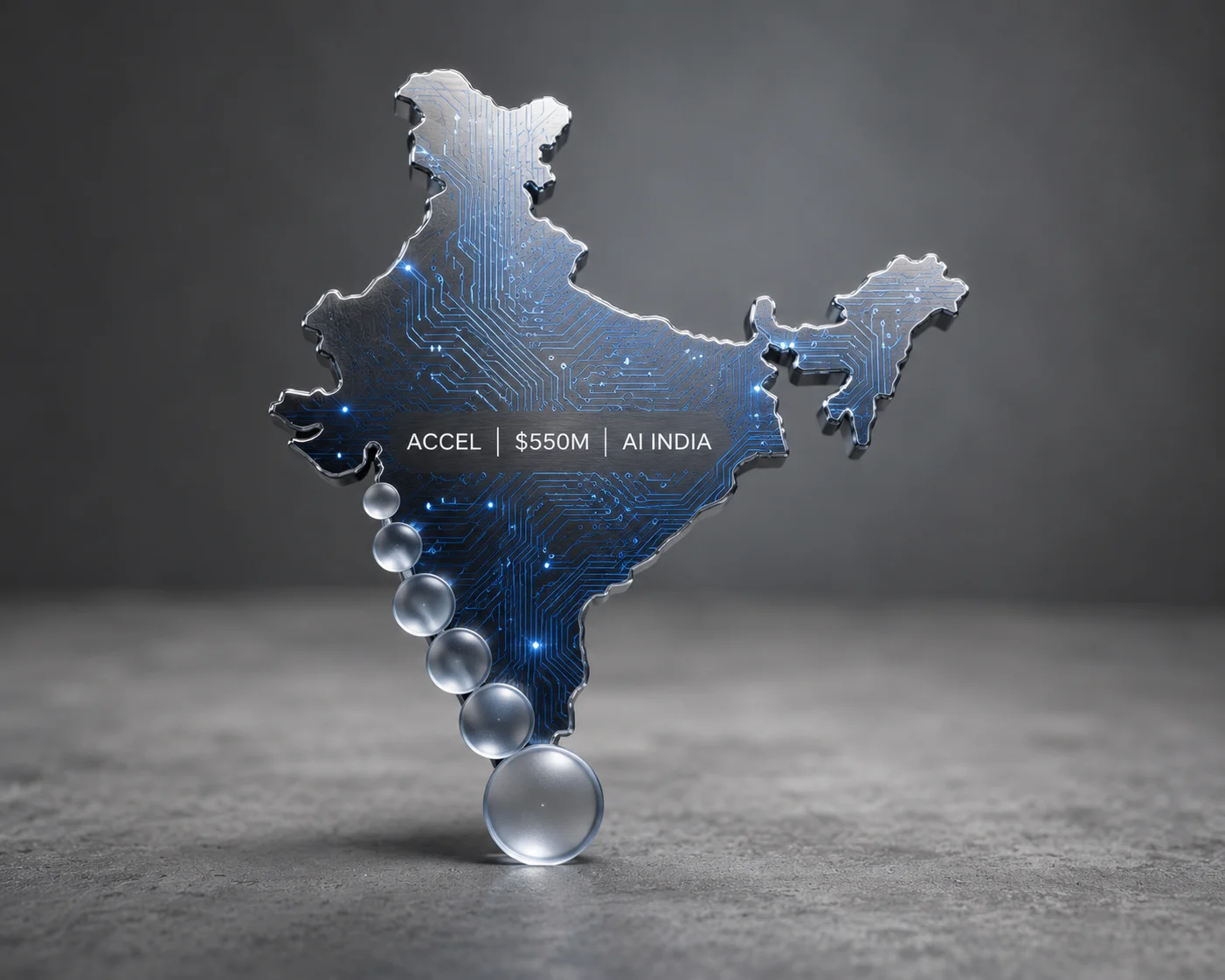
Accel, the venture capital firm that wrote the first institutional cheque into Flipkart at a $4 million valuation and helped seed Swiggy before it became one of India's largest technology companies, announced on August 11, 2026 that it has closed a $550 million ninth early-stage India fund. The vehicle is one piece of a considerably larger, record-setting $3.5 billion global fundraise spanning four separate funds — Accel's biggest capital raise in its history — and it arrives as artificial intelligence reshapes not just what startups build, but how quickly venture capital itself feels compelled to move.
What makes this particular India fund noteworthy is not simply its size, though $550 million is a meaningful sum by any standard. It is the timing. Accel closed Fund IX barely nineteen months after unveiling its previous India vehicle — a $650 million fund from January 2025 — and did so while more than half of that earlier fund's capital still sits undeployed. In an industry where funds are typically raised only once the prior vintage is substantially spent, running two large India funds in parallel is unusual enough that Accel's own partners have described it not as an accident of scheduling, but as a deliberate statement about how differently they believe this particular technology cycle is unfolding for Indian founders compared to every wave that came before it.
QUICK-LOOK SNAPSHOT
Firm : Accel Announcement Date : August 11, 2026 India Fund : Ninth early-stage India fund ("Fund IX") India Fund Size : $550 million Total Global Raise : $3.5 billion across four new vehicles Other Vehicles : $1.35 billion global growth/expansion fund (seed to IPO), $800 million US fund, $800 million Europe & Israel fund Prior India Fund : Fund VIII, $650 million, closed January 2025 — more than 55% still undeployed Gap Between Fund VIII and Fund IX : ~19 months Total India Capital Raised (18 months) : $1.2 billion, a record pace Fund IX Deployment Start : Expected in 2027 Notable Historical Accel Bets in India : Flipkart, Swiggy, Freshworks Notable Accel Global AI Bets : Anthropic, Cursor, Perplexity
THE HEADLINE NUMBER, IN CONTEXT
To understand why Accel's India commitment matters beyond the raw dollar figure, it helps to see how it fits into the firm's broader four-fund global raise — the largest fundraising exercise in Accel's history.
HOW ACCEL'S $3.5 BILLION IS SPLIT ACROSS FOUR VEHICLES
Global Growth/Expansion Fund ██████████████████████████████ $1.35 billion United States Fund █████████████████░░░░░░░░░░░░░ $800 million Europe & Israel Fund █████████████████░░░░░░░░░░░░░ $800 million India Fund (Fund IX) ███████████░░░░░░░░░░░░░░░░░░░ $550 million
The India allocation is the smallest of the four regional and global vehicles in absolute dollar terms, but that comparison undersells its significance. India's fund is dedicated purely to early-stage investing in a single country, whereas the $1.35 billion growth vehicle is a common pool designed to serve breakout companies across all of Accel's geographies — including India — once they need larger, later-stage follow-on cheques. In other words, India-based founders are not limited to drawing on the $550 million fund alone; they can also access the larger global growth pool as their companies scale, a structural detail Accel's partners have specifically flagged as important for keeping meaningful ownership stakes in Indian companies through to an eventual public listing.
A FUND RAISED "AHEAD OF SCHEDULE," AND WHY THAT'S THE STORY
The most unusual detail in this announcement is not the size of the fund but its timing. Accel's eighth India fund, a $650 million vehicle, was unveiled in January 2025. Under normal venture capital practice, a firm typically waits until a fund is substantially deployed — often 70% to 80% invested — before returning to its limited partners (the institutional investors, pension funds, and endowments that supply venture capital firms with capital) to raise a successor vehicle. Accel has broken from that pattern here in a fairly dramatic way: Fund IX has closed while, according to the firm's own partners, more than 55% of Fund VIII's capital remains available and uninvested.
ACCEL INDIA FUND SIZE, ACROSS RECENT VINTAGES
Fund VI (2019) ████████████████████████████░░░░░ $550 million Fund VII (2022) ██████████████████████████████████ $650 million Fund VIII (2025) ██████████████████████████████████ $650 million Fund IX (2026) ████████████████████████████░░░░░ $550 million
Interestingly, at $550 million, Fund IX is actually $100 million smaller than both its immediate predecessor and the fund before that — and it lands at exactly the same size as Accel's sixth India fund, raised back in 2019. That detail complicates any simple "bigger and bigger" narrative around Accel's India ambitions; the firm is not chasing an ever-larger single vehicle so much as running two substantial funds simultaneously, a structure that gives it more total capital deployed into India over the medium term even as any single fund's headline number holds steady or dips slightly.
Accel partner Shekhar Kirani, who has been among the most vocal in explaining the firm's reasoning publicly, has framed the decision to raise Fund IX early not as a response to running out of money, but as a bet on timing itself. His argument, echoed across Accel's public statements, centres on a claim that distinguishes this technology cycle from every previous one Accel has invested through in India: that artificial intelligence, unlike the internet, mobile, or cloud computing waves before it, is arriving in India at essentially the same moment it is arriving everywhere else in the world, rather than reaching Indian founders and Indian markets years after Silicon Valley had already defined the category.
WHY "NO LAG THIS TIME" MATTERS TO ACCEL'S STRATEGY
This idea — that India is experiencing AI adoption in near-real-time alongside the rest of the world, rather than importing an already-mature technology wave — is central enough to Accel's stated rationale that it is worth examining directly, because it reframes what an "India fund" is even meant to accomplish in 2026.
In earlier technology cycles, Indian startups frequently followed a well-worn playbook: take a business model or product category that had already been validated and refined in the United States or China, and adapt it for Indian market conditions — lower price points, different payment behaviours, vernacular language support, and so on. That approach produced enormous successes, including Flipkart's adaptation of the e-commerce model and Swiggy's localisation of on-demand delivery, both companies Accel backed from very early stages. But it also meant Indian founders were, almost by definition, playing a game of catch-up, building for a market that was several years behind the frontier of what the underlying technology could do.
Accel's argument is that generative and agentic AI does not follow that same lagged pattern. Indian enterprises, Indian consumers, and Indian developers are adopting large language models, AI coding tools, and AI-powered products at effectively the same time as their counterparts in the US, Europe, and China — meaning an Indian founder building an AI product today is not translating a proven Western business model for a local market, but building at the actual frontier of what is technologically possible, for both domestic and international customers simultaneously.
Accel partner Barath Shankar Subramanian, addressing how this changes the opportunity for Indian founders relative to earlier waves, put the firm's philosophy in blunt, characteristically venture-capital terms: the strategic approach hasn't fundamentally changed — get in early, and stay long. What has changed, in his account, is the size and shape of the addressable market itself: because Indian enterprises are adopting AI domestically at the same time Indian founders are building AI products for global enterprise customers, the total opportunity, in Accel's framing, is effectively doubling — a simultaneous domestic and export market rather than a sequential one.
WHAT ACCEL IS ACTUALLY LOOKING FOR
Accel has identified three broad sectors as the primary focus for its India strategy going forward — consumer, fintech, and advanced manufacturing — with artificial intelligence explicitly described as cutting across and reshaping all three, rather than standing apart as a fourth, separate category.
ACCEL'S STATED INDIA FOCUS AREAS
CONSUMER Continued online adoption not just in India's largest metros, but expanding into Tier 1 cities and what Accel refers to internally as "Bharat" — smaller cities and towns representing the next wave of Indian internet and AI product adoption.
FINTECH New AI-enabled fintech use cases, building on India's existing, globally distinctive digital payments infrastructure and the deep financial-services talent base that infrastructure has produced.
ADVANCED MANUFACTURING Precision manufacturing, along with the defence and space sectors — areas where AI-driven design, automation and quality control are increasingly seen as a source of genuine competitive advantage rather than a purely software-layer opportunity.
Notably, Accel's framing treats AI less as its own standalone sector to invest behind and more as a horizontal force reshaping how every one of these existing sectors operates — a distinction that matters for how the firm will likely evaluate pitches. A founder need not be building a foundation-model company or an AI-research lab to fit Accel's Fund IX thesis; a fintech startup using AI for underwriting, or a manufacturing startup using AI for defect detection, would appear to fit just as comfortably within the fund's stated mandate.
THE BROADER INDIAN VENTURE CAPITAL LANDSCAPE: ACCEL IS NOT ALONE
Accel's fundraise is the latest, and largest, in a string of major India-dedicated venture capital announcements through 2026, reflecting a broader wave of institutional confidence in the country's startup ecosystem that has been building steadily since India's post-2023 "funding winter" gave way to renewed growth.
MAJOR INDIA-FOCUSED FUND CLOSES IN 2026
Firm Fund Announced Size Focus ────────────────────────────────────────────────────────────────────────── Peak XV Partners February 2026 $1.3 billion India Seed, (across 3 funds) India Venture, and APAC Elevation Capital July 2026 $500 million Fund IX, early- stage (Seed & Series A) Accel August 2026 $550 million Fund IX, early- stage, AI-focused
Peak XV Partners — the India and Southeast Asia investment firm that spun out from Sequoia Capital's global operations in 2023 — announced in February 2026 that it had raised $1.3 billion combined across its India Seed, India Venture and broader Asia-Pacific vehicles, positioning AI, fintech and consumer businesses as key areas of opportunity across the region. Elevation Capital followed in July 2026 with a $500 million Fund IX, explicitly concentrated on early-stage Seed and Series A investing in Indian founders. Accel's $550 million close in August rounds out what has become an extraordinarily active twelve months for large-scale India-dedicated venture fundraising, even as some global investors have grown more cautious about deploying fresh capital given geopolitical instability, including conflict in the Middle East, weighing on broader risk appetite.
This clustering of major fund closes is itself a signal worth reading carefully. When three of India's most established, most successful venture firms — each with a long track record of backing category-defining Indian companies — all return to raise substantial new India vehicles within the same six-to-eight month window, it suggests a shared, high-conviction read on the state of the market, rather than any single firm's idiosyncratic bet.
THE DATA BEHIND THE CONVICTION
Accel's optimism is not occurring in a vacuum — it is arriving alongside a broader set of data points suggesting India's position in the global venture capital and AI landscape has been shifting meaningfully upward through 2026.
India climbed three places in PitchBook's fourth annual global venture ecosystem rankings, moving from sixth to third place overall — a jump the research firm's own methodology suggests reflects genuine structural improvement in the country's startup ecosystem rather than a one-off statistical anomaly, since PitchBook's Development Score is built on a six-year look-back window designed to smooth out short-term volatility. Separately, funding specifically into Indian AI startups reached $1.067 billion in the first half of 2026 alone, up 33% year-on-year, with deal count rising from 112 to 157 transactions over the same period — evidence that the AI funding wave washing over Silicon Valley has a genuine, measurable domestic counterpart in India, not merely a handful of headline-grabbing outlier deals.
INDIAN AI STARTUP FUNDING, H1 2025 VS H1 2026 (US$ MILLIONS)
H1 2025 ██████████████████████░░░░░░░░░░░░░░░░ ~$800M (approx.) H1 2026 ███████████████████████████████████░░░ $1,067M (+33% YoY)
The single largest Indian AI funding round of the first half of 2026 illustrates the kind of company Accel and its peers are positioning themselves to catch early: Sarvam, an Indian conversational AI platform, raised $234 million in the first close of a targeted $300 million Series B round in June 2026, valuing the company at $1.5 billion, with backing from HCLTech, Bessemer Venture Partners, Khosla Ventures and Peak XV Partners. Sarvam's platform reportedly now handles more than 2 million interactions daily — a scale of usage that underscores Accel's central thesis about simultaneous domestic and global AI adoption playing out inside India in something close to real time.
INSIDE ACCEL'S TRACK RECORD IN INDIA
Accel's credibility in making a bet of this scale rests heavily on a genuinely unusual historical track record as an early, high-conviction investor in India, predating the current AI cycle by well over a decade. The firm holds a particular kind of institutional folklore status in Indian startup circles for having written the first institutional cheque into Flipkart at a post-money valuation of just $4 million — an investment that, following Walmart's eventual acquisition of a majority stake in the company for roughly $16 billion, stands among the most successful early-stage venture bets in Indian technology history by any measure.
Accel's India partner Anand Daniel led the firm's seed investment into food-delivery company Swiggy at a $2 million pre-money valuation, years before Swiggy went public in November 2024 in what was, at the time, the largest global technology IPO of that year, achieving a valuation above $11 billion at listing. Beyond Flipkart and Swiggy, Accel's India portfolio includes Freshworks, the enterprise software company that itself went on to list on the Nasdaq, and Urban Company, among a long list of Indian companies that have reached unicorn status with Accel as an early institutional backer.
On the global side, Accel's more recent portfolio has extended directly into the frontier AI companies defining the current moment: the firm has backed Anthropic, the AI safety and research company behind the Claude family of models; Cursor, one of the most widely adopted AI-native coding tools; and Perplexity, the AI-powered search and answer engine — giving Accel's India-based partners direct, first-hand visibility into how frontier AI companies scale globally, insight the firm is explicitly positioning as a competitive advantage in evaluating which Indian AI founders have a genuine shot at building comparable, globally competitive businesses.
THE STRUCTURAL LOGIC OF THE PARALLEL GROWTH FUND
One detail in Accel's announcement deserves particular attention because it addresses a problem that has quietly constrained Indian venture capital for years: the difficulty early-stage investors have historically faced in maintaining meaningful ownership stakes in their own portfolio companies once those companies become genuine breakout successes.
The mechanics of this problem are straightforward. An early-stage fund like Accel's $550 million India vehicle typically writes initial cheques in the low single-digit millions to tens of millions of dollars. But if one of those portfolio companies goes on to become a true breakout — the next Flipkart or Swiggy — it may eventually need a $100 million or $200 million follow-on round to fund its later-stage growth, a cheque size that a dedicated early-stage fund of Fund IX's scale cannot easily lead on its own without concentrating an outsized share of the entire fund into a single bet. Historically, this dynamic has forced early-stage investors to either accept significant dilution of their ownership stake as breakout companies raise larger rounds led by new, later-stage investors, or to stretch their own fund's construction rules well beyond what prudent portfolio diversification would normally allow.
Accel's $1.35 billion global growth vehicle, part of this same four-fund raise, is explicitly designed to remove that constraint. Because the growth fund is not allocated to any single geography, it can deploy follow-on capital into breakout companies across Accel's entire global portfolio — including India — without competing for capital against the early-stage India fund's own core mandate. In practice, this means an Indian AI startup that graduates from an initial Accel seed or Series A cheque into a genuine growth-stage breakout can, in principle, continue receiving substantial follow-on capital from the same institutional relationship all the way through to an eventual IPO, rather than needing to bring in an entirely new set of unfamiliar late-stage investors at each subsequent funding round.
WHAT THIS MEANS FOR INDIAN AI FOUNDERS
For founders building AI startups in India, Accel's announcement carries a fairly direct, practical message: a very large, historically successful institutional investor has just signalled, in the clearest way a venture firm can signal anything — by committing hundreds of millions of dollars of actual capital — that it expects Indian AI companies to be judged by, and to compete directly against, global benchmarks, not merely regional ones.
That framing carries real implications for how founders might think about company-building decisions from day one: product design aimed at international as well as domestic customers, engineering and go-to-market talent capable of competing for enterprise customers outside India, and a level of technical ambition that assumes the relevant competitive set is Silicon Valley's frontier AI labs and startups, not merely other companies within India's own domestic market. Accel's own public commentary reinforces this framing directly, with the firm describing its belief that Indian founders can build globally competitive companies from their earliest stages, supported by the country's deep engineering talent base and its large, rapidly growing domestic technology market functioning as a genuine home-field advantage rather than a limitation.
It is worth noting, too, that Fund IX will not begin actively writing cheques until 2027, according to Accel's own disclosed timeline — meaning the fund's immediate practical effect on the ground is more limited than the headline announcement might suggest. In the interim, Accel's partners have indicated that the firm will continue deploying the substantial remaining capital in its eighth fund, giving it, in effect, two active pools of India-dedicated capital running in parallel for at least the next several quarters.
A GLOSSARY FOR READERS NEW TO VENTURE CAPITAL
For readers less familiar with venture capital terminology that appears repeatedly in coverage like this, a few definitions are worth laying out plainly:
VENTURE CAPITAL FUND — a pool of money raised by an investment firm from institutional backers (called limited partners), which the firm then invests into a portfolio of early-stage startups over a period typically spanning several years, aiming to generate outsized returns from a small number of eventual breakout successes.
LIMITED PARTNERS (LPs) — the pension funds, university endowments, sovereign wealth funds, and wealthy individuals who supply the actual capital that venture firms like Accel invest on their behalf; a venture firm's "general partners" (its named investment professionals) manage that capital in exchange for management fees and a share of eventual profits.
SEED / SERIES A / SERIES B / GROWTH STAGE — sequential stages of startup funding, generally representing increasing company maturity: seed rounds typically fund a company's earliest product and team; Series A and B rounds fund proven early growth; growth-stage rounds fund companies with established revenue that are scaling toward a larger exit, such as an IPO or acquisition.
FOLLOW-ON INVESTMENT — additional capital an existing investor puts into a company it has already backed, typically in a later funding round, done specifically to maintain (or avoid excessive dilution of) that investor's existing ownership percentage as the company raises larger rounds over time.
UNICORN — industry shorthand for a privately held startup valued at $1 billion or more; India is currently home to more than 100 companies that have reached this status.
DRY POWDER — venture capital industry slang for capital that a fund has raised but not yet invested; Accel's disclosure that more than 55% of its eighth India fund remains "dry powder" is central to why raising a ninth fund so soon was considered unusual.
FREQUENTLY ASKED QUESTIONS
HOW MUCH DID ACCEL RAISE, AND WHAT IS IT FOR? Accel raised $3.5 billion globally across four new funds, of which $550 million is specifically dedicated to early-stage investing in Indian startups, with a particular focus on AI, consumer, fintech and advanced manufacturing companies.
WHY IS THIS FUND UNUSUAL COMPARED TO A TYPICAL VENTURE RAISE? Accel closed this fund only about 19 months after its previous India vehicle, and did so while more than 55% of that prior fund's capital remains uninvested — a parallel-fund structure that is unusual in venture capital at this scale, and one Accel's partners describe as a deliberate bet on timing rather than a routine refill of capital.
WHEN WILL ACCEL START INVESTING FUND IX'S MONEY? According to the firm's own disclosed timeline, active deployment from Fund IX is expected to begin in 2027, with Accel continuing to invest from its still-substantial eighth fund in the interim.
WHAT KINDS OF COMPANIES IS ACCEL LOOKING TO FUND? The firm has named consumer, fintech and advanced manufacturing (including precision manufacturing, defence and space) as its primary sector focus areas, with artificial intelligence described as a horizontal force cutting across and reshaping all three, rather than a standalone category on its own.
IS ACCEL THE ONLY MAJOR FIRM RAISING A LARGE NEW INDIA FUND RIGHT NOW? No. Peak XV Partners raised $1.3 billion across its India and Asia-Pacific vehicles in February 2026, and Elevation Capital raised a $500 million Fund IX in July 2026, making Accel's close the third major India-dedicated fundraise from an established firm within roughly a six-month window.
WHAT IS ACCEL'S TRACK RECORD IN INDIA? Accel was the first institutional investor in Flipkart, entering at a $4 million valuation before the company was later acquired in majority part by Walmart for roughly $16 billion, and was an early backer of Swiggy, which went public in a landmark 2024 IPO. The firm has also backed Freshworks and Urban Company, among other prominent Indian technology companies.
WHY GLOBAL LPs ARE STILL WRITING BIG CHECKS FOR INDIA, DESPITE HEADWINDS
Accel's ability to close a $550 million fund within weeks — reportedly oversubscribed, according to the firm's own characterisation of the process — is itself a notable data point given the broader macroeconomic backdrop global venture investors have been navigating through 2026. Conflict in the Middle East has, by multiple accounts, made a number of large global institutional investors more cautious about committing fresh capital into higher-risk asset classes generally, and emerging-market venture capital has historically been among the categories most sensitive to that kind of pullback in risk appetite.
That Accel was able to move so quickly against this backdrop suggests its limited partners view India, and specifically India's AI opportunity, as sufficiently differentiated from broader emerging-market risk to warrant continued, undiminished commitment. Part of that differentiation likely traces back to structural factors specific to India that have little to do with the AI cycle directly: a stable, large, English-speaking talent pool of engineers; a maturing exit environment, evidenced by a growing string of successful Indian technology IPOs in recent years; and continued government-level investment in digital infrastructure, including India's national AI mission, which has reportedly onboarded more than 38,000 GPUs for subsidised access — directly lowering one of the largest cost barriers AI-focused founders face when building compute-intensive products.
Total venture capital fundraising dedicated to India also roughly doubled year-over-year in 2025, reaching approximately $5.4 billion, according to industry trackers — a trend Accel's Fund IX close in 2026 appears to be extending rather than reversing. That broader fundraising momentum, combined with India's continued rise in global startup ecosystem rankings, suggests institutional investors are increasingly treating India's venture capital market as a maturing, independently investable category in its own right, distinct from the more generalised "emerging markets" bucket it might have been grouped into a decade ago.
HOW ACCEL'S BET COMPARES TO RIVALS' AI POSITIONING
While Peak XV Partners, Elevation Capital and Accel have all raised substantial new India-dedicated funds within a similar window in 2026, the firms differ meaningfully in stated focus and stage strategy, which is worth understanding for founders trying to determine which investor might be the best fit for their specific company.
HOW THREE MAJOR 2026 INDIA FUNDS COMPARE
Firm Fund Size Stage Focus Sector Emphasis ────────────────────────────────────────────────────────────────────────── Peak XV Partners $1.3B (3 Seed through growth, AI, fintech, funds) plus broader APAC consumer Elevation Capital $500M Concentrated on Seed Indian founders and Series A broadly, early- stage focus Accel $550M Early-stage, with Consumer, fintech, access to a separate advanced $1.35B global growth manufacturing, AI pool for follow-ons cutting across all
Peak XV's combined $1.3 billion positions it as the largest single pool of India-dedicated capital among the three, spanning everything from its early-stage Surge accelerator program through growth-stage investing, and extending its remit across the broader Asia-Pacific region rather than India alone. Elevation Capital's $500 million Fund IX, by contrast, is deliberately narrower in stage focus, concentrating specifically on Seed and Series A companies rather than spreading capital across the full company lifecycle. Accel's structure sits somewhere between the two: a dedicated early-stage India fund paired with guaranteed access to a much larger, geography-agnostic growth pool for the specific subset of portfolio companies that go on to become genuine breakout successes.
For a founder evaluating which of these firms to approach, this distinction can matter considerably. A company still validating its earliest product-market fit might find Elevation's tightly focused early-stage mandate a more natural conversation, while a founder already anticipating the need for substantial, repeated follow-on capital as the company scales toward an eventual IPO might be drawn to the structural advantage Accel's paired early-stage-plus-growth-fund model offers.
THE INDIA-SPECIFIC AI OPPORTUNITY, BEYOND EXPORT-FOCUSED STARTUPS
Much of the coverage surrounding Accel's fund, and the broader wave of India-focused AI venture capital in 2026, has understandably emphasised the export dimension of the opportunity — the idea of Indian founders building AI products for global enterprise customers, competing directly against Silicon Valley companies for the same international market. But Accel's own stated focus areas suggest an equally important, if less headline-grabbing, domestic dimension to the thesis.
India's sheer scale — more than 900 million internet users, a rapidly expanding base of smartphone owners in smaller Tier 1 cities and towns beyond the country's largest metros, and a $3.5 trillion economy still in the relatively early stages of digitising many everyday consumer and business interactions — represents a domestic AI opportunity that, on its own, would be substantial even without any international ambitions attached to it. Accel's explicit inclusion of continued online adoption in what it terms "Bharat" — the smaller cities and towns that represent India's next major wave of internet and technology adoption, distinct from its already largely digitised metro areas — signals that the firm sees meaningful, durable value in AI products built primarily to serve Indian consumers and businesses themselves, not solely in companies chasing global enterprise contracts from day one.
This dual-market framing is, in fact, precisely what Accel partner Barath Shankar Subramanian pointed to in describing why he believes the addressable opportunity for Indian AI founders is effectively doubling relative to earlier technology cycles: domestic adoption and international export ambitions are, in his account, occurring simultaneously rather than sequentially, giving founders a genuine choice — or, for the most ambitious companies, the ability to pursue both — rather than forcing an early strategic bet on one market over the other.
WHAT TO WATCH NEXT
Several open questions will determine whether Accel's bet proves prescient over the coming years. The most immediate is simply whether the firm's remaining Fund VIII capital, and the eventual deployment of Fund IX starting in 2027, actually flow disproportionately toward AI-native companies as the firm's public messaging suggests, or whether the realities of deal flow push capital back toward more conventional consumer, fintech and SaaS bets with AI as a secondary feature rather than a core differentiator. A second question is whether the "no lag this time" thesis holds up as AI infrastructure costs, talent competition and regulatory attention all continue to evolve rapidly — factors that could either reinforce India's simultaneous-adoption advantage or introduce new frictions specific to building AI companies in the Indian market that don't apply elsewhere. Finally, the coming eighteen to twenty-four months will offer an early read on whether the broader clustering of major India-dedicated fund closes in 2026 — from Peak XV, Elevation, and now Accel — translates into a genuine acceleration in the number of globally competitive Indian AI companies reaching meaningful scale, or whether the current enthusiasm reflects investor conviction running somewhat ahead of what the underlying founder pipeline can yet deliver.
KEY FACTS AT A GLANCE
• Firm: Accel • India fund: Ninth early-stage India vehicle, $550 million, closed August 11, 2026, reportedly oversubscribed and closed within weeks • Part of: A record $3.5 billion global raise across four new funds • Other vehicles: $1.35 billion global growth fund, $800 million US fund, $800 million Europe & Israel fund • Prior India fund: $650 million Fund VIII, closed January 2025, still more than 55% undeployed • Total India capital raised in 18 months: $1.2 billion — a record pace • Focus areas: Consumer, fintech, advanced manufacturing, with AI cutting across all three • Fund IX deployment expected to begin: 2027 • Historical India bets: Flipkart (first institutional cheque, $4M valuation), Swiggy (seed round, $2M pre-money valuation), Freshworks
THE BOTTOM LINE
Accel's $550 million India fund is, on the surface, one line item within a much larger $3.5 billion global fundraising announcement — and in raw dollar terms, it is not even the largest of the firm's four new vehicles. But the decision to raise it now, barely a year and a half after the previous India fund, while that earlier fund still holds well over half its capital, is the part of this story that carries the most signal. It reflects a bet by one of the most experienced, most successful investors in India's startup history that this particular technology wave — unlike the internet, mobile, and cloud waves before it — is not going to arrive in India several years late. If Accel's partners are right that Indian founders are now building at the actual frontier of artificial intelligence, for both domestic and global customers, at effectively the same moment as their counterparts anywhere else in the world, then a fund positioned to move early and stay committed for the long haul is exactly the kind of capital that thesis would demand. Whether that bet is validated will likely become clearer only once Fund IX actually begins writing cheques in 2027 — but the size, timing, and conviction behind this announcement leave little doubt about how seriously Accel is taking the wager in the meantime.
DISCLAIMER: This article is intended for general informational and news purposes only and does not constitute investment advice. Fund sizes, valuations and deployment timelines are based on public statements from Accel and third-party reporting current as of publication and may be subject to revision. Readers considering any investment decision related to venture capital funds or the companies mentioned in this article should consult primary source disclosures and a licensed financial advisor.